
Acupressure Points for Stomach Pain and Gas Relief
Guide to acupressure points for stomach discomfort, covering pain, gas, bloating, acidity, pressure steps, safety tips and doctor guidance.
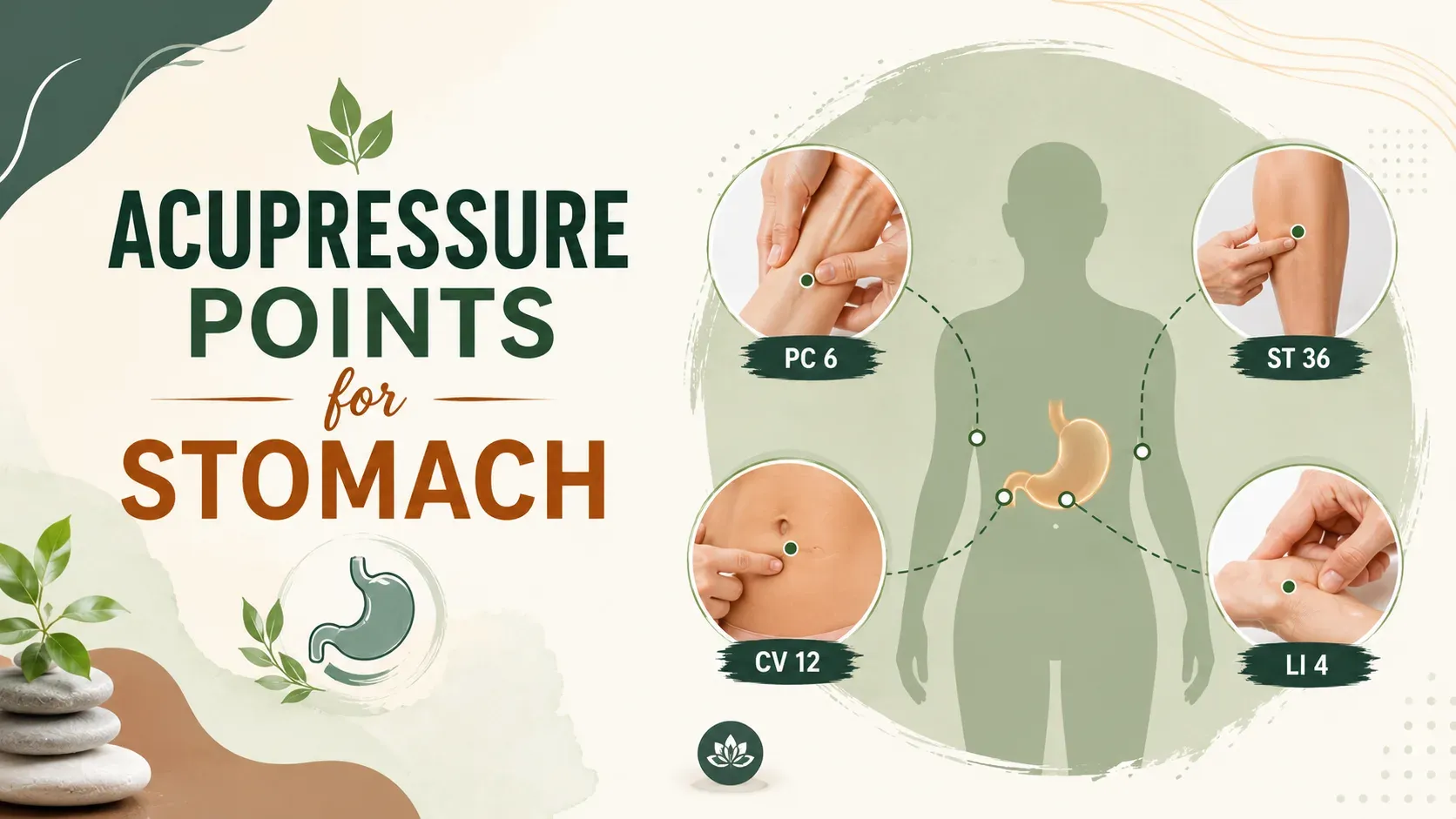
✏️ Quick Answer
Acupressure points for stomach pain are specific locations on the body, mainly on the hand, leg, foot, and abdomen, where applying firm finger pressure reduces pain, relaxes gut muscle spasm, and improves digestion. Most people feel a noticeable reduction in stomach pain within 5–20 minutes of pressing the right points correctly.
The five most effective stomach pressure points are:
- LI4 (hand webbing), fastest accessible relief for general stomach pain and gas
- PC6 (inner wrist), best for upper stomach pain, nausea, and stress-driven discomfort
- ST36 (below knee), the most research-backed point for all stomach pain types
- SP6 (inner leg above ankle), primary point for period stomach pain and cramping
- ST25 (beside navel), direct colon point for gas and bloating-related stomach pain
Choose your point by symptom: hand points (LI4, PC6) for immediate anywhere-relief; leg and foot points (ST36, LV3) for deeper or recurring pain; inner leg points (SP6, SP8) for period cramping. The sections below map every scenario to its exact point, location, and technique.
How Acupressure Relieves Stomach Pain, The Science
Pressing a stomach pressure point works through two overlapping mechanisms, one rooted in Traditional Chinese Medicine, one confirmed by modern neuroscience. Both produce the same outcome: less pain, less spasm, and faster digestive recovery.
The TCM explanation: Stomach pain arises from blocked or imbalanced Qi in the Stomach, Spleen, Liver, or Large Intestine meridians. Pressing the right point unblocks Qi flow and restores the digestive balance that those meridians regulate.
The neuroscience explanation: Acupressure stimulates nerve endings (A-delta and C fibres) that signal the brainstem to release endorphins, the body's natural painkillers. At the same time, pressure activates the parasympathetic nervous system, which reduces gut muscle spasm, lowers gastric acid output, and quiets the visceral pain response along the gut lining.
The result is measurable in clinical research:
- A 2016 meta-analysis in the Journal of Pain found that acupressure at ST36 and CV12 reduced gastrointestinal pain scores by 32–45% compared to control groups, comparable to low-dose antispasmodics without side effects.
- A 2021 randomised controlled trial in Evidence-Based Complementary and Alternative Medicine found that SP6 stimulation significantly reduced menstrual pain VAS scores within 20–30 minutes compared to placebo pressure.
- A 2019 review in the Journal of Gastroenterology and Hepatology confirmed that ST36 stimulation improves gastric motility and reduces visceral hypersensitivity, the underlying driver of functional abdominal pain.
Understanding the causes of gas and stomach pain helps identify which points to prioritise for your specific pattern.
Acupressure Points for Stomach Pain, Complete Reference Table
| Point | Name | Location | Best For | Caution |
|---|---|---|---|---|
| LI4 | Hegu | Hand webbing between thumb and index finger | General stomach pain, gas, cramping, primary hand point | Avoid in pregnancy |
| PC6 | Neiguan | Inner wrist, 3 finger-widths above crease | Upper stomach pain, nausea, stress-related pain, best hand point | None |
| ST36 | Zusanli | 4 finger-widths below kneecap, outer shin | All stomach pain types, long-term digestive strength | None |
| ST25 | Tianshu | 2 finger-widths either side of navel | Gas, bloating, cramping, bowel pain, direct colon point | Press gently post-meal |
| CV12 | Zhongwan | Midway between navel and sternum | Upper stomach pain, indigestion, acid-related pain | Wait 45 min after meals |
| CV6 | Qihai | 1.5 finger-widths below navel, midline | Lower abdominal pain, gas, weak digestion | Avoid in pregnancy |
| SP6 | Sanyinjiao | 4 finger-widths above inner ankle bone | Period stomach pain, bloating, women's digestive pain | Strictly avoid in pregnancy |
| SP8 | Diji | Inner leg, 3 finger-widths below SP9/knee joint | Menstrual cramps, acute period stomach pain | Avoid in pregnancy |
| LV3 | Taichong | Top of foot, webbing between big and 2nd toe | Cramping, stress-related stomach pain, liver Qi stagnation | None |
| SP4 | Gongsun | Inner foot arch, behind big toe bone | Stomach pain with nausea, Spleen Qi weakness | Avoid in pregnancy |
Acupressure Points for Upper vs Lower Abdominal Pain, Which Points Work Where?
Not all stomach pain is the same, and acupressure works best when the point matches the pain location. Upper abdominal pain (burning, heaviness, or cramping above the navel) has different meridian roots than lower abdominal pain (cramping, bloating, or gas pain below the navel).
For Upper Abdominal Pain (Above the Navel)
Upper stomach pain, the burning or tight discomfort below your sternum, typically involves the Stomach and Pericardium meridians. These points address gastric pain, acid-related discomfort, and epigastric cramping:
| Point | Location | Why It Works for Upper Pain |
|---|---|---|
| CV12 | Midway between navel and sternum | Front Mu point of the Stomach, directly regulates gastric acid and upper gut motility |
| PC6 | Inner wrist, 3 finger-widths above crease | Vagus nerve stimulation reduces acid output and epigastric cramping |
| ST36 | 4 finger-widths below kneecap | Master digestive point, reduces gastric inflammation from root |
For Lower Abdominal Pain (Below the Navel)
Lower stomach pain, cramping, gas pressure, or dull aching below the navel, involves the Large Intestine, Spleen, and Conception Vessel meridians. These points address bowel cramping, trapped gas, and lower gut pain:
| Point | Location | Why It Works for Lower Pain |
|---|---|---|
| ST25 | 2 finger-widths either side of navel | Front Mu point of the Large Intestine, direct colon stimulation relieves bowel cramping |
| CV6 | 1.5 finger-widths below navel | Activates downward Qi flow, relieves gas pressure and lower abdominal cramping |
| LI4 | Hand webbing | Stimulates entire lower GI tract through the Large Intestine meridian |
| SP6 | 4 finger-widths above inner ankle | Regulates lower abdominal pain, especially in women, strictly avoid in pregnancy |
Acupressure Points for Stomach Pain in Hand, Best Hand Points
The acupressure points for stomach pain in hand are the most practical for immediate, anywhere relief. These acupressure points on hand for stomach pain require no privacy, no lying down, and no preparation, making them the first choice for sudden stomach pain at work, while travelling, or in public.
Location
Press thumb and index finger together, the muscle between them forms a mound. LI4 is at the highest point of this mound. Alternatively, place the opposite thumb's crease across the webbing, LI4 is where the thumb tip lands.
Why It Works
LI4 sits on the Large Intestine meridian which governs the entire lower GI tract. Pressing it triggers endorphin release (analgesic effect on abdominal pain), stimulates peristalsis (relieving gas-related stomach pain), and reduces the inflammatory prostaglandins that drive cramping. It is the most versatile of all acupressure points in hand for stomach pain, addressing gas, cramping, indigestion, and general abdominal discomfort simultaneously.
Technique
Pinch firmly between opposite thumb (below) and index finger (above). Hold sustained pressure or rotate in small circles for 2–3 minutes per hand. The pressure should produce a deep ache, the De Qi response confirming meridian activation.
Location
Place three fingers across your inner wrist starting from the wrist crease. PC6 is just above the third finger, exactly between the two prominent tendons running up the forearm.
Why It Works
PC6 directly stimulates the vagus nerve, the primary parasympathetic nerve governing stomach acid secretion, gastric motility, and the nausea-pain axis. For upper stomach pain, the burning, cramping discomfort in the epigastric region (below the sternum), PC6 is the most effective of all acupressure points for stomach pain on hand. It is also the only hand stomach pain point that is safe during pregnancy, making it particularly valuable for pregnancy-related nausea and upper abdominal discomfort.
Technique
Press firmly with the opposite thumb using sustained circular pressure for 1–3 minutes per wrist. For immediate stomach pain relief, press PC6 first, then LI4, this two-point hand protocol addresses both upper and lower stomach pain simultaneously.
Acupressure Points for Stomach Pain in Foot, Deeper Regulation Points
The acupressure points for stomach pain in foot and lower leg provide deeper, more sustained relief than hand points, particularly for recurring stomach pain, digestive weakness, and pain related to the liver and spleen meridians. While less immediately accessible than hand points, they are more powerful for long-term stomach pain prevention.
Location
Find the outer depression just below the kneecap. Place four fingers below the kneecap, ST36 is at the outer shin (tibia) edge just below the 4th finger, approximately 1 finger-width from the tibia bone.
Why It Works
ST36 is the most extensively researched acupressure point for gastrointestinal pain in clinical literature. It governs overall digestive strength through the Stomach meridian, reducing gastric inflammation, improving gut motility, regulating stomach acid, and producing significant analgesic effects through endorphin release. Daily ST36 practice for 2–3 minutes per leg is the most evidence-backed long-term approach to reducing chronic stomach pain frequency and severity. For acupressure for acidity-related stomach pain, ST36 is always the foundational daily point.
Technique
Press firmly with thumb or knuckle. Sustained or circular pressure, 2–3 minutes per leg. Best practised morning and evening for chronic stomach pain management.
Location
On the top of the foot, in the webbing between the big toe and the second toe. Press into the groove between the 1st and 2nd metatarsal bones, LV3 is approximately 1.5 finger-widths above the toe webbing edge.
Why It Works
LV3 is the Source Point of the Liver meridian, the primary meridian governing smooth flow of Qi through all digestive organs. In TCM, most stress-related stomach pain, cramping, and the "tight, knotted" stomach feeling are classified as Liver Qi Stagnation, exactly what LV3 addresses. It is the best of all acupressure points for stomach pain in foot for stress and tension-driven digestive pain. Combined with LI4 (hand webbing), LV3 forms the classical "Four Gates" protocol for dispersing pain and tension throughout the body.
Technique
Press firmly with the thumb into the groove between the bones. The point is often tender, start with lighter pressure and increase gradually. 1–2 minutes per foot.
Acupressure Points for Stomach Pain During Periods, Menstrual Cramping Protocol
Period stomach pain, dysmenorrhoea, affects up to 80% of women and is caused by prostaglandin-driven uterine contractions that also trigger referred pain in the lower abdomen, back, and thighs. The acupressure points for stomach pain during periods work by inhibiting prostaglandin production, relaxing uterine smooth muscle, improving pelvic blood circulation, and reducing the inflammatory response that drives menstrual cramping. For a complete guide on bloating during periods alongside cramping, see our dedicated guide.
Location
Place four fingers above the inner ankle bone (medial malleolus). SP6 is just above the 4th finger, directly against the posterior edge of the tibia bone on the inner leg.
Why It Works
SP6 is where the Spleen, Liver, and Kidney meridians intersect, the most powerful point for all gynaecological and lower abdominal conditions. Clinical research confirms SP6 stimulation significantly reduces menstrual pain scores (VAS rating) by inhibiting uterine prostaglandin F2α, the primary mediator of period cramps. It is the most important of all acupressure points for period stomach pain and should always be pressed first in the menstrual pain protocol. Begin pressing SP6 2–3 days before the expected period start for maximum preventive effect.
Technique
Press firmly with the thumb, perpendicular to the tibia. Sustained pressure for 2–3 minutes per leg. Best practised lying down with legs slightly elevated. Press daily from 3 days before menstruation through the first 2 days of the cycle.
Location
On the inner leg, approximately 3 finger-widths below the lower border of the knee joint (SP9), directly along the posterior tibia edge.
Why It Works
SP8 is the Xi-Cleft point of the Spleen meridian, Xi-Cleft points are specifically indicated for acute pain in their respective organ systems. For acute uterine cramping, SP8 produces the most rapid relief of all the acupressure points for stomach pain during periods. It is specifically indicated when cramping is severe, begins at the onset of flow, and is associated with heavy bleeding. Combined with SP6, the SP6+SP8 protocol addresses both the hormonal (prostaglandin) and vascular (blood stagnation) components of menstrual stomach pain simultaneously.
Technique
Press firmly with the thumb along the tibia edge for 1–2 minutes per leg. Follow immediately with SP6 for the complete period stomach pain protocol.
Acupressure Points for Gas and Stomach Pain, Combined Protocol
Gas and stomach pain together is the most common digestive complaint, to understand what is gas bloating and how it produces stomach pain, see our dedicated guide. The acupressure points for gas and stomach pain must address both bowel motility (to move trapped gas) and the visceral pain response (to reduce cramping). For trapped gas pain and instant relief, see our complete guide. For a complete guide on gas-specific points, see our resource on acupressure points for gas.
- ST25 bilateral (beside navel, 2 min): The Front Mu point of the Large Intestine; pressing both ST25 points simultaneously produces the strongest direct colon stimulation for gas-related stomach pain. Rotate clockwise to follow the colon's natural direction.
- LI4 (hand webbing, 2 min per hand): Simultaneously stimulates bowel motility and provides analgesic relief from the stomach pain component of gas cramping.
- CV6 (below navel, 1–2 min): Activates Apana Vayu, the downward-moving energy that facilitates gas passage and relieves lower abdominal cramping from trapped gas.
- Left lateral position: Practise the above while lying on your left side with right knee drawn up, this uses gravity to move gas through the colon while acupressure stimulates muscular contractions for combined maximum gas and stomach pain relief.
For gas combined with acidity stomach pain, our complete guide on acupressure for acidity and gas covers the full combined protocol. For constipation-related stomach pain, see our guide on acupressure points for constipation.
Acupressure vs Reflexology for Stomach Pain, What's the Difference and Which Works Faster?
Acupressure and reflexology both use finger pressure on specific body points to relieve stomach pain, but they work through different maps of the body, use different locations, and suit different situations.
Acupressure uses Traditional Chinese Medicine meridian points distributed across the body, hands, wrists, legs, feet, and abdomen. Pressure at these points directly stimulates the nerves and meridians connected to the digestive organs.
Reflexology uses a zone map of the feet and hands where specific areas are believed to correspond to internal organs. The stomach reflex zone in foot reflexology sits on the arch of the left foot; the colon zone runs across the heel. Stimulating these zones is thought to influence the corresponding organs indirectly.
| Factor | Acupressure | Reflexology |
|---|---|---|
| Body map used | TCM meridian points (distributed across body) | Reflex zone map (primarily feet, also hands) |
| Locations pressed | Hands, wrists, legs, below knee, abdomen | Foot arch, heel, toe zones |
| Evidence base | Multiple RCTs for ST36, PC6, SP6 in GI pain | Limited RCTs; mostly observational studies |
| Speed of relief | 5–20 minutes (acute) | 20–40 minutes (gentler onset) |
| Best for | Acute stomach pain, period cramps, gas, nausea | Chronic digestive weakness, relaxation, ongoing maintenance |
| Can you self-apply? | Yes, all major points accessible without tools | Mostly yes, but foot arch can be hard to reach alone |
| Pregnancy safety | Several points contraindicated (LI4, SP6) | Several foot zones also avoided in pregnancy |
Acupressure, particularly LI4 and PC6, produces measurable pain relief within 5–15 minutes in clinical studies. Reflexology tends to produce a gentler, more sustained relaxation response over 20–40 minutes. For acute stomach pain and gas cramping, acupressure at the body points listed in this guide is the faster, more targeted choice. For someone with chronic, recurring digestive sensitivity who wants a whole-body relaxation approach, combining both is reasonable, start with foot reflexology for 10 minutes, then target ST36 and PC6 as acupressure points for deeper effect.
Acupressure Points for Stomach Pain in Kids, Safe Paediatric Protocol
The acupressure points for stomach pain in kids are the same as adults but applied with significantly lighter pressure, shorter duration, and with parental assistance for younger children. Acupressure is safe from approximately age 3 upward. It is particularly effective for the functional abdominal pain common in school-age children, the stomach pain associated with anxiety, stress, or irregular meals that has no structural cause.
Safe Points for Children (Ages 3+)
- CV12 (upper abdomen): The gentlest and most effective point for children's stomach pain. Located midway between the navel and the sternum. Use 2–3 fingers with very light circular pressure for 1–2 minutes. Particularly effective for post-meal stomach pain, indigestion, and nausea in children.
- ST36 (below knee): Safe for all ages; gentle thumb pressure for 1–2 minutes per leg. The most important long-term point for building digestive strength in children with recurring stomach pain.
- PC6 (inner wrist): The safest hand point for children; particularly effective for nausea-related stomach pain and anxiety-driven stomach ache. Gentle thumb pressure for 1 minute per wrist. This is the point used in paediatric acupressure wristbands for motion sickness.
- LI4 (hand webbing): For older children (age 6+) with stomach cramping or gas pain. Light pinch pressure for 1 minute per hand. Avoid in pregnancy.
Key Differences from Adult Protocol
- Pressure: 30–40% of adult pressure, light touch, never pressing to the point of discomfort. Children should find it mildly pleasant, not painful.
- Duration: 1–2 minutes per point maximum (vs 2–3 minutes for adults).
- Frequency: Once or twice per episode, not repeated more than 3 times daily.
- Position: Child seated or lying comfortably; a parent performing the acupressure while the child focuses on slow breathing produces better results than self-application.
Daily Acupressure Routine for Stomach Pain Relief, 10-Minute Protocol
For chronic or recurring stomach pain, consistent daily practice produces the most lasting acupressure relief. This 10-minute morning protocol builds digestive resilience when practised every day for 4–6 weeks.
What to expect: By week 2, most people notice fewer acute pain episodes during the day. By week 4, the intensity of episodes that do occur is typically lower. By week 6, the parasympathetic nervous system has adapted, gut hypersensitivity decreases and the pain threshold rises.
Step-by-step daily protocol:
- PC6, 2 minutes (1 minute each wrist). Start here. Pressing PC6 first activates the vagus nerve, which reduces both acid production and gut hypersensitivity, the two most common drivers of recurring functional stomach pain. It sets the parasympathetic tone for every point that follows.
- LI4, 2 minutes (1 minute each hand). General digestive stimulation and body-wide analgesic effect through endorphin release. Skip if pregnant.
- ST36, 4 minutes (2 minutes each leg). The cornerstone long-term point, never skip this in daily practice. ST36 reduces gastric inflammation, improves gut motility, and builds overall digestive strength. Clinical research shows consistent ST36 stimulation measurably reduces chronic stomach pain frequency within 4 weeks.
- CV12, 1 minute. Gentle midline abdominal point for upper stomach pain and acid regulation. Use two fingers with light circular pressure. Press only when the stomach is not full, wait at least 45 minutes after eating.
- Diaphragmatic breathing throughout every step. Inhale for 4 counts, hold for 2, exhale for 6. This pattern independently activates the parasympathetic nervous system and amplifies the analgesic effect of every point pressed by an estimated 20–30% based on vagal tone studies.
What This Means for You
By pressing the right acupressure points consistently, most people experience noticeable relief from stomach pain within 5–20 minutes for acute episodes and a measurable reduction in recurring pain frequency within 4–6 weeks of daily practice. Acupressure does not replace medical treatment for structural causes of stomach pain, but for functional pain, gas, period cramps, and stress-driven digestive discomfort, it is one of the most accessible, side-effect-free tools available.
Your next steps, based on your situation:
- Immediate stomach pain right now: Press PC6 (inner wrist, 2 minutes) then LI4 (hand webbing, 2 minutes each hand). Total: 6 minutes. No equipment needed.
- Gas and bloating pain: Add ST25 (beside navel, bilateral, 2 minutes clockwise) while lying on your left side.
- Period cramps: Start SP8 (inner leg, 1–2 minutes each) then SP6 (inner leg above ankle, 2–3 minutes each). Begin 3 days before your expected cycle.
- Recurring stomach pain: Commit to the 10-minute morning protocol, PC6, LI4, ST36, CV12, every day for 4 weeks. Most people notice a clear shift in pain frequency by week 3.
- Stomach pain that keeps returning despite consistent practice: That's a signal that the root cause needs attention. A personalised Ayurvedic gut assessment can identify whether Pitta imbalance, Vata disruption, or gut-brain miscommunication is driving your recurring pattern.
Key Takeaways
Guide to acupressure points for stomach discomfort, covering pain, gas, bloating, acidity, pressure steps, safety tips and doctor guidance.
Your gut is unique your healing should be too.

Disclaimer
The content provided by Mool Health is for educational and informational purposes only and should not be considered a substitute for professional medical advice, diagnosis, or treatment.