
Acupressure Points for Acidity and Gas Relief
A complete guide to acupressure points for acidity and gas, covering PC6, LI4, ST36, CV12, SP4, safety tips and doctor guidance.
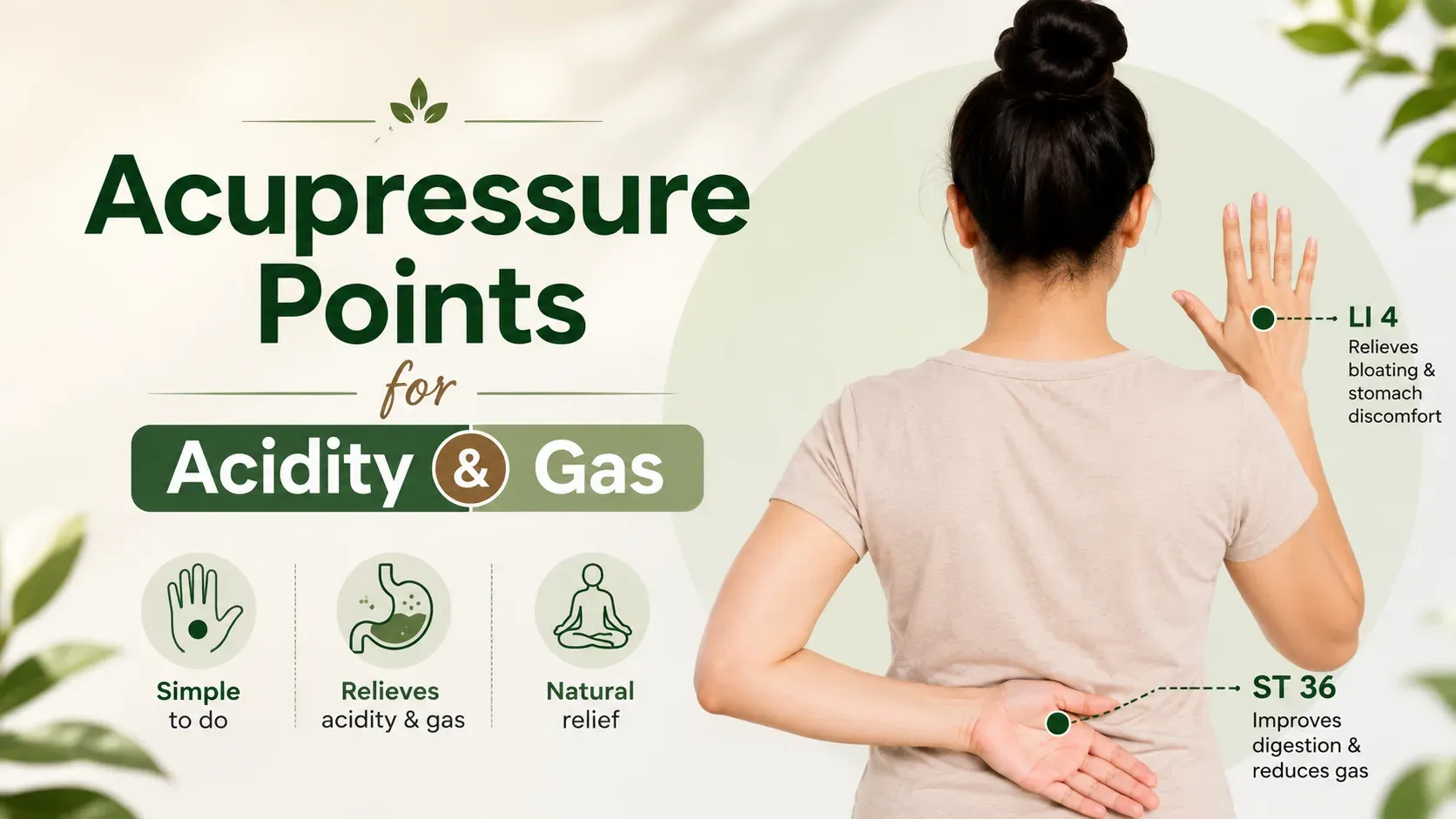
Acupressure Points for Acidity and Gas: Complete Guide
Quick Answer
The most useful acupressure points for acidity and gas are PC6 on the inner wrist, LI4 between the thumb and index finger, ST36 below the knee, CV12 on the upper abdomen and SP4 on the inner foot arch. Firm, steady pressure for 1 to 3 minutes may help some people ease nausea, acid discomfort, bloating or trapped gas. Acupressure is supportive care and should not replace medical treatment for frequent, severe or red-flag symptoms.
What Is Acupressure for Acidity and Gas?
Acupressure for acidity and gas is a self-care technique that applies firm, sustained pressure to specific points on the body to support digestion, calm nausea and help trapped gas move. It does not use needles, medicine or equipment.
It is different from acupuncture because acupressure can be done with your thumb or fingers. Acupuncture uses fine needles and should be performed only by a trained practitioner.
For digestive discomfort, acupressure is usually used as an add-on habit along with meal timing, hydration, slow eating, sleep and trigger-food tracking. For recurring reflux, it is also useful to understand what is acidity and whether symptoms are linked to reflux, bloating or slow digestion.
The five key acupressure points covered in this guide are:
- •PC6, Neiguan: inner wrist point for nausea, acidity, heartburn and upper-chest tightness.
- •LI4, Hegu: hand webbing point often used for gas movement and abdominal cramping.
- •ST36, Zusanli: below-knee point for overall digestion, post-meal heaviness and bloating.
- •CV12, Zhongwan: upper-abdomen point for acid discomfort, nausea and gastric regulation.
- •SP4, Gongsun: inner-foot point for gas, bloating, IBS-type cramping and weak digestion patterns.
Important: Acupressure may help mild functional symptoms, but it is not a substitute for diagnosis. Chest pain, breathlessness, black stool, blood in vomit, severe abdominal pain, persistent vomiting or unexplained weight loss needs medical care.
How Does Acupressure Work for Acidity and Gas?
Acupressure may work through a mix of nerve stimulation, muscle relaxation, pain modulation and traditional meridian-based mechanisms. The effect is usually gentle and symptom-supportive rather than curative.
1. Vagal nerve support
Points such as PC6 may influence the parasympathetic nervous system, often called the rest-and-digest pathway. This may help calm nausea, reduce stress-linked gut tension and support smoother digestive rhythm.
2. Gut motility support
Points such as LI4, ST36 and SP4 are traditionally used to support intestinal movement. This can be useful when gas feels trapped or when bloating comes with sluggish digestion. For deeper symptom understanding, read about trapped gas pain.
3. Stress and gut-brain connection
Stress can increase gut sensitivity and worsen acidity, gas or cramps in many people. Acupressure combined with slow breathing may support the gut-brain axis by shifting the body away from a fight-or-flight state.
4. Local relaxation
Gentle abdominal pressure, especially around CV12, may help relax tight upper-abdominal muscles. This should be done carefully and never on a full stomach.
Acupressure works best when paired with basic acidity and gas care: smaller meals, slow chewing, avoiding late heavy dinners, staying upright after food and identifying personal triggers.
The Five Best Acupressure Points for Acidity and Gas
The table below gives the location, best use and pressing duration for each point. Start with the points you can reach easily, especially PC6, LI4 and ST36.
| Point | Name | Location | Best For | How to Press | Duration |
|---|---|---|---|---|---|
| PC6 | Neiguan | Inner wrist, about 3 finger-widths above the wrist crease, between two tendons | Nausea, acidity, heartburn, chest tightness | Firm circular thumb pressure on each wrist | 1 to 3 min per side |
| LI4 | Hegu | Soft webbing between thumb and index finger | Gas movement, abdominal cramps, general digestive stimulation | Pinch firmly between opposite thumb and index finger | 1 to 2 min per hand |
| ST36 | Zusanli | Outer shin, about 4 finger-widths below the kneecap | Bloating, post-meal heaviness, digestion support | Firm thumb or knuckle pressure | 2 to 3 min per leg |
| CV12 | Zhongwan | Upper-abdomen midline, halfway between navel and breastbone | Acidity, nausea, upper-stomach discomfort | Gentle clockwise pressure with 2 or 3 fingers | 2 to 3 min |
| SP4 | Gongsun | Inner foot arch, behind the base of the big toe bone | Gas, bloating, IBS-type cramping | Firm thumb pressure into inner arch | 1 to 2 min per foot |
PC6, Neiguan: Acupressure Point for Acidity, Nausea and Heartburn
PC6 is the most practical point for acidity-related nausea and upper-digestive discomfort because it is easy to press anywhere. It is located on the inner wrist and is also the point used by many nausea wristbands.
Location: inner wrist, 3 finger-widths above the wrist crease, between the two tendons.
Best for: nausea, acidity, heartburn, burping and chest tightness after meals.
Duration: 1 to 3 minutes on each wrist.
How to Find PC6
Turn your palm upward. Place three fingers of the opposite hand across the wrist crease. PC6 lies just above the third finger, between the two tendons in the center of the inner wrist. When you press correctly, you may feel a mild ache or dull pressure.
How to Press PC6 Correctly
- Place your opposite thumb on the point between the two tendons.
- Apply firm but comfortable pressure. It should feel like a deep ache, not sharp pain.
- Move the thumb in small circles or hold steady pressure.
- Continue for 1 to 3 minutes, then repeat on the other wrist.
- Breathe slowly through the nose while pressing, especially if acidity worsens with stress.
PC6 can be useful when acidity comes with nausea, burping, heartburn or a sour taste. If these symptoms happen often, understand whether they may be linked to acid reflux rather than occasional acidity.
LI4, Hegu: Acupressure Point for Quick Gas Movement
LI4 is a hand point traditionally used for pain, tension and digestive movement. For gas, it is often used when bloating feels stuck or when abdominal pressure is paired with cramps.
Location: hand webbing between the thumb and index finger.
Best for: trapped gas, abdominal cramping and digestive stimulation.
Duration: 1 to 2 minutes per hand.
Avoid: during pregnancy unless cleared by a qualified clinician.
How to Find LI4
Bring your thumb and index finger together. The muscle between them forms a small mound. LI4 is near the highest point of this mound, in the webbing between the thumb and index finger.
How to Press LI4 Correctly
- Use the opposite thumb and index finger to pinch the LI4 area.
- Apply steady pressure until you feel a deep, tolerable ache.
- Hold or move in tiny circles for 1 to 2 minutes.
- Repeat on the other hand.
- Stop if you feel sharp pain, numbness or unusual tingling.
Pregnancy caution: LI4 is commonly listed as a point to avoid during pregnancy in traditional practice. Pregnant people should not self-press LI4 for gas relief unless a qualified clinician advises it.
ST36, Zusanli: Master Digestive Point for Gas and Bloating
ST36 is one of the most used digestive acupressure points in traditional Chinese medicine. It is chosen for bloating, slow digestion, heaviness after meals and general digestive weakness.
Location: outer shin, below the knee.
Best for: bloating, gas, post-meal heaviness, fatigue with poor digestion.
Duration: 2 to 3 minutes per leg.
How to Find ST36
Sit with your knee bent. Find the outer hollow below the kneecap. Place four fingers below this hollow. ST36 is near the outer edge of the shinbone, about one finger-width away from the bone.
How to Press ST36 Correctly
- Sit comfortably with your leg relaxed.
- Use your thumb, knuckle or two fingers to press the point.
- Apply firm pressure in small circles or hold steady pressure.
- Continue for 2 to 3 minutes on each leg.
- Use it after the largest meal or in the evening if bloating is a recurring issue.
ST36 works best as a daily support point rather than only during discomfort. For gas-prone digestion, also review gas and bloating causes to identify food and lifestyle triggers.
CV12, Zhongwan: Acupressure Point for Upper-Stomach Acidity
CV12 is located over the upper abdomen and is used for upper-stomach fullness, nausea, burping and acid discomfort. Because this point sits close to the stomach, pressure must be gentle.
Location: midline of the upper abdomen, halfway between the navel and the lower end of the breastbone.
Best for: acidity, nausea, upper-stomach heaviness and acid reflux-type discomfort.
Duration: 2 to 3 minutes.
Important: wait at least 45 minutes after meals before pressing.
How to Find CV12
Place one hand on your abdomen. CV12 lies on the center line, midway between the navel and the breastbone. The area may feel mildly tender when acidity or gastric discomfort is active.
How to Press CV12 Correctly
- Sit back or lie down comfortably. Do not press CV12 while standing.
- Use two or three fingers together, not a single thumb.
- Apply gentle pressure and move slowly in clockwise circles.
- Continue for 2 to 3 minutes.
- Stop if burning, nausea or pain increases.
Do not use strong abdominal pressure if you are pregnant, recently had abdominal surgery, have a hernia, severe pain or an undiagnosed abdominal condition.
SP4, Gongsun: Acupressure Point for Gas, Bloating and IBS-Type Cramps
SP4 is located on the inner foot arch and is traditionally used for weak digestion, bloating, abdominal distension and cramping. It is often paired with ST36 for people whose gas is recurrent and not just one-time discomfort.
Location: inner foot arch, behind the base of the big toe bone.
Best for: gas, bloating, IBS-type cramping and digestion that feels weak or sluggish.
Duration: 1 to 2 minutes per foot.
How to Find SP4
On the inner side of the foot, feel for the long bone that runs from the big toe toward the arch. SP4 lies in the small depression just behind the base of this bone, on the inner arch. It can feel tender when bloating is active.
Why SP4 Works for Gas and Bloating
In traditional practice, SP4 supports the spleen and stomach meridian system, which is linked to food transformation and fluid movement. In practical terms, it is used when bloating feels heavy, digestion is slow or cramps come with irregular bowel movement.
How to Apply SP4 Correctly
- Sit comfortably and cross one ankle over the opposite knee.
- Use your thumb to press into the inner arch behind the big toe bone.
- Apply firm, steady pressure for 1 to 2 minutes.
- Use small circles if the point feels too tender.
- Repeat on the other foot.
SP4 may be helpful after a heavy meal or when gas is paired with cramps. However, severe pain, persistent diarrhoea, blood in stool or unexplained weight loss needs medical assessment, not self-treatment.
Which Acupressure Point Should You Press Based on Your Symptom?
Choose the point based on the main symptom. Pressing one or two relevant points is better than pressing every point randomly.
| Your Main Symptom | Best Point | Why It Helps | Simple Routine |
|---|---|---|---|
| Sour burps or heartburn | PC6 + CV12 | Calms nausea and upper-stomach discomfort | PC6 2 min each wrist, then gentle CV12 2 min |
| Trapped gas after meals | LI4 + ST36 | Supports gas movement and gut motility | LI4 1 min each hand, ST36 2 min each leg |
| Bloating with heaviness | ST36 + SP4 | Supports slow digestion and abdominal distension | ST36 2 min each leg, SP4 1 min each foot |
| Nausea with acidity | PC6 | Commonly used for nausea and upper digestive discomfort | PC6 2 to 3 min each wrist |
| Stress-linked acidity | PC6 + slow breathing | May support rest-and-digest nervous response | PC6 2 min each side with slow breathing |
| Upper-abdomen fullness | CV12 | Local support for upper-stomach discomfort | Gentle clockwise circles for 2 min, not after meals |
5-Minute Acupressure Routine for Acidity and Gas
Use this short routine when acidity and gas are mild, functional and not linked with emergency symptoms.
- Minute 1: Press PC6 on the left wrist with slow breathing.
- Minute 2: Press PC6 on the right wrist.
- Minute 3: Press LI4 on both hands for 30 seconds each, avoid during pregnancy.
- Minute 4: Press ST36 on the right and left leg for about 30 seconds each.
- Minute 5: Sit upright, breathe slowly and sip room-temperature water.
For chronic acidity, acupressure alone is not enough. Combine it with smaller dinners, avoiding late-night meals, walking after food and other habits used to reduce acidity naturally.
When Is the Best Time to Use Acupressure for Acidity and Gas?
| Situation | Best Time | Point Choice | Notes |
|---|---|---|---|
| After a heavy meal | 45 to 60 minutes later | PC6, ST36 | Avoid abdominal pressure immediately after food |
| Gas feels trapped | Anytime, if not pregnant | LI4, ST36 | Use gentle walking too |
| Night-time acidity | Before sleep, not on a full stomach | PC6, gentle CV12 | Stay upright after dinner |
| Morning bloating | After waking or after breakfast | ST36, SP4 | Pair with warm water and movement |
| Stress-related symptoms | During stress or before meals | PC6 | Add slow breathing |
Safety Precautions: Who Should Avoid or Modify Acupressure?
Acupressure is usually gentle, but it is not risk-free for everyone. Use light pressure, avoid painful areas and do not press on injured, swollen or infected skin.
- •Pregnancy: avoid LI4 and strong abdominal pressure unless cleared by a qualified clinician.
- •Recent surgery or hernia: avoid abdominal points such as CV12 until a doctor approves.
- •Severe pain: do not use acupressure to cover up severe abdominal or chest pain.
- •Bleeding disorders or blood thinners: use very gentle pressure and ask a doctor first if bruising is common.
- •Diabetes with neuropathy: be careful with foot points such as SP4 because sensation may be reduced.
- •Children and elderly people: use lighter pressure and shorter duration.
Stop immediately if pressure causes sharp pain, dizziness, nausea worsening, numbness, tingling that does not settle, breathlessness or chest tightness.
When Should You See a Doctor Instead of Relying on Acupressure?
Mild gas or acidity after a heavy meal can often be managed with simple care. But recurring or severe symptoms need medical evaluation, especially when red flags are present.
- •Acidity or reflux happens more than twice a week.
- •You have difficulty swallowing or pain while swallowing.
- •You have chest pain, breathlessness, sweating or pain spreading to the arm or jaw.
- •You vomit blood or material that looks like coffee grounds.
- •You notice black stool or blood in stool.
- •There is unexplained weight loss, persistent vomiting or severe abdominal pain.
- •Symptoms continue despite lifestyle changes or keep returning for several weeks.
A doctor can check whether the issue is simple acidity, GERD, gastritis, ulcer, gallbladder disease, IBS or another condition that needs targeted care.
Acupressure vs Antacids: Is Acupressure Enough?
Acupressure may help some people feel lighter, calmer or less bloated, but it does not neutralise stomach acid the way an antacid does, and it does not heal GERD complications. Think of it as supportive care, not a replacement for medical treatment.
| Factor | Acupressure | Antacids or Medicine |
|---|---|---|
| Best for | Mild functional gas, nausea, stress-linked discomfort | Acid neutralisation, frequent reflux or diagnosed GERD |
| Speed | May help in minutes for some people | Often works quickly for acid symptoms |
| Root cause | Supports stress and motility patterns | Depends on medicine type and diagnosis |
| Long-term role | Daily supportive habit if safe | Use as advised by doctor or pharmacist |
| Limitations | Does not diagnose or treat disease | May not fix lifestyle or trigger patterns alone |
For lasting relief, combine safe symptom care with trigger tracking, meal timing, sleep, hydration, gentle movement and medical guidance when symptoms are frequent.
Acidity, gas or bloating keeps coming back?
Find your digestive pattern and understand what may be triggering recurring gut symptoms.
Take Free Gut Health Test Explore More Gut Health ArticlesConclusion
Acupressure points for acidity and gas can be useful for mild, functional discomfort when used correctly. PC6 is helpful for nausea and acidity, LI4 for gas movement, ST36 for digestion support, CV12 for upper-stomach discomfort and SP4 for bloating with cramping.
Use gentle, consistent pressure, avoid risky points in pregnancy and do not delay medical care for frequent reflux or red-flag symptoms. For recurring acidity, gas or bloating, the goal should be to understand the underlying digestive pattern rather than only manage symptoms temporarily.
Key Takeaways
A complete guide to acupressure points for acidity and gas, covering PC6, LI4, ST36, CV12, SP4, safety tips and doctor guidance.
Your gut is unique your healing should be too.

Disclaimer
The content provided by Mool Health is for educational and informational purposes only and should not be considered a substitute for professional medical advice, diagnosis, or treatment.