
Acupressure Points for Gas: 9 Points for Immediate Gas Relief, Chest Gas & Constipation
This complete guide covers the 9 best acupressure points for gas — LI4 and PC6 for immediate gas relief on hand, CV17 for gas in chest, CV6 + ST25 + TE6 for gas with constipation, and ST36 + SP6 for gas and bloating long-term.
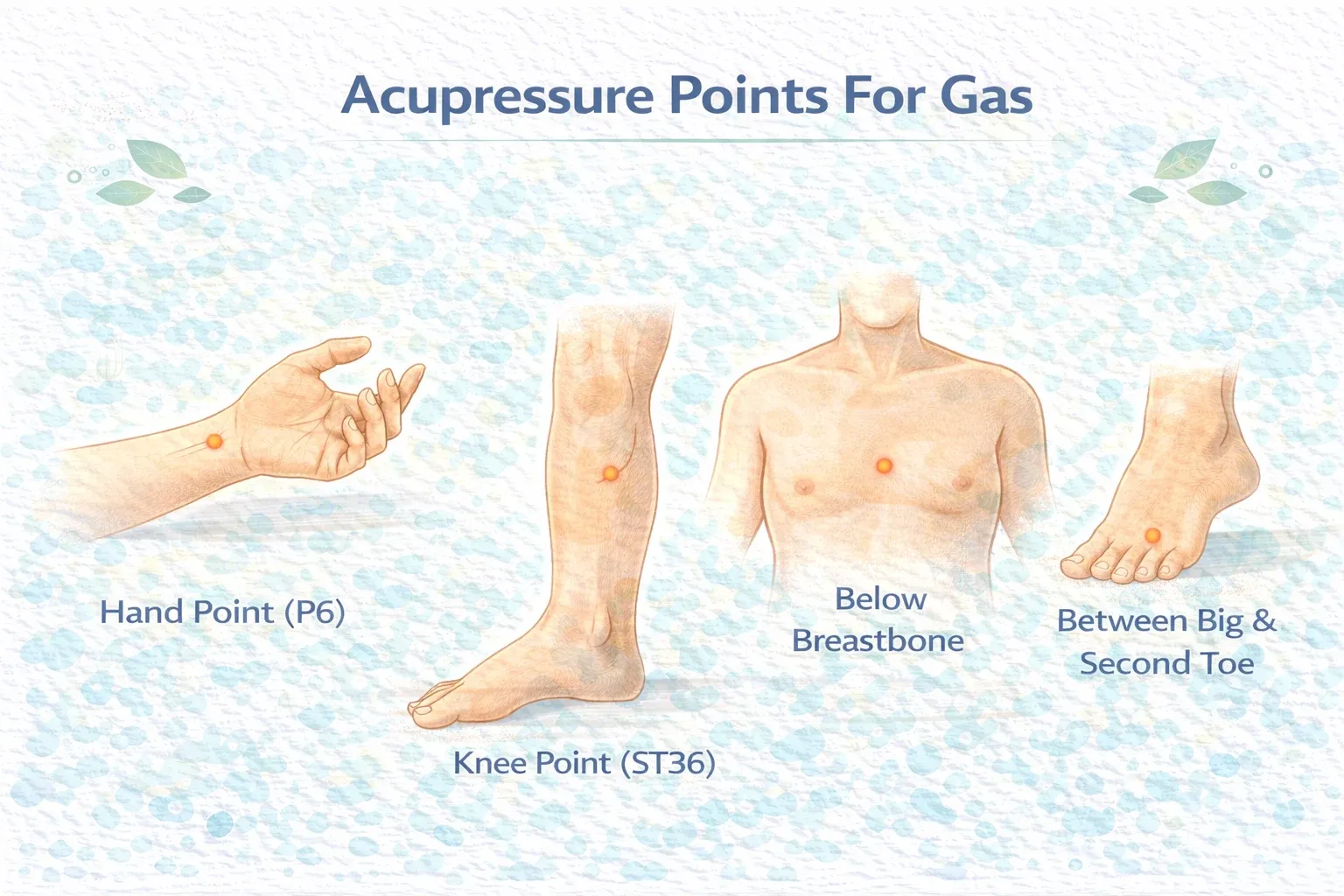
✏️ Quick Answer
The best acupressure points for gas are LI4 (hand webbing), ST25 (beside navel), ST36 (below knee), CV6 (lower abdomen), and SP6 (inner leg). For gas specifically — LI4 and ST25 are the most immediately effective. The acupressure points for immediate gas relief on hand are LI4 and PC6 — both accessible anywhere without equipment, delivering relief in 5–15 minutes.
Best gas acupressure points — at a glance:
- ·LI4 — Hand webbing; best hand point for immediate gas release and intestinal stimulation
- ·ST25 — Beside navel; directly releases trapped intestinal gas within 5–10 min
- ·ST36 — Below knee; master point for gas, bloating, and overall gut motility
- ·CV6 — Lower abdomen; best for lower abdominal and constipation-related gas
- ·CV17 — Centre of chest; best acupressure point for gas in chest and upper gas pain
- ·SP6 — Inner leg; best for gas with bloating and constipation (avoid in pregnancy)
Trapped gas is one of the most universally uncomfortable digestive experiences — and it rarely waits for a convenient moment. Whether it is sharp gas pain in the chest that mimics a heart attack, lower abdominal cramping from constipation-related gas, or the relentless post-meal bloating that makes every evening miserable — acupressure points for gas offer a drug-free, equipment-free solution that works in minutes. All you need are your hands and the knowledge of where to press.
Understanding the causes of gas and bloating helps make sense of why acupressure is so effective. Gas accumulates when peristalsis slows, when fermentation outpaces absorption, or when the intestinal muscles are in spasm. Acupressure directly addresses all three mechanisms — stimulating peristalsis, relaxing intestinal smooth muscle, and reducing the inflammation that drives fermentation. This guide covers every gas scenario: gas on the hand, gas in the chest, gas with constipation, gas with bloating, and the emergency immediate gas relief protocol.
Acupressure Points for Gas: Complete Reference Table
| Point | Name | Location | Best For | Relief Time | Caution |
|---|---|---|---|---|---|
| LI4 | Hegu | Webbing between thumb and index finger | Gas release in hand, immediate relief, abdominal pain | 2–5 min | Avoid in pregnancy |
| ST25 | Tianshu | 2 finger-widths either side of navel | Trapped intestinal gas, bloating, diarrhea, constipation | 5–10 min | Press gently after meals |
| ST36 | Zusanli | 4 finger-widths below kneecap, outer shin | Gas, bloating, weak digestion, overall gut motility | 10–15 min | None |
| CV6 | Qihai (Sea of Qi) | 1.5 finger-widths below navel, midline | Lower abdominal gas, constipation gas, Qi deficiency | 5–10 min | Avoid in pregnancy |
| CV12 | Zhongwan | Midway between navel and sternum base | Upper gas, gastric gas, nausea with gas, acidity | 5–10 min | Wait 45 min post-meal |
| CV17 | Shanzhong (Chest Centre) | Centre of sternum, level with the 4th rib | Gas in chest, chest tightness, upper gas pain | 5–10 min | Gentle pressure only |
| SP6 | Sanyinjiao | 4 finger-widths above inner ankle bone | Gas with bloating, constipation gas, women's digestive issues | 10–15 min | Strictly avoid in pregnancy |
| PC6 | Neiguan | 3 finger-widths above inner wrist crease, between tendons | Gas with nausea, upper gas pain, stress-related gas | 5–10 min | None |
| TE6 | Zhigou | Outer forearm, 3 finger-widths above wrist crease | Gas with constipation, bloating, lateral rib gas pain | 10–15 min | Avoid in pregnancy |
Acupressure Points on Hand for Gas — Best Hand Points for Immediate Relief
The acupressure points on hand for gas are the most practical and accessible — no need to remove shoes, lie down, or find a private space. These are the points you can press during a meeting, while travelling, or right at the dining table. The three best acupressure points for gas relief on hand:
- Location — Press your thumb and index finger together — a muscle mound forms between them. LI4 is at the peak of this mound. Alternatively, lay your opposite thumb's crease across the webbing — LI4 is where your thumb tip lands.
- Why it works for gas — LI4 sits on the Large Intestine meridian — the most direct meridian pathway governing colon function, gas movement, and bowel transit. Pressing LI4 immediately stimulates peristaltic contractions in the large intestine, moving trapped gas toward the rectum for release. This is the primary acupressure point for gas release in hand — most people feel gas movement begin within 60–90 seconds of firm pressure. It also reduces intestinal spasm (which traps gas), making it doubly effective for cramping gas pain.
- Technique — Pinch the webbing between your opposite thumb (below) and index finger (above). Apply the firmest comfortable pressure — rotate slightly or maintain sustained pressure. Hold 1–2 minutes per hand. Alternate hands. The classic "De Qi" aching sensation confirms correct point activation.
- Location — 3 finger-widths above the inner wrist crease, exactly between the two tendons (flexor carpi radialis and palmaris longus). A slight ache or electric sensation when pressed confirms correct location.
- Why it works for gas — PC6 stimulates the vagus nerve and calms the entire upper GI tract — reducing nausea, stomach cramping, and oesophageal spasm that accompanies upper gas pain. When gas is accompanied by nausea, belching, or discomfort in the upper abdomen, PC6 is the superior hand point. As an acupressure point for immediate gas relief on hand, PC6 paired with LI4 creates the fastest two-point protocol available without removing clothing.
- Technique — Press firmly with opposite thumb in small circular motions. Hold 1–3 minutes per wrist. Breathe slowly — long exhales enhance vagal activation and amplify relief.
- Location — On the outer (dorsal) forearm, 3 finger-widths above the back of the wrist crease, between the radius and ulna bones.
- Why it works for gas with constipation — TE6 sits on the Triple Energizer (San Jiao) meridian — governing the movement and transformation of fluids and energy through the entire digestive tract. It is specifically indicated for gas that is stuck due to constipation or sluggish bowel transit — the type of gas that builds up throughout the day with no relief. Combined with LI4, TE6 forms the most effective hand-based protocol for acupressure points for gas and constipation.
- Technique — Press firmly into the groove between the two forearm bones. Sustained pressure or circular friction for 1–2 minutes per arm. Best combined with LI4 in the same session for constipation-related gas.
Acupressure Points for Gas in Chest — Releasing Upper Trapped Gas
Acupressure points for gas in chest address one of the most alarming gas experiences — sharp pain or pressure in the chest, upper sternum, or left side of the chest that is often confused with cardiac pain. Chest gas typically originates from the stomach or oesophagus — not the intestines — and responds to different points than lower abdominal gas.
- Location — On the midline of the sternum (breastbone), level with the 4th intercostal space — approximately at the level of the nipples. The point is directly on the breastbone, not the side of the chest.
- Why it works for chest gas — CV17 sits on the Conception Vessel meridian and is the primary gathering point (Mu point) for the Pericardium — governing the upper thoracic cavity including oesophagus and cardiac region. Stimulating CV17 relaxes the oesophageal smooth muscle, reduces gas trapped in the upper GI tract, and relieves the chest pressure and tightness caused by gas in the chest area. It also has a calming effect on the mind that helps distinguish and manage the anxiety that often accompanies chest gas pain.
- Technique — Use the heel of your hand or three fingers pressed together. Apply gentle but firm sustained pressure — the sternum is sensitive, so begin lightly and increase gradually. Circular friction or sustained hold for 2–3 minutes while taking slow, deep breaths.
Supporting Points for Chest Gas
- CV12 (Zhongwan) — Midway between navel and sternum — directly releases gas from the stomach body into the intestines, reducing the upward pressure that causes chest gas. Press with 3 fingers, 2–3 minutes, gentle circular motion.
- PC6 (Neiguan) — Inner wrist — reduces oesophageal spasm and the nausea that accompanies chest gas. The most accessible hand point for chest gas relief — can be pressed while the other hand works CV17.
- ST16 (Yingchuang) — On the chest, 3rd intercostal space, below the collarbone — releases lateral chest gas pressure and rib discomfort associated with trapped upper gas.
Acupressure Points for Gas and Constipation
Gas and constipation almost always co-exist — when stool is backed up in the colon, gas produced by fermentation has nowhere to go and builds up painfully. The acupressure points for gas and constipation address both the bowel transit issue and the gas accumulation simultaneously. Understanding what is constipation helps identify which type of constipation is causing the gas — Vata-type (dry, hard stools) responds differently to acupressure than Kapha-type (sluggish, heavy).
- Location — 1.5 finger-widths directly below the navel on the abdominal midline. This is the centre of the lower abdominal energy field in both TCM and Ayurveda (approximates the Apana Vayu seat).
- Why it works — CV6 tonifies and moves Qi in the lower abdomen — directly stimulating the sigmoid colon and rectum to contract and move stool and gas toward elimination. It is particularly effective for gas that is trapped in the lower abdomen and cannot pass due to constipation. Regular daily practice of CV6 for 2–3 minutes improves lower bowel motility over time.
- Technique — Use three fingers pressed together. Apply firm but not harsh pressure — the lower abdomen is more sensitive than the hand or leg. Small clockwise circles for 2–3 minutes. Best practiced lying down or sitting with hips relaxed.
- Location — Exactly 2 finger-widths to the left and right of the navel. There are two ST25 points — one on each side. Both are typically pressed simultaneously with the index and middle fingers of each hand.
- Why it works — ST25 is the Front Mu point of the Large Intestine — its direct alarm point that regulates all large intestinal function. Pressing ST25 bilaterally simultaneously stimulates the entire large intestine meridian through its front reflex, triggering peristalsis and releasing trapped gas along the full length of the colon. It is uniquely effective for the type of gas that feels stuck and immovable — the deeply uncomfortable trapped gas of constipation.
- Technique — Press both ST25 points simultaneously with the index fingers of each hand. Use firm pressure with small clockwise circles for 2–3 minutes. Follow with ST36 and LI4 in the same session for maximum gas and constipation relief.
- Location — 4 finger-widths above the inner ankle bone (medial malleolus), just behind the tibia bone's inner edge.
- Why it works — SP6 is one of the most powerful points in TCM — it is the intersection of three major yin meridians (Spleen, Liver, and Kidney), governing digestion, hormonal function, and fluid metabolism simultaneously. For gas with bloating — particularly the hormonal gas women experience premenstrually — SP6 is the most comprehensive single point available. It improves Spleen Qi (digestive energy), reduces dampness (fluid retention that contributes to bloating), and stimulates bowel motility for constipation-related gas. This is the go-to acupressure point for gas and bloating in women with hormonal digestive patterns.
- Technique — Press firmly behind the tibia, not on the bone itself. Sustained pressure or circular friction for 1–2 minutes per leg. Combine with ST36 for a complete lower-body gas relief session.
Acupressure Points for Immediate Gas Relief — Emergency Protocol
When gas strikes suddenly and you need acupressure points for immediate gas relief, this is the step-by-step protocol combining the fastest-acting points for maximum speed:
- Press LI4 — both hands (2 minutes) — Start immediately. Pinch the webbing between thumb and index finger on your right hand as firmly as you can tolerate. Hold for 60 seconds, then switch to the left hand for 60 seconds. You should feel gas beginning to shift within 90 seconds of starting. This is the foundation of any immediate gas relief protocol.
- Press ST25 — bilateral (1–2 minutes) — Place index fingers of both hands 2 finger-widths either side of your navel. Press firmly and rotate clockwise simultaneously. This directly stimulates the large intestine from its front reflex point. Gas often begins to pass within 1–2 minutes of this step.
- Deep diaphragmatic breathing throughout — Inhale 4 counts, hold 2, exhale 6. Do not hold your breath. The long exhale activates the parasympathetic nervous system — the "rest and digest" mode — which dramatically amplifies peristalsis and gas movement. This breathing pattern combined with acupressure is significantly more effective than either alone.
- Left lateral position + knee to chest — If you can lie down, do so on your left side with your right knee drawn up toward your chest. This position uses gravity to move gas from the ascending colon (right side) across the transverse colon and down the descending colon (left side) toward elimination — the fastest gravitational gas movement position. Press LI4 while in this position for combined acupressure + positional gas relief.
- Add ST36 if available (2 minutes) — Press ST36 on both legs while lying on your left side to further stimulate gut motility. The combination of LI4 + ST25 + ST36 + left lateral position + diaphragmatic breathing is the most complete immediate gas relief protocol available without medication.
This protocol complements other gas relief approaches — for a complete comparison, see our guide on medicine for gas and bloating including both acupressure, herbal, and pharmaceutical options. Combining acupressure with mudra for digestion (particularly Vayu Mudra and Apana Mudra) creates a powerful hands-only digestive therapy that requires nothing external.
Acupressure Points for Gas and Bloating — Targeting Both Together
Acupressure points for gas and bloating need to address two related but distinct mechanisms: gas production and gas trapping (the bloating aspect). For the combined gas-bloating presentation, the most effective points are:
- ST36 + SP6 combination — The most clinically validated pair for gas and bloating. ST36 stimulates overall digestive Qi and gut motility; SP6 reduces dampness (water retention contributing to bloating) and improves Spleen-mediated digestion. Press both daily for 2–3 minutes each, consistently for 4–6 weeks, for long-term gas and bloating reduction.
- ST25 bilateral — For the physical trapped gas component of bloating — the distension caused by gas accumulation in the large intestine. ST25 is the most direct point for releasing intestinal gas that causes visible abdominal distension.
- CV6 + CV12 — Lower and upper abdominal paired pressure — CV6 releases lower colonic gas, CV12 releases gastric and upper intestinal gas. Together they address the full length of the abdominal cavity for comprehensive bloating relief.
For a complete guide to the combined acidity and gas presentation, see our detailed resource on acupressure points for acidity and gas — which covers the overlap between gas-dominant and acidity-dominant digestive problems. Complementary physical practices — particularly yoga for digestion asanas like Pawanmuktasana (wind-relieving pose) — dramatically enhance the acupressure effect when practiced in the same session.
📋 Key Takeaways
- LI4 (hand webbing) is the best acupressure point for immediate gas release on hand — activates the Large Intestine meridian and produces perceptible gas movement within 60–90 seconds
- ST25 (beside navel) is the most direct point for trapped intestinal gas — the Front Mu point of the Large Intestine, effective in 5–10 minutes
- CV17 (centre of sternum) is the primary acupressure point for gas in chest — relaxes oesophageal smooth muscle and releases upper GI trapped gas
- For gas and constipation together — LI4 + TE6 (outer forearm) + CV6 (below navel) addresses both bowel transit and gas accumulation simultaneously
- ST36 + SP6 is the best daily practice combination for gas and bloating — 2–3 min each, twice daily for 4–6 weeks produces lasting improvement
- The emergency immediate gas relief protocol: LI4 (2 min) → ST25 bilateral (2 min) → left lateral position → diaphragmatic breathing throughout
- Avoid LI4, SP6, CV6, and TE6 during pregnancy — these points stimulate uterine contractions
- The De Qi sensation (deep ache or heaviness at the point) confirms effective stimulation — it is desirable, not a sign of pressing too hard
- Combining acupressure with mudra practice, yoga asanas, and deep diaphragmatic breathing dramatically amplifies all gas relief effects
Why Mool Health for Digestive Wellness
Mool Health integrates Ayurvedic Marma Chikitsa pressure therapy, herbal formulations, and personalised dietary protocols to address gas and bloating at the root. Acupressure is a powerful immediate tool — but lasting gas relief comes from identifying why your gut is producing excess gas in the first place. Our Ayurvedic gut health specialists help you find your personal gas triggers and build a complete protocol combining pressure therapy, diet, and targeted Ayurvedic medicine.
⚠️ Medical Disclaimer
This article is published by Mool Health for educational purposes only and does not substitute professional medical advice. Acupressure is a complementary therapy and should not replace medical evaluation for persistent or severe gas, unexplained chest pain, or diagnosed conditions including IBD, GERD, or gastrointestinal obstruction. Certain acupressure points are contraindicated during pregnancy. Chest pain that is severe, accompanied by breathlessness or left arm pain, requires immediate emergency medical attention — do not delay care for acupressure. If gas is chronic or significantly impairs daily life, consult a qualified physician or gastroenterologist.
Key Takeaways
This complete guide covers the 9 best acupressure points for gas — LI4 and PC6 for immediate gas relief on hand, CV17 for gas in chest, CV6 + ST25 + TE6 for gas with constipation, and ST36 + SP6 for gas and bloating long-term.
Your gut is unique your healing should be too.

Disclaimer
The content provided by Mool Health is for educational and informational purposes only and should not be considered a substitute for professional medical advice, diagnosis, or treatment.