
Acupressure Points for Acidity Relief: Natural Way to Reduce Acid Reflux
This article explains acupressure points for acidity relief and how traditional pressure techniques may support digestive comfort.
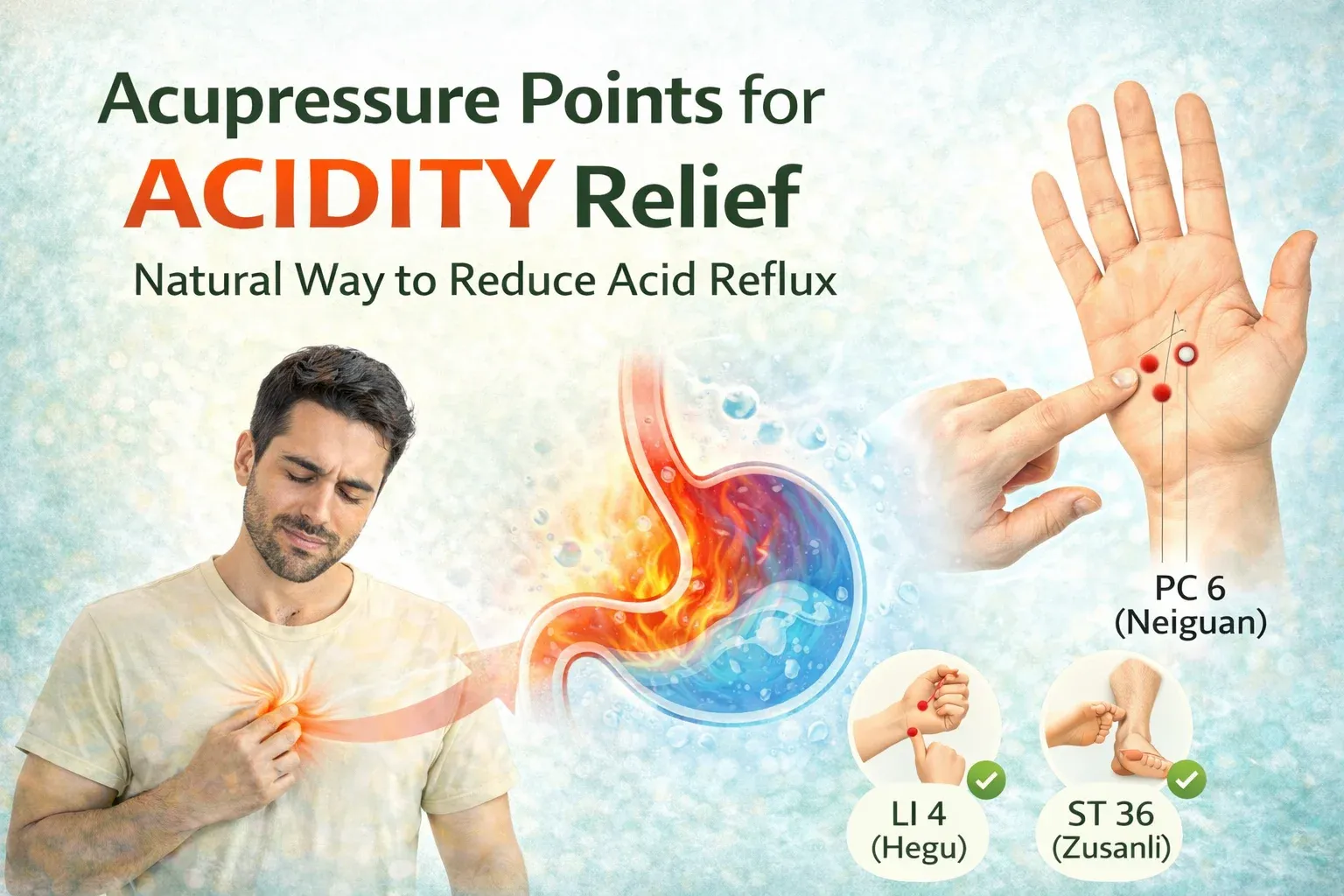
Quick Answer
Acupressure cannot neutralise stomach acid the way an antacid does - but that is not the whole story.
Specific pressure points on the hand, wrist, leg, and abdomen connect to the digestive and nervous systems through pathways studied in both traditional Chinese medicine and modern physiology. Pressing them firmly for 1-2 minutes can trigger the parasympathetic nervous system - the body's "rest and digest" mode - which slows acid secretion, relaxes digestive muscles, and reduces gas pressure. Most people feel a reduction in bloating or chest heaviness within 5-10 minutes.
What Are Acupressure Points for Acidity?
Acupressure points for acidity are specific body locations where applied finger pressure may activate nerve pathways that calm the digestive tract, reduce gas, and ease acid reflux discomfort - without any equipment or medication.
The six most evidence-referenced acupressure points for acidity and gas are:
- PC6 (Neiguan) - inner wrist, 3 fingers below the palm crease
- ST36 (Zusanli) - outer shin, 4 fingers below the kneecap
- SP6 (Sanyinjiao) - inner ankle, 4 fingers above the ankle bone
- CV12 (Zhongwan) - midpoint between the navel and the breastbone
- LI4 (Hegu) - fleshy web between the thumb and index finger
- CV17 (Shanzhong) - centre of the chest, for gas trapped in the chest
Acupressure is a traditional healing practice rooted in Traditional Chinese Medicine (TCM). Unlike acupuncture, it uses no needles - only finger, thumb, or knuckle pressure applied to specific points along meridian pathways. It is widely used for digestive discomfort, gas and bloating, stress, headaches, and nausea.
According to Mool Health's gut health research team, acidity is rarely a single-cause problem. It typically involves a combination of excess acid production, gut motility changes, and nervous system dysregulation - all of which acupressure can partially address.
How Do Acupressure Points Work for Acidity? The Mechanism Explained
Acupressure works on acidity through three overlapping mechanisms. Understanding them helps in applying pressure more effectively.
1. Vagus nerve stimulation The vagus nerve runs from the brainstem through the chest and into the abdomen. Pressing PC6 (inner wrist) activates vagal tone, which signals the gut to slow down acid production and speed up gastric emptying. Faster emptying means less acid sitting in the stomach, directly reducing reflux frequency.
2. Parasympathetic activation Stress triggers the sympathetic nervous system - the "fight or flight" response - which tightens digestive muscles and slows gut motility. This is why stress-eating commonly causes gas and bloating. Acupressure points, when pressed slowly and deliberately, shift the body toward parasympathetic dominance ("rest and digest"), relaxing the lower oesophageal sphincter and reducing reflux episodes.
3. Meridian pathways (Traditional Chinese Medicine) In TCM, the Stomach meridian and Pericardium meridian are directly associated with digestive function. Blockages in these meridians - caused by poor diet, stress, or emotional upset - are believed to manifest as acidity and gas. Stimulating ST36 and PC6 is thought to restore balanced energy flow in these meridians.
Key research finding: A 2014 review published in Evidence-Based Complementary and Alternative Medicine found that stimulation of ST36 (Zusanli) significantly increased gastric motility in subjects with functional dyspepsia - a common cause of bloating and post-meal heaviness.
Additionally, cortisol - the stress hormone - directly stimulates gastric acid secretion. Acupressure addresses both the nervous system and the digestive system simultaneously, which is why it often provides faster relief than dietary changes alone.
Citable summary: PC6 stimulation activates the vagus nerve, triggering a parasympathetic response that may reduce gastric acid secretion and ease reflux within minutes.
Acupressure Points for Acidity in Hand: Locations and How to Use Them
Acupressure points for acidity in the hand are the easiest to access - they require no special position and can be used anywhere, including at a desk or in a waiting room.
PC6 (Neiguan) - Inner Wrist Point
Best for: Nausea, acid reflux, upper abdominal tightness
Exact location: Turn your arm so the palm faces upward. Place three fingers across the wrist, starting from the first wrist crease. PC6 is directly below the third finger, between the two central tendons.
How to press:
- Use your opposite thumb to press firmly but gently on the point.
- Apply steady pressure for 2 minutes. Press and hold - do not rub.
- Breathe slowly and deeply throughout.
- Switch wrists and repeat.
What to expect: A mild aching or tingling sensation is normal and indicates the correct location. Most people feel reduced nausea or chest tightness within 3-5 minutes.
LI4 (Hegu) - Hand Web Point
Best for: Digestive cramping, constipation-linked gas, overall gut tension
Exact location: The fleshy area between the thumb and index finger, at the highest point of the muscle mound when the two fingers are pressed together.
How to press:
- Pinch this area firmly between the opposite thumb and index finger.
- Apply strong, firm pressure for 1-2 minutes.
- A slightly sore sensation confirms the correct point.
- Avoid during pregnancy.
What to expect: Reduced cramping and movement of trapped gas downward within 5-10 minutes.
Palm Centre Point
Best for: General digestive relaxation, mild gas discomfort
Exact location: The centre of the palm.
How to press:
- Press the centre of the palm with the opposite thumb.
- Massage gently in circular motions for about 1 minute.
- Repeat on both hands.
People who search for acupressure points for acidity and gas in hand often find this point useful as a supplementary technique alongside PC6 and LI4.
Acupressure Points for Acidity and Gas: Full Body Points
Beyond the hand, several acupressure points for acidity and gas on the leg, ankle, and abdomen provide deeper and more sustained digestive support.
ST36 (Zusanli) - Outer Shin Point
Best for: Bloating, gas, indigestion, low digestive energy
ST36 is the single most studied acupressure point for digestive health. Modern research has shown it influences gastric motility - the speed at which the stomach empties - which is directly linked to gas, bloating, and acid backup.
Exact location: Find the kneecap. Place four fingers below the lower edge of the kneecap. ST36 is 1 finger width to the outer side of the shin bone (tibia).
How to press:
- Press firmly with the thumb or knuckle.
- Apply pressure in small clockwise circles for 2 minutes.
- A deep ache at the point is normal and indicates correct location.
- Repeat on the other leg.
What to expect: Improved bowel sounds and reduced abdominal fullness within 10-15 minutes of consistent pressure.
SP6 (Sanyinjiao) - Inner Ankle Point
Best for: Bloating, hormonal digestive upset, IBS-type gas
SP6 is the meeting point of three meridians - the Spleen, Liver, and Kidney. It is especially effective for hormonal acidity, bloating after meals, and sluggish digestion.
Exact location: Find the highest point of the inner ankle bone. Place four fingers above it. SP6 is just behind the shin bone on the inner leg.
How to press:
- Press with the thumb using steady, firm pressure.
- Hold for 1-2 minutes, breathing slowly.
- Do not use during pregnancy.
What to expect: Reduced bloating and a general sense of abdominal relaxation, particularly useful for women with hormonal acidity patterns.
CV12 (Zhongwan) - Abdomen Point
Best for: Post-meal heaviness, acid reflux, stomach fullness
Exact location: Midway between the navel and the bottom of the breastbone - approximately 4 finger widths above the navel.
How to press:
- Lie down or sit comfortably.
- Use two or three fingertips to apply gentle but firm pressure.
- Massage in slow clockwise circles for 2 minutes.
- Do not press within 30 minutes of a heavy meal.
What to expect: Reduced post-meal bloating and easier passage of gas within 10-15 minutes.
LV3 (Taichong) - Top of Foot Point
Best for: Stress-driven acidity, anger-triggered reflux, persistent bloating
In TCM, LV3 is used to resolve Liver qi stagnation - which often manifests as stress-driven acidity and persistent bloating.
Exact location: On the top of the foot, in the web between the big toe and second toe, approximately 1.5 inches back from the toe cleft.
How to press:
- Press firmly with the thumb for 1-2 minutes.
- A strong aching sensation is considered therapeutic.
- Repeat on both feet.
Mool Health tip: If acidity is worst during or after stressful periods - deadlines, poor sleep, or emotional tension - LV3 is the recommended starting point. The Liver meridian in TCM governs smooth digestive energy flow, and stress disrupts that flow directly.
Acupressure Points for Gas Trapped in the Chest and Heartburn
Gas trapped in the chest feels different from stomach gas - it causes a tight, pressing sensation that can resemble heartburn or, in some cases, mild chest pain. This is sometimes described as upper GI gas or gastric reflux gas. The primary acupressure point for this symptom is CV17.
CV17 (Shanzhong) - Centre of the Chest
Best for: Gas trapped in the chest, heartburn, oesophageal tightness, belching difficulty
Exact location: The centre of the breastbone (sternum), level with the fourth rib space. To find it: draw an imaginary line from nipple to nipple - CV17 is where this line meets the breastbone.
How to press:
- Sit upright or lie on your back.
- Place 2-3 fingertips flat against the centre of the breastbone.
- Apply gentle, steady pressure - do not press hard on the sternum.
- Hold for 1-2 minutes while breathing slowly and deeply.
- Alternatively, tap this area gently with your fingertips 10-15 times.
What to expect: Belching often occurs within 2-3 minutes, indicating that trapped chest gas is releasing. Heartburn sensation may reduce over 5-10 minutes.
Heartburn vs. Acidity vs. Acid Reflux: Which Acupressure Points Apply
| Term | What It Means | Best Acupressure Points |
|---|---|---|
| Acidity | Excess acid production in the stomach | CV12, ST36, PC6 |
| Acid reflux | Acid moving up from stomach into oesophagus | PC6, CV17, ST36 |
| Heartburn | Burning sensation in chest from reflux | CV17, PC6 |
| Gas / Bloating | Gas trapped in stomach or intestines | LI4, ST36, SP6 |
Important: Distinguishing Chest Gas from Cardiac Symptoms
Acupressure on CV17 is appropriate for gas-related chest discomfort with clear digestive triggers such as a heavy meal, carbonated drinks, or lying down after eating.
See a doctor immediately if chest discomfort includes:
- Pain spreading to the left arm, jaw, or back
- Breathlessness or sweating alongside chest tightness
- Chest pain with no digestive trigger
5-Minute Acupressure Routine for Instant Gas and Acidity Relief
This routine delivers meaningful, measurable relief from an active gas or acidity episode. It is not a cure for chronic acidity, but it can significantly reduce symptoms within one session.
Before starting:
- Sit upright or lie down comfortably.
- Loosen any tight clothing around the abdomen.
- Take three slow, deep breaths - this alone begins to activate the parasympathetic response.
Step 1 (0-1 min): PC6 - Inner Wrist Press PC6 on the left wrist (3 finger widths below the palm crease, between the two central tendons) with firm thumb pressure. Hold 30 seconds, then switch to the right wrist. PC6 is the fastest-acting point for upper GI symptoms - nausea, reflux, and oesophageal tightness ease here first.
Step 2 (1-2 min): LI4 - Hand Web Pinch the web between the thumb and index finger firmly. Hold 30 seconds per hand. This releases gut tension and helps move trapped gas downward.
Step 3 (2-3 min): CV12 - Abdomen Place fingertips 4 finger widths above the navel. Press gently and massage in 10 clockwise, then 10 anticlockwise circles. This stimulates gastric emptying.
Step 4 (3-4 min): ST36 - Outer Shin Press 4 finger widths below the kneecap on the outer shin. Apply firm circular pressure for 30 seconds each leg. This is the core digestive support point for gas and bloating.
Step 5 (4-5 min): CV17 - Centre of Chest (Only if chest gas or heartburn is present.) Apply gentle fingertip pressure on the breastbone while breathing deeply. Tap gently 10-15 times to encourage belching.
What to expect from this routine:
- Within 2-3 minutes: mild belching or abdominal gurgling as gas begins to move
- Within 5-10 minutes: reduced bloating pressure, easier breathing, reduced chest tightness
- Within 15-20 minutes: most gas-related symptoms significantly reduced
For hyperacidity specifically, the PC6 + CV12 + ST36 trio is the core combination. Consistent daily use over 2-4 weeks may show cumulative benefit as the gut gradually recalibrates acid output and motility rhythm.
Quick Reference: All 6 Acupressure Points for Acidity and Gas
| Point | Location | Best For | Pressure Duration |
|---|---|---|---|
| PC6 (Neiguan) | Inner wrist, 3 fingers below crease | Nausea, reflux, upper GI tightness | 2 min each wrist |
| ST36 (Zusanli) | Outer shin, 4 fingers below kneecap | Bloating, gas, indigestion | 2 min each leg |
| LI4 (Hegu) | Hand web between thumb and index finger | Cramping, gas movement | 1-2 min each hand |
| SP6 (Sanyinjiao) | Inner ankle, 4 fingers above ankle bone | Hormonal bloating, IBS gas | 1-2 min each leg |
| CV12 (Zhongwan) | Midpoint navel to breastbone | Post-meal heaviness, reflux | 2 min, clockwise |
| CV17 (Shanzhong) | Centre of breastbone | Chest gas, heartburn, belching | 1-2 min, gentle |
Foot and Leg Acupressure Routine for Deeper Digestive Support
Foot and leg acupressure points are especially useful when hand points have not provided enough relief, or when deeper digestive support is needed during a rest period.
Recommended routine for foot and leg points:
- Sit comfortably with feet on the floor or legs extended.
- ST36 (outer shin) - 2 minutes each leg, firm clockwise circles.
- SP6 (inner ankle) - 1-2 minutes each leg, steady thumb pressure.
- LV3 (top of foot, toe web) - 1-2 minutes each foot, firm thumb pressure.
- Total time: 8-12 minutes.
This sequence is particularly effective for post-meal heaviness, hormonal digestive patterns, and stress-driven acidity.
Who Should Avoid Acupressure for Acidity?
Acupressure is usually gentle, but it is not suitable for everyone. Some points can affect circulation, uterine contractions, or pain sensitivity, so caution is important.
Avoid or take medical advice first if:
- You are pregnant, especially for LI4 and SP6 points
- You have severe chest pain, breathlessness, sweating, or pain spreading to the arm or jaw
- You have abdominal pain with fever, vomiting, black stools, or blood in stool
- You recently had abdominal surgery or injury
- You have a bleeding disorder or are taking blood thinners
- You have skin infection, swelling, or wounds over the pressure point
Acupressure can support symptom relief, but it should not replace medical care for recurring acidity, severe reflux, or warning signs.
When Acupressure Is Not Enough
If acidity or gas keeps returning, pressure points may reduce discomfort but will not address the underlying pattern. Recurring symptoms may be linked to irregular meals, stress, gut motility problems, constipation, GERD, gastritis, or food intolerance.
Mool Health recommends tracking symptoms for 7 days, noting triggers such as tea, coffee, spicy food, late meals, stress, sleep disruption, constipation, and bloating. This helps identify whether acidity is occasional or part of a deeper gut pattern.
Find the Root Cause of Acidity and Gas
If acidity, gas, bloating, or chest heaviness keeps returning, understand your gut pattern instead of relying only on short-term relief methods.
Key Takeaways
This article explains acupressure points for acidity relief and how traditional pressure techniques may support digestive comfort.
Your gut is unique your healing should be too.

FAQs
PC6 on the inner wrist, CV12 on the abdomen, and ST36 on the outer shin are commonly used for acidity, reflux, gas, bloating, and post-meal heaviness.
ST36, LI4, SP6, and CV12 may help gas and bloating by supporting gut motility, relaxing abdominal tension, and helping trapped gas move through the intestines.
Acupressure may help reduce reflux discomfort by calming the nervous system and supporting gastric motility. It does not neutralise acid like an antacid and should not replace medical treatment for frequent reflux.
Most points can be pressed for 1-2 minutes on each side using firm but comfortable pressure. A mild ache is normal, but sharp pain means you should stop.
Yes, but avoid strong abdominal pressure such as CV12 within 30 minutes of a heavy meal. Hand and wrist points like PC6 or LI4 are usually easier to use after meals.
Some points, especially LI4 and SP6, should be avoided during pregnancy unless advised by a qualified practitioner. Pregnant women with acidity should consult their doctor before using acupressure routines.
See a doctor if acidity or gas is frequent, severe, lasts more than 2 weeks, wakes you at night, or comes with vomiting, black stool, blood, weight loss, chest pain, or swallowing difficulty.
Disclaimer
The content provided by Mool Health is for educational and informational purposes only and should not be considered a substitute for professional medical advice, diagnosis, or treatment.