
Trapped Gas Pain: Why It Hurts, Where It Happens and How to Get Relief
Trapped gas pain can feel sharp, crampy or shifting. This guide explains causes, pain locations, instant relief steps and warning signs.
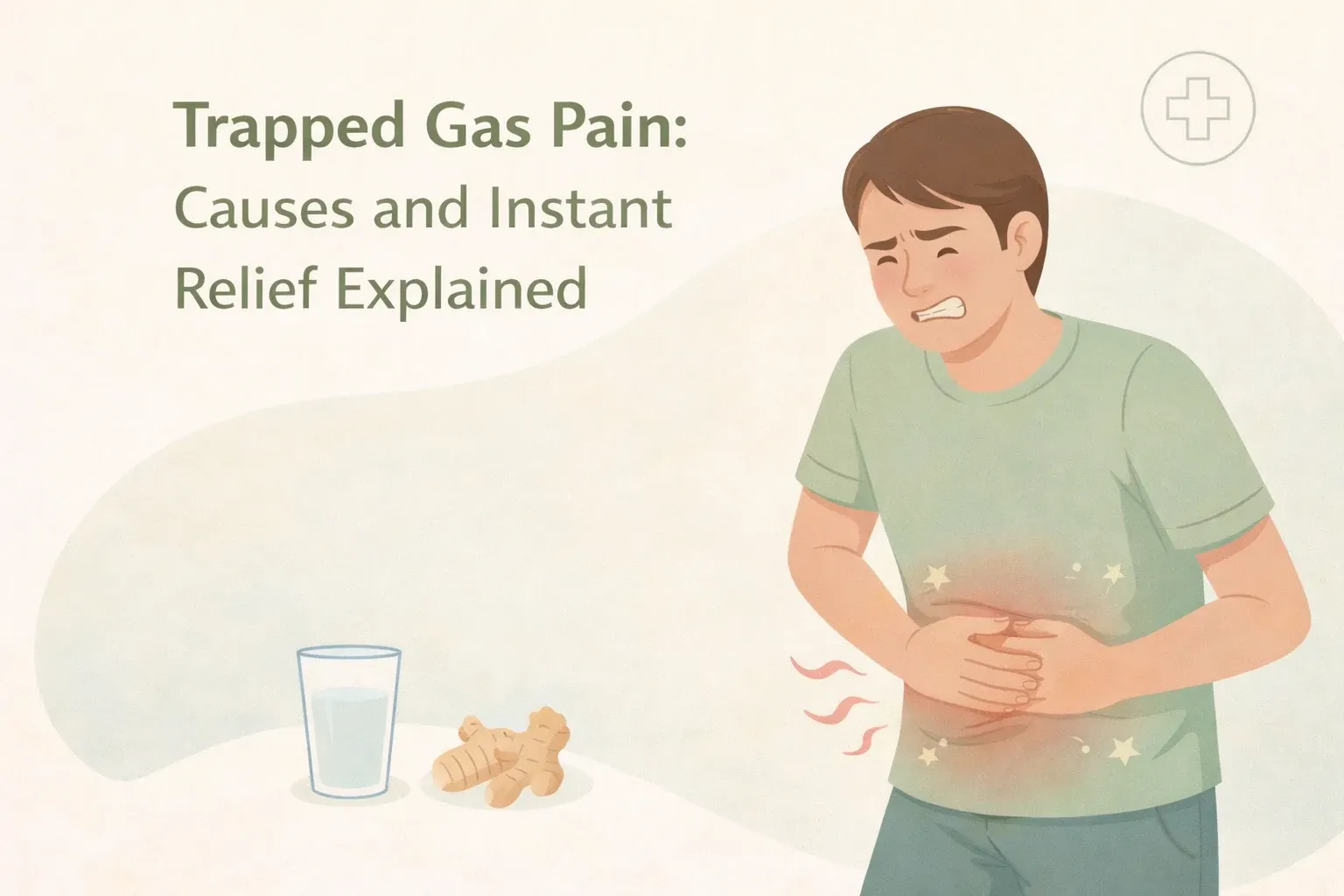
Quick Answer
Trapped gas pain happens when gas builds up in the stomach or intestines and cannot move out easily. It may feel sharp, crampy, tight, shifting, or like pressure under the ribs, in the lower abdomen, back, or even chest.
Most mild episodes improve within 30 to 60 minutes with gentle walking, posture changes, warm compress, deep breathing, and passing gas or stool. However, daily trapped gas or pain with fever, vomiting, blood in stool, severe constant pain, chest pressure or no bowel movement for several days needs medical evaluation.
- Fastest relief: Walk slowly for 10 to 15 minutes
- Helpful support: Warm compress, knees-to-chest pose, upright sitting and deep breathing
- Common causes: Fast eating, constipation, food intolerance, slow motility, stress and gut bacteria imbalance
- Important warning: Gas pain should move or reduce after passing gas, walking or bowel movement
- Doctor needed: Severe constant pain, fever, blood, vomiting, chest pain, urinary symptoms or worsening pain
What Is Trapped Gas Pain?
Trapped gas pain is a digestive condition in which gas accumulates in the stomach or intestines and cannot pass naturally, causing cramping, abdominal bloating, and pressure that may feel sharp or dull, fixed or moving.
Key facts at a glance:
- Most episodes are caused by swallowed air, fermentation of undigested food, or gut bacteria imbalance
- Pain can appear in the upper abdomen, lower abdomen, one side, under the ribs, or radiate to the back
- Walking for 10-15 minutes is the single most effective method for immediate relief
- Warmth therapy on the abdomen relaxes intestinal muscle within 15-20 minutes
- Chronic or daily trapped gas signals a root cause that needs a more holistic approach
Trapped gas is not a sign that something is seriously wrong, but that does not make it any less real or uncomfortable. Understanding the causes of gas and bloating is the foundation of both immediate and long-term relief.
Why Does Trapped Gas Hurt? The Biology Behind the Pressure
Trapped gas hurts because the gut wall has the same stretch-sensitive pain receptors as any other organ, and the colon is not built to accommodate large pockets of stationary gas.
When a gas bubble stalls at one of the colon's natural bends, the intestinal wall distends to hold it. This distension activates mechanoreceptors, pressure-sensitive nerve endings embedded in the gut lining. These receptors send pain signals via the vagus nerve to the brain, which registers the sensation as sharp, cramping, or radiating pain depending on the speed and degree of distension.
Three factors amplify trapped gas pain specifically:
- Location at a flexure: Gas trapped at the hepatic or splenic flexure cannot move freely in either direction, so the pressure has nowhere to decompress
- Intestinal hypersensitivity: People with IBS or chronic gut inflammation have a lower pain threshold for the same degree of distension, the same amount of gas that causes mild discomfort in one person causes significant pain in another
- Spasm: When the gut wall is already irritated from stress, inflammation, or a food intolerance, smooth muscle can go into spasm around a gas pocket, dramatically increasing perceived pain
Key fact: Trapped gas pain is a distension signal, not a damage signal. The gut wall is stretching, not tearing. This is why the pain can disappear within minutes once the gas moves, something that does not happen with appendicitis or kidney stones.
How Does Trapped Gas Form? The Step-by-Step Mechanism
Trapped gas forms through a predictable sequence of events that begins every time you eat or drink.
- Air enters the digestive tract. Every time you eat, drink, or talk, you swallow small amounts of air. Faster eating, carbonated drinks, and chewing gum dramatically increase this intake.
- Bacteria in the large intestine ferment undigested food. Carbohydrates, especially fibrous vegetables, beans, and dairy products, that the small intestine cannot fully digest pass into the large intestine. Gut bacteria break them down through fermentation, releasing hydrogen, carbon dioxide, and sometimes methane as by-products. This is the primary source of intestinal gas. Healthy adults produce between 500-2,000 ml of intestinal gas per day through this process.
- Gas accumulates faster than it moves. Normally, gas moves through the colon in a steady wave and exits as flatulence or is partially absorbed into the bloodstream. When gut motility slows, because of constipation, stress, or food intolerances, gas builds up behind slow-moving stool.
- Gas reaches a flexure and stalls. The colon has natural bends where gas pools more easily. A gas bubble reaching one of these bends and failing to pass leads to localised pain.
- The pain signal fires. The gut wall stretches to accommodate accumulated gas. This stretching activates pain receptors, which send signals to the brain interpreted as cramping, pressure, or sharp pain depending on the speed and degree of distension.
The key insight: trapped gas pain is the result of the gut's movement (motility) falling out of sync with gas production, not a sign of tissue damage. This is why movement, warmth, and posture changes work so quickly.
Where Does Trapped Gas Pain Occur? A Location-by-Location Guide
Gas does not stay in one place. It moves through the digestive tract and can get stuck at different points, each producing a distinct pattern of pain.
| Pain Location | What It Feels Like | Common Cause |
|---|---|---|
| Upper abdomen | Heaviness, fullness, burping | Swallowed air, slow stomach emptying |
| Lower abdomen | Cramps in waves | Constipation, food fermentation |
| One side, left under rib | Sharp, stabbing, radiates to shoulder | Gas at splenic flexure |
| One side, right lower | Ache, tender to touch | Gas at hepatic flexure |
| Back | Dull, shifting ache | Large intestine gas pressure |
| Chest | Tightness, feels like a heart issue | Gas pushing up through diaphragm |
Trapped gas on one side is entirely possible when all the pressure pools at one of the colon's two main bends, the hepatic flexure on the right and the splenic flexure on the left. Right-side gas pain can mimic appendicitis. Left-side gas pain near the splenic flexure can mimic heart pain. Neither means something is wrong with the heart or appendix, but persistent one-sided pain warrants medical evaluation.
Trapped gas under the ribs at the splenic flexure produces a tight, stabbing sensation under the lower left rib that can radiate to the left shoulder. Lying on the left side often worsens it; moving and gentle walking help release it.
Trapped gas pain in the back occurs when gas pressure in the large intestine radiates to the lower back, producing a dull ache often mistaken for a muscular problem or kidney discomfort. The key distinction: back pain from gas shifts and changes when you move, pass gas, or have a bowel movement. Kidney-related or muscular back pain is generally more fixed in location.
What Are the Main Causes of Trapped Gas Pain?
Trapped gas pain typically arises from one or more of the following causes:
- Swallowing excess air: Eating too fast, talking while eating, drinking through straws, chewing gum, or smoking cause air to collect in the stomach and lead to pressure and discomfort
- Poor digestion and enzyme imbalance: If food is not broken down properly, it ferments in the gut, producing gas. Low stomach acid, enzyme deficiency, or irregular eating timings worsen this
- Gut microbiome imbalance: When gut bacteria balance is disturbed by stress, infections, antibiotics, or poor diet, gas-producing bacteria increase, leading to more bloating and trapped gas pain
- Constipation and slow bowel movement: When stools move slowly, gas gets trapped behind them. People with chronic constipation often find that gas pain relief is temporary unless bowel habits improve
- Food intolerances: Mild lactose intolerance or sensitivity to certain carbohydrates (FODMAP foods) can cause gas to accumulate in the stomach and intestines
- Stress and lifestyle: Skipping meals, eating late at night, sitting for long hours, and chronic stress disturb digestion, gut bacteria, and overall gut function together
What Are the Symptoms of Trapped Gas Pain?
Trapped gas produces a recognisable cluster of symptoms that tend to shift with body position and digestive activity.
| Symptom | What It May Feel Like |
|---|---|
| Abdominal bloating | Tight, swollen belly |
| Sharp or crampy pain | Comes and goes, shifts location |
| Chest discomfort | Often mistaken for heart issues |
| Excess burping | Especially after meals |
| Feeling full quickly | Even with small portions |
| Lower back ache | Dull pressure that shifts with bowel activity |
Shifting, posture-responsive symptoms are the clearest signal that gas, and not a more serious condition, is the cause. If pain is severe, persistent, or associated with fever, vomiting, or weight loss, medical evaluation is important.
How to Get Instant Relief from Trapped Gas Pain at Home
The fastest gas pain relief comes from physical methods that restart gut motility. Most people feel meaningful relief within 15 to 45 minutes when combining movement, warmth, and posture. According to Mool Health's gut health team, the following methods are the most consistently effective. For people who get gas after meals, walking after meals can also support digestion and help gas move naturally.
1. Gentle Movement and Posture
Lying still allows gas to pool at intestinal bends. Movement triggers peristalsis, the wave-like muscular contractions that push gut contents forward.
- Walk slowly for 10-15 minutes (most effective single method)
- Bring knees to chest while lying on your back, this compresses the lower colon and dislodges trapped gas
- Sit upright instead of slouching, slouching compresses the ascending colon and slows gas transit
- Lie on your left side for right-side or under-rib gas trapped at the splenic flexure
Most people notice gurgling and the urge to pass gas within 10 to 20 minutes of walking.
2. Warmth Therapy
Apply a warm water bag or heating pad to the abdomen for 15 to 20 minutes. This relaxes the smooth muscle of the intestinal wall, reduces the spasm that often holds gas in place, and allows it to move. A 2006 study in The Lancet confirmed that topical heat at 40°C activates heat-sensitive receptors in the gut wall, blocking pain signals in a mechanism similar to opioid receptors, this is neurological pain modulation, not just comfort. Warmth therapy is particularly effective for crampy, one-sided gas pain at the colon flexures.
3. Deep Breathing
Slow diaphragmatic breathing, breathing from the belly so that the abdomen rises rather than the chest, physically relaxes the gut wall and improves motility. Practice 5 to 8 deep belly breaths, then walk for 5 minutes. This combination typically reduces pain within 15 to 30 minutes.
4. Helpful Foods and Drinks for Immediate Relief
| Helpful Option | How It Helps |
|---|---|
| Warm water | Stimulates gut movement and gastrocolic reflex |
| Jeera (cumin) water | Stimulates digestive enzyme secretion; reduces bloating |
| Saunf (fennel) | Anethole compound relaxes intestinal smooth muscle |
| Ginger | Accelerates gastric emptying; reduces fermentation time |
| Ajwain (carom seeds) | Thymol acts as a natural antispasmodic |
Avoid ice-cold drinks, carbonated beverages, and heavy fried foods when gas pain is active.
How to Get Rid of Trapped Gas in Your Back: Step-by-Step
Back pain from trapped gas responds best to a combination of position change and movement. Follow these steps in order:
- Lie flat on your back on a firm surface. Bring both knees to your chest and hold for 30 seconds. This compresses the descending colon and nudges gas toward the rectum.
- Rock your knees gently side to side. Ten to fifteen slow rocks massage the large intestine and break up stubborn gas pockets. Most people feel gurgling within 2-3 minutes.
- Switch to child's pose. Kneel on the floor, sit back on your heels, and extend your arms forward with your forehead on the floor. Hold for 60 seconds. This position uses gravity to shift gas from the transverse colon toward the descending colon.
- Stand and walk slowly for 5-10 minutes. Gravity and peristalsis work together. A slow walk is more effective than lying still even after the stretches.
- Apply a warm compress to the lower back and abdomen simultaneously if the ache persists. The heat relaxes the smooth muscle of the colon wall, reducing the spasm that keeps gas in place.
If back pain is still present after completing these steps and passing gas, and particularly if the pain is localised, constant rather than shifting, or associated with urinary symptoms, it may not be gas. See the differential diagnosis section below.
How Long Does Trapped Gas Pain Last? Timeline and What to Expect
The duration of trapped gas pain depends on the underlying cause.
| Type of Episode | Typical Duration | Key Sign It Is Improving |
|---|---|---|
| Acute gas after a meal | 20-60 minutes | Audible gut sounds, urge to pass gas |
| Gas from constipation | Hours to 1-2 days | Improves significantly after bowel movement |
| Gas from food intolerance | 2-4 hours after offending food | Reduces with fasting and water intake |
| Gas during high-stress period | Recurs daily until stress resolves | Linked to mood and meal timing |
| Chronic or daily trapped gas | Weeks, with flare-ups | Needs gut health evaluation |
When trapped gas pain returns daily or lasts more than 3 to 5 days, it usually points to an underlying pattern: chronic constipation, food intolerance, gut microbiome imbalance, or irritable bowel syndrome. Understanding what drives the specific pattern is the most durable approach.
Trapped Gas vs. Other Conditions: When to Stop Assuming It Is Just Gas
Not every abdominal pain episode is trapped gas. This comparison table helps distinguish trapped gas from conditions that require different management.
| Condition | Typical Location | Character of Pain | Key Distinguishing Feature |
|---|---|---|---|
| Trapped gas | Upper, lower, or one-side abdomen; back | Shifting, crampy, comes and goes | Improves with movement, passing gas, or bowel movement |
| Appendicitis | Starts near belly button, moves to lower right | Steady, worsening over hours | Does NOT improve with gas passage; fever, nausea |
| Heart attack | Chest, left arm, jaw | Pressure, squeezing; may feel like indigestion | Does not change with posture; shortness of breath, sweating |
| IBS | Lower abdomen, variable | Chronic, recurrent, linked to bowel habits | Long pattern history; linked to stress and food |
| Kidney stones | Flank, back, lower abdomen | Severe, comes in waves, radiates to groin | Often associated with urinary symptoms |
| Gastritis / ulcer | Upper middle abdomen | Burning, gnawing; worsened by food or fasting | Consistent upper-belly burning across meals |
Safe to manage at home if: pain moves or changes location when you shift position, reduces after passing gas or having a bowel movement, is not associated with fever, vomiting, or visible blood in stools, and has a clear dietary or lifestyle trigger.
Seek medical attention immediately if:
- Pain is severe and constant (not shifting or crampy)
- It worsens progressively over 2-3 hours without any relief
- You have fever above 38°C alongside abdominal pain
- You see blood in vomit or stools
- You have had no bowel movement for 3 or more days alongside worsening pain
- The pain radiates to your left arm, jaw, or chest with shortness of breath
Relief Methods Compared: Home Remedies vs OTC Options
Different trapped gas relief methods work in different ways. Movement and posture help gas physically move. Heat relaxes intestinal muscle. Some OTC options may help acute gas bubbles, but they do not fix repeated gas if constipation, intolerance or gut imbalance is the real driver.
| Approach | How It Helps | Best For | Limitation |
|---|---|---|---|
| Walking and posture change | Restarts gut motility | Acute post-meal trapped gas | Needs movement and space |
| Warm compress | Relaxes intestinal spasm | Crampy one-sided gas pain | Does not fix the gas source |
| Deep breathing | Calms gut tension and stress response | Stress-linked gas discomfort | Works best with walking or posture change |
| Simethicone | Breaks large gas bubbles into smaller ones | Occasional gas bloating after heavy meals | Does not address constipation or food intolerance |
| Food trigger tracking | Identifies repeat gas triggers | Chronic or daily trapped gas | Needs consistency for 1 to 2 weeks |
Mool Health’s Perspective on Trapped Gas Pain
Mool Health looks at trapped gas pain as a movement and fermentation problem, not just a one-time gas issue. Quick relief matters, but repeated trapped gas often needs a deeper look at constipation, food intolerance, stress, meal timing and overall gut health.
If gas pain keeps returning daily, track your meals, bowel movements, stress levels, trigger foods and symptom timing for at least 1 to 2 weeks. This helps identify whether the problem is linked to slow motility, lactose sensitivity, IBS-like patterns or broader digestion problems.
Key Takeaways
Trapped gas pain can feel sharp, crampy or shifting. This guide explains causes, pain locations, instant relief steps and warning signs.
Your gut is unique your healing should be too.

Disclaimer
The content provided by Mool Health is for educational and informational purposes only and should not be considered a substitute for professional medical advice, diagnosis, or treatment.