
Food Digestion Time Chart: How Long Common Foods Take
A practical digestion time chart that helps you understand why some foods feel light, why some feel heavy, and how timing, oil and cooking method affect digestion.
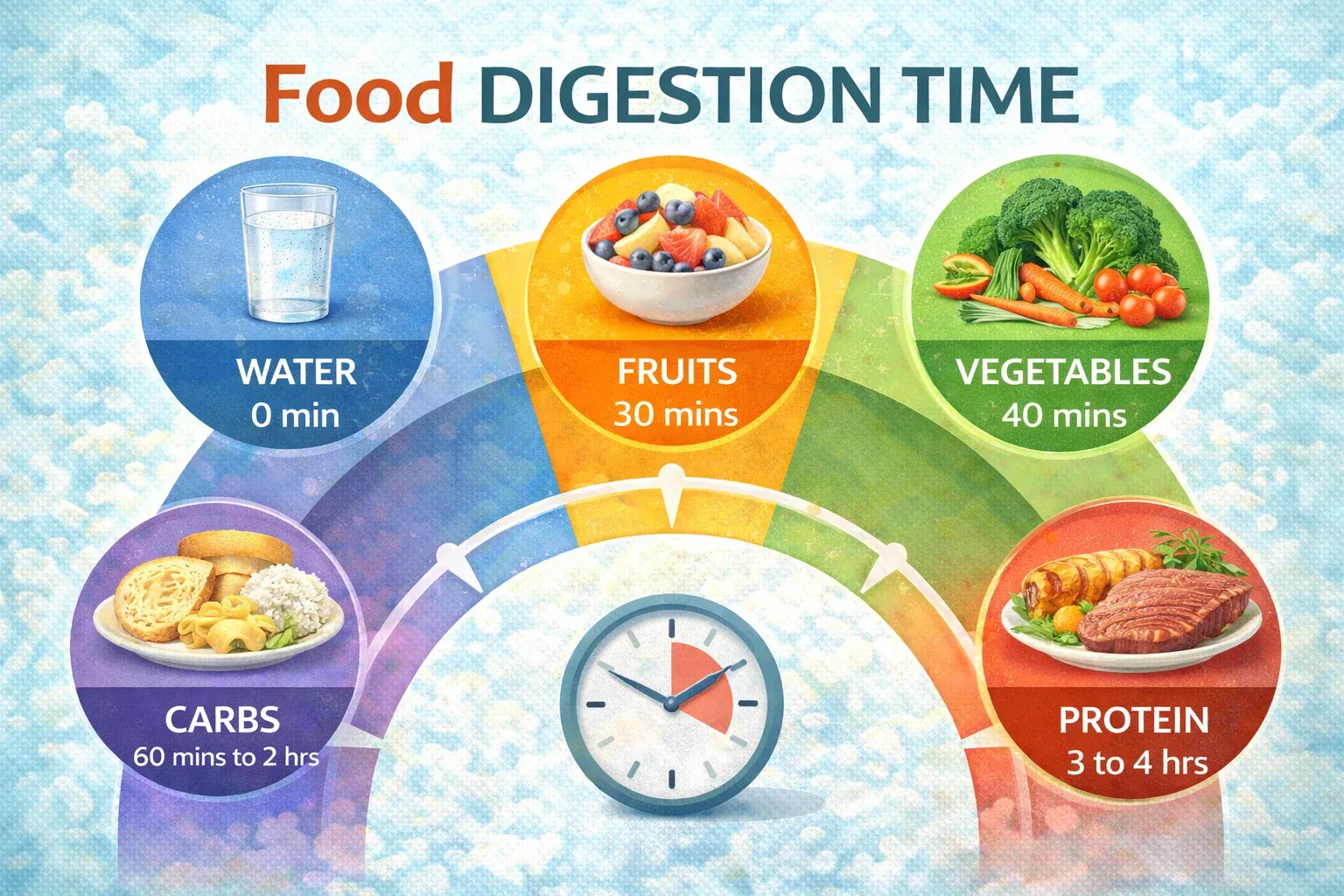
Quick Answer
Food digestion time varies by water content, fibre, protein density, fat content, portion size and cooking method. Light foods like water, fruits, rice and idli usually empty from the stomach faster, while fried food, pizza, burgers, mutton and biryani take longer and may feel heavier.
- •Fast foods usually include water, watery fruits, white rice, idli and some light proteins.
- •Moderate foods include dal, roti, milk, chicken and paneer depending on preparation.
- •Slow foods include fried snacks, oily curries, pizza, burgers and red meat.
- •Digestion time is an estimate, not a fixed clock. Your gut health, stress, sleep, constipation and meal timing change the experience.
A food digestion time chart helps you understand why some meals feel light while others sit heavy for hours. It is especially useful if you plan meals around work, workouts, sleep, acidity, bloating or constipation.
The same food can digest differently based on cooking method. Plain rice feels lighter than biryani rice, boiled egg feels lighter than fried egg, and grilled chicken feels lighter than chicken curry.
What Is a Food Digestion Time Chart?
A food digestion time chart groups foods by how quickly they usually leave the stomach and move into the small intestine. This is often called stomach emptying time. Full gut transit, from eating to stool elimination, takes much longer and varies from person to person.
For broader basics, read Mool Health’s guide on how to improve digestion.
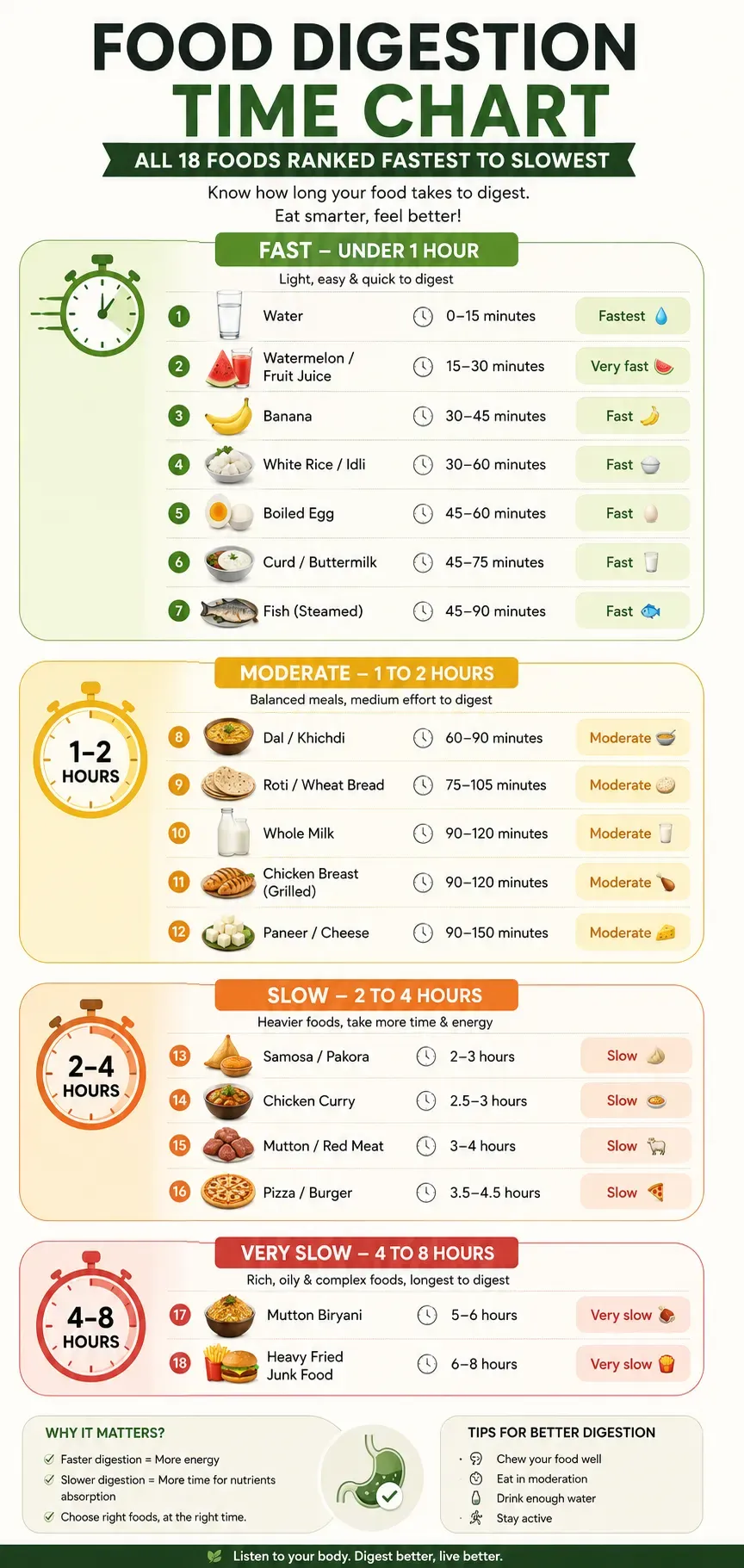
Food Digestion Time Chart: Fastest to Slowest
Use this chart as a practical estimate for healthy adults. Individual digestion can be faster or slower depending on gut health, portion size, stress, sleep and activity.
| Speed Zone | Foods | Approximate Stomach Time | What It Means |
|---|---|---|---|
| Very fast | Water, watery fruits, fruit juice | 0 to 30 minutes | Usually leaves the stomach quickly |
| Fast | Banana, white rice, idli, boiled egg, curd, steamed fish | 30 to 90 minutes | Light and easier for many people |
| Moderate | Dal, khichdi, roti, whole milk, grilled chicken, paneer | 1 to 2.5 hours | Balanced meals with protein or fibre |
| Slow | Samosa, pakora, chicken curry, mutton, pizza, burger | 2 to 4.5 hours | Higher fat, protein density or oil |
| Very slow | Mutton biryani, heavy fried junk food, large oily meals | 4 to 8 hours | Large, fatty and mixed meals that feel heavy |
Detailed Food Digestion Time Chart
| Food | Approximate Stomach Time | Speed | Why It Digests This Way |
|---|---|---|---|
| Water | 0 to 15 minutes | Very fast | No solid digestion needed |
| Watermelon or watery fruits | 15 to 30 minutes | Very fast | High water content |
| Banana | 30 to 45 minutes | Fast | Soft texture and easy carbohydrates |
| White rice or plain idli | 30 to 60 minutes | Fast | Low fat and simple starch |
| Boiled egg | 45 to 60 minutes | Fast | Cooked protein in a simple form |
| Curd or buttermilk | 45 to 75 minutes | Fast to moderate | Fermented dairy, but tolerance varies |
| Steamed fish | 45 to 90 minutes | Fast to moderate | Soft animal protein |
| Dal or khichdi | 60 to 90 minutes | Moderate | Protein plus fibre |
| Roti or wheat bread | 75 to 105 minutes | Moderate | Whole wheat fibre slows digestion |
| Whole milk | 90 to 120 minutes | Moderate | Protein, lactose and fat |
| Grilled chicken breast | 90 to 120 minutes | Moderate | Lean protein |
| Paneer | 90 to 150 minutes | Moderate | Protein plus dairy fat |
| Samosa or pakora | 2 to 3 hours | Slow | Fried dough and oil |
| Chicken curry | 2.5 to 3 hours | Slow | Protein plus oil and spices |
| Mutton or red meat | 3 to 4 hours | Slow | Dense protein and connective tissue |
| Pizza or burger | 3.5 to 4.5 hours | Slow | Fat, refined carbs and protein together |
| Mutton biryani | 5 to 6 hours | Very slow | Red meat, rice, oil, spices and portion size |
| Heavy fried junk food | 6 to 8 hours | Very slow | High fat and large meal load |
Stomach digestion estimates for healthy adults. Full gut transit adds 12–72 hours depending on food and individual gut health.
Why Do Digestion Times Differ So Much?
1. Fat Slows the Stomach
Fat is one of the biggest reasons meals feel heavy. A boiled egg is usually lighter than a fried egg, plain roti is lighter than paratha, and grilled chicken is lighter than chicken curry because added oil and fat slow stomach emptying.
2. Dense Protein Takes More Work
Protein-rich foods need stomach acid and enzymes to break them down. Soft fish usually feels lighter than red meat, while mutton and beef feel heavier because of dense fibres and connective tissue.
3. Fibre and Food Structure Matter
Whole grains, vegetables, dals and legumes contain fibre. Fibre is helpful for bowel health, but it can slow stomach emptying and cause gas in sensitive people if portions are large or food is not cooked well.
4. Cooking Method Changes Everything
Pressure cooking, boiling and steaming usually make food easier to tolerate. Frying, heavy gravies, cream, excess ghee and late-night large meals usually make digestion feel slower.
Full Digestive Tract Time: Eating to Elimination
Stomach emptying is only the first part of digestion. Full gut transit includes the mouth, stomach, small intestine and large intestine.
| Digestive Stage | Approximate Time | What Happens |
|---|---|---|
| Mouth | 1 to 3 minutes | Chewing and saliva begin digestion |
| Oesophagus | A few seconds | Food moves to the stomach |
| Stomach | 30 minutes to 8 hours | Food mixes with acid and enzymes |
| Small intestine | 2 to 6 hours | Most nutrient absorption happens here |
| Large intestine | 10 to 59 hours or more | Water is absorbed and stool forms |
| Full transit | Around 24 to 72 hours | Varies by food, fibre, hydration and gut motility |
Digestion Time by Food Category
Mutton Digestion Time
Mutton is usually one of the heavier everyday proteins because it is dense and often cooked with oil, spices and gravy. For a full breakdown, read Mool Health’s guide on mutton digestion time.
| Mutton Preparation | How Heavy It Feels | Better Tip |
|---|---|---|
| Pressure-cooked mutton | Moderate to heavy | Easier than tough, oily cuts |
| Mutton curry | Heavy | Use less oil and eat at lunch |
| Mutton biryani | Very heavy | Avoid late dinner portions |
| Mutton kebab | Moderate | Grilled is lighter than fried |
Chicken Digestion Time
Chicken is usually easier than mutton, especially when boiled or grilled. Preparation changes everything. Read more on chicken digestion time.
| Chicken Preparation | Approximate Stomach Time | Why |
|---|---|---|
| Boiled or grilled chicken breast | 90 to 120 minutes | Lean protein |
| Chicken curry | 2.5 to 3 hours | Oil and gravy slow digestion |
| Chicken biryani | 4 to 5 hours | Rice, oil, spices and protein together |
| Fried chicken | 3.5 to 4.5 hours | High fat and fried coating |
Egg Digestion Time
Boiled eggs are usually easier than fried eggs because they avoid extra oil. For a dedicated guide, see egg digestion time.
| Egg Preparation | Approximate Stomach Time | Best Use |
|---|---|---|
| Boiled egg | 45 to 60 minutes | Simple protein |
| Poached egg | 45 to 60 minutes | Light preparation |
| Omelette | 75 to 90 minutes | Oil and fillings slow it |
| Fried egg | 90 to 120 minutes | Higher fat load |
Rice, Idli and Roti Digestion Time
Plain rice and idli usually digest faster than roti, paratha or fried rice because they are lower in fat and easier on the stomach. Read Mool Health’s guide on rice digestion time for more detail.
| Food | Approximate Stomach Time | Note |
|---|---|---|
| Plain white rice | 30 to 60 minutes | Fast and low fat |
| Plain idli | 30 to 60 minutes | Steamed and fermented |
| Dal rice | 60 to 90 minutes | Protein and fibre from dal |
| Plain roti | 75 to 105 minutes | Whole wheat fibre slows it |
| Paratha | 2 to 3 hours | Oil and stuffing add heaviness |
Milk and Paneer Digestion Time
Milk and paneer can feel moderate or heavy depending on lactose tolerance and fat content. Compare with Mool Health’s guides on milk digestion time and paneer digestion time.
- •Milk: may feel light for some people but can cause bloating if lactose intolerance is present.
- •Curd and buttermilk: may feel easier than milk for some people, but dairy sensitivity still matters.
- •Paneer: protein plus dairy fat makes it slower than curd or buttermilk.
- •Cheese-heavy meals: often feel heavier due to higher fat.
Fruit Digestion Time
Fruits with high water content usually move faster through the stomach. Banana is soft and often easy for many people, but portion and ripeness matter. Read more on banana digestion time.
| Fruit Type | Approximate Stomach Time | Note |
|---|---|---|
| Watermelon | 15 to 30 minutes | Very high water content |
| Banana | 30 to 45 minutes | Soft and easy for many people |
| Apple | 45 to 60 minutes | More fibre |
| Fruit juice | 15 to 30 minutes | Fast, but high sugar load if overused |
Fast Food Digestion Time
Pizza, burgers, fries and fried snacks usually feel heavy because they combine refined carbohydrates, fat, salt, cheese, sauces and large portions.
- •Pizza: cheese, refined flour and oil slow digestion.
- •Burger: bun, patty, sauce and cheese create a mixed heavy meal.
- •Fries: deep-fried starch is harder than boiled or steamed potato.
- •Combo meals: large portions plus carbonated drinks often worsen bloating.
How to Use This Chart for Better Digestion
- Eat slower-digesting foods earlier in the day when possible.
- Keep heavy meals at least 3 to 4 hours before bedtime.
- Choose pressure-cooked, steamed, boiled or grilled foods more often than fried foods.
- Reduce oil, ghee, cheese and cream if heaviness is common.
- Walk for 10 to 15 minutes after large meals.
- Do not judge digestion by time alone. Track bloating, acidity, stool pattern and energy too.
What to Drink After Heavy Meals
Warm water, jeera water, fennel tea or ginger tea may suit some people after heavy meals, but the right drink depends on acidity, gas and tolerance. For details, read Mool Health’s guide on what to drink after a meal.
- •For general heaviness: warm water in small sips.
- •For gas: jeera water or fennel tea if it suits you.
- •For oily meals: ginger tea may help some people, but avoid if it worsens acidity.
- •Avoid: cold soft drinks, alcohol and large liquid volumes after heavy meals.
When Slow Digestion Needs Attention
If food repeatedly feels stuck, bloating is daily, or bowel movement is irregular, it may be more than normal digestion time. Check Mool Health’s guide on slow digestion symptoms.
- •Persistent bloating after most meals
- •New constipation or diarrhoea
- •Repeated vomiting
- •Blood in stool or black stool
- •Unexplained weight loss
- •Severe abdominal pain
- •Difficulty swallowing
- •Symptoms that worsen despite lighter meals
Mool Health’s Perspective on Food Digestion Time
At Mool Health, digestion time is not treated like a rigid clock. The same chart can look different for two people depending on gut health, stress, sleep, hydration, acidity, bowel habits and food tolerance.
Mool Health’s Free Gut Test helps you review your symptom pattern, food triggers and bowel habits so you can understand why certain foods feel heavy for you.
Do Some Foods Always Feel Heavy?
A digestion chart can guide you, but recurring heaviness, bloating or acidity needs a closer look at your gut pattern. Take Mool Health’s free gut test to understand your triggers.
Medical Disclaimer
This content is for informational purposes only and does not replace professional medical advice, diagnosis or treatment. Food digestion times are estimates and can vary by age, health condition, medicines, pregnancy, gut disorders and individual tolerance. If you have severe abdominal pain, repeated vomiting, blood in stool, black stool, unexplained weight loss, difficulty swallowing, dehydration, persistent diarrhoea or symptoms that are worsening, consult a qualified healthcare professional.
Key Takeaways
- •Food digestion time depends on fat, protein, fibre, cooking method and portion size.
- •Water, fruits, white rice, idli and steamed fish are usually faster.
- •Paneer, milk, roti, dal and chicken are usually moderate.
- •Fried foods, mutton, pizza, burgers and biryani usually feel slower and heavier.
- •Heavy meals are usually better at lunch than late at night.
- •Persistent or painful symptoms need medical advice.
Your gut is unique your healing should be too.

Disclaimer
The content provided by Mool Health is for educational and informational purposes only and should not be considered a substitute for professional medical advice, diagnosis, or treatment.