
Banana Digestion Time: How Long It Takes and Best Time to Eat
Banana Digestion time depends on ripeness and food combinations. Ripe bananas usually digest in 2–3 hours, while unripe bananas and milk-based shakes take longer.
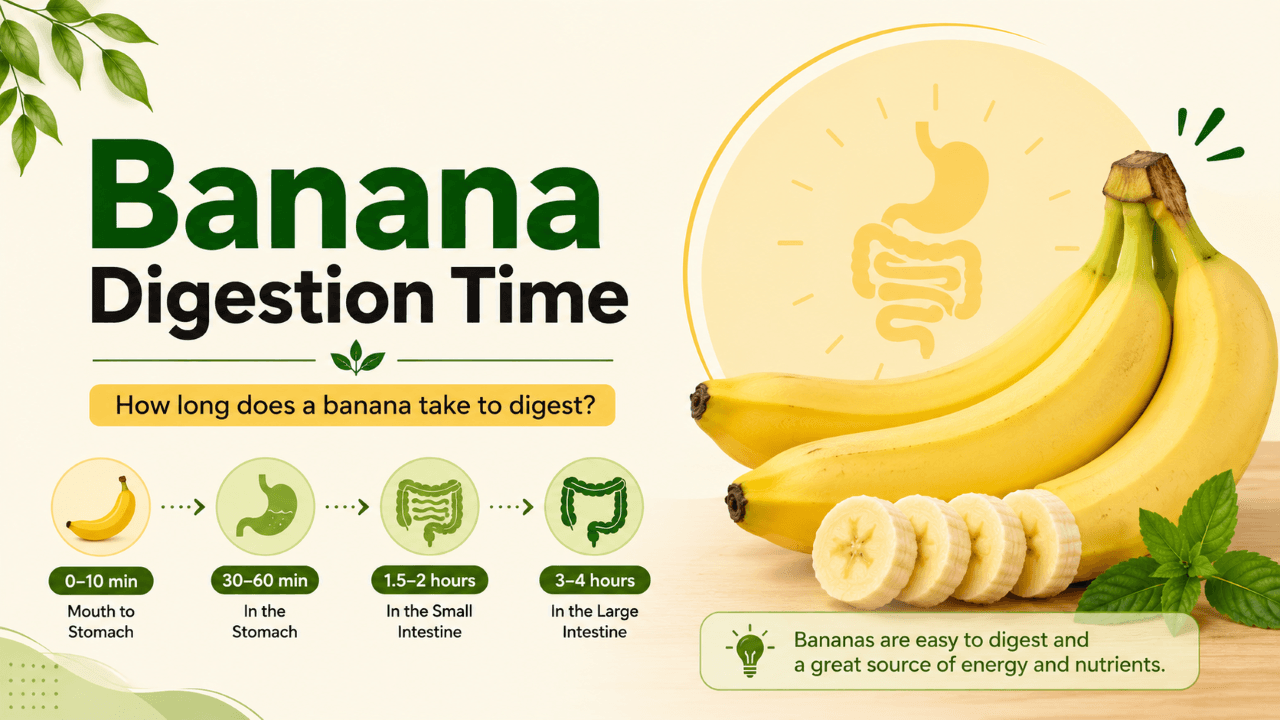
Quick Answer
Banana digestion time depends mainly on ripeness. A ripe banana takes about 45-60 minutes to leave the stomach and around 2-3 hours for full digestion and absorption. An unripe banana can take 3-4 hours, while a banana shake with milk may take 4-5 hours.
- Ripe yellow banana: 45-60 minutes in the stomach, 2-3 hours full digestion
- Overripe banana: 30-45 minutes in the stomach, 1.5-2 hours full digestion
- Unripe or green banana: 1.5-2 hours in the stomach, 3-4 hours full digestion
- Banana shake with milk: 2-3 hours in the stomach, 4-5 hours full digestion
- Morning is the best time to eat banana for easier digestion
Bananas are one of the most common fruits in India, but their digestion time is often misunderstood. A ripe banana is usually easy on the gut, while an unripe banana, a banana shake, or banana eaten late at night may feel heavier.
Understanding banana digestion time helps you decide when to eat it, how much to eat, and which banana type works best for your gut. This is especially useful for people dealing with slow digestion, bloating, IBS, or post-illness gut recovery.
From a nutrition point of view, banana provides quick carbohydrates, soluble fibre, potassium, vitamin B6, and prebiotic starch. From an Ayurvedic point of view, banana is sweet, cooling, and heavy, so timing and food combinations matter.
How Long Does It Take to Digest a Banana?
A ripe banana takes 45-60 minutes to leave your stomach and around 2-3 hours for full digestion through the stomach and small intestine. An unripe banana takes longer because it contains resistant starch, which is harder for the body to break down.
The 2-3 hour figure refers to digestion and nutrient absorption. The remaining fibre moves through the large intestine over 24-72 hours as part of normal gut transit. That does not mean banana is sitting undigested in your stomach for days.
| Banana Type | Stomach Time | Full Digestion | Digestibility |
|---|---|---|---|
| Overripe banana with brown spots | 30-45 min | 1.5-2 hrs | Very easy |
| Ripe yellow banana | 45-60 min | 2-3 hrs | Easy |
| Red banana | 45-60 min | 2-2.5 hrs | Easy |
| Unripe or green banana | 1.5-2 hrs | 3-4 hrs | Moderate |
| Banana shake with milk | 2-3 hrs | 4-5 hrs | Slow |
For a wider comparison across foods, you can also check a food digestion time chart.
How Banana Is Digested: Stage by Stage
Banana digestion happens across the mouth, stomach, small intestine, and large intestine. The process is different for ripe and unripe bananas because ripening changes starch into simple sugars.
Stage 1: Mouth, 0-2 Minutes
Digestion starts in the mouth. When you chew a ripe banana, salivary amylase begins breaking down carbohydrates. This is why a ripe banana tastes sweeter the longer you chew it. Unripe banana contains more resistant starch, which does not break down meaningfully in the mouth.
Stage 2: Stomach, 45 Minutes to 2 Hours
The stomach churns banana into a semi-liquid form called chyme. A ripe banana has a soft texture, low fat, and moderate soluble fibre, so it usually leaves the stomach in 45-60 minutes. An unripe banana can stay for 1.5-2 hours because resistant starch needs more processing.
Stage 3: Small Intestine, 1-2 Hours
In the small intestine, enzymes finish breaking down banana carbohydrates. Glucose, fructose, and sucrose are absorbed into the bloodstream. Pectin, the soluble fibre in banana, slows absorption slightly and supports better blood sugar stability.
Stage 4: Large Intestine and Fermentation
Resistant starch and fibre enter the colon, where gut bacteria ferment them. This produces short-chain fatty acids such as butyrate, which support the gut lining. However, this fermentation can also create gas, especially with unripe bananas.
To understand digestion basics more clearly, read this guide on what is digestion.
Banana Digestion Time in the Stomach
Banana digestion time in the stomach is mostly about gastric emptying. This means how long the banana stays in your stomach before moving into the small intestine.
For a ripe banana eaten alone, stomach emptying usually takes 45-60 minutes. This is faster than many solid foods because ripe bananas are soft, low in fat, and easy to break down.
Why Ripe Bananas Digest Faster
- They are low in fat, so they do not strongly slow gastric emptying
- Their soft texture requires less stomach churning
- Their starch has mostly converted into simple sugars
- Their pectin forms a gentle gel that supports smoother digestion
Why Unripe Bananas Take Longer
Unripe bananas contain 70-80% resistant starch. Human enzymes cannot fully break down this starch in the stomach or small intestine. It moves to the colon, where gut bacteria ferment it. This is why green bananas may feel heavier and cause bloating in some people.
| Food Combination | Estimated Stomach Time |
|---|---|
| Ripe banana alone | 45-60 min |
| Banana with nuts or peanut butter | 1.5-2 hrs |
| Banana with curd or yoghurt | 1-1.5 hrs |
| Banana with whole milk | 2-3 hrs |
| Banana with oats | 1.5-2 hrs |
How Long Does It Take to Digest 2, 3, or 4 Bananas?
Eating more bananas increases digestion time, but not in a perfectly linear way. Your stomach and small intestine have a limited processing capacity. After a point, excess fructose and fibre can move into the colon and ferment.
| Quantity | Stomach Time | Full Digestion | Notes |
|---|---|---|---|
| 1 banana | 45-60 min | 2-3 hrs | Ideal for most adults |
| 2 bananas | 60-90 min | 2.5-3.5 hrs | Fine for active individuals |
| 3 bananas | 1.5-2 hrs | 3-4 hrs | May cause bloating in sensitive people |
| 4 or more bananas | 2-2.5 hrs | 4-5 hrs | Fructose overload is more likely |
For everyday snacking, 1 banana is enough for most people. Athletes or highly active individuals may tolerate 2 bananas better because their energy demand is higher.
How Ripeness Affects Banana Digestion Time
Ripeness is the biggest factor affecting banana digestion time. As a banana ripens, resistant starch turns into simpler sugars. This makes the banana softer, sweeter, and easier to digest.
- Green or unripe banana: High in resistant starch. Good for microbiome diversity but may cause gas and bloating.
- Ripe yellow banana: Balanced option for most people. Digests in 2-3 hours and is gentle on the gut.
- Overripe banana: Fastest to digest because most starch has converted to simple sugar. Useful during recovery but may not suit diabetics.
- Red banana: Similar digestion time to yellow banana, slightly denser and often considered easier on Pitta in Ayurveda.
Banana can be helpful in both loose stools and constipation, depending on ripeness, hydration, and overall diet. Read more about banana for diarrhea and banana for constipation.
Banana Digestion Time vs Other Fruits
Bananas are mid-speed digesters. They digest faster than apples and avocados, but slower than watery fruits like watermelon or papaya.
| Fruit | Stomach Time | Full Digestion | Key Reason |
|---|---|---|---|
| Watermelon | 20-30 min | 30-45 min | High water, low fibre |
| Papaya | 30-45 min | 45-60 min | Contains papain enzyme |
| Ripe banana | 45-60 min | 2-3 hrs | Pectin and moderate sugar |
| Mango | 45-60 min | 2-3 hrs | Similar sugar and fibre load |
| Apple | 60-90 min | 2.5-3 hrs | Higher insoluble fibre |
| Avocado | 2-3 hrs | 3-4 hrs | High fat content |
For quick energy, ripe banana works well. For very fast gastric clearance, watery fruits are faster. For sustained fullness, banana with oats, nuts, or seeds may work better.
Banana Shake and Red Banana Digestion Time
Banana Shake Digestion Time
Banana shake digestion time is around 4-5 hours when made with milk. This is much slower than a plain ripe banana because milk adds fat and protein, both of which slow gastric emptying.
Ayurveda also classifies banana with milk as Viruddha Ahara, meaning an incompatible food combination. In people with weak digestion, this combination may cause heaviness, mucus, bloating, or sluggishness.
Red Banana Digestion Time
Red banana digestion time is similar to ripe yellow banana. It takes about 45-60 minutes in the stomach and 2-2.5 hours for full digestion. It is slightly denser but not significantly slower when ripe.
Red banana is often considered suitable for children, elderly people, and people with acid reflux, depending on tolerance.
Factors That Affect Your Personal Banana Digestion Time
Reference timelines are averages. Your actual digestion time may be faster or slower depending on your gut condition, food combinations, and lifestyle.
- Gut motility: Slow motility extends digestion time, while fast motility may move food too quickly.
- Stomach acid levels: Adequate stomach acid supports efficient digestion.
- Food combinations: Banana alone is faster, banana with milk, nuts, or heavy meals is slower.
- Meal size: A banana eaten as a snack digests faster than banana added after a heavy meal.
- Stress levels: Chronic stress can slow digestion through the gut-brain axis.
- Age: Older adults may digest food more slowly due to reduced enzyme output.
- Gut microbiome: A diverse microbiome handles pectin and resistant starch better.
If banana consistently causes bloating or discomfort, it may be worth checking for IBS symptoms or broader gut imbalance.
Ayurvedic Perspective on Banana Digestion
Ayurveda classifies banana as sweet, cooling, and heavy. It can reduce Pitta and Vata when eaten correctly, but may increase Kapha when eaten at night, in excess, or with incompatible foods.
Ayurvedic Rules for Banana Consumption
- Eat ripe banana rather than green banana if your digestion is weak
- Avoid banana with milk because it is considered Viruddha Ahara
- Avoid banana late at night because digestive fire is lower
- Limit banana if you have sluggish digestion, mucus, or congestion
- Use cardamom or honey with banana in moderation to support digestibility
Best Time to Eat Banana for Digestion
The best time to eat banana for digestion is morning or mid-morning, when your digestive system is active. Banana before workout can also be useful because it provides quick carbohydrates and potassium.
| Time | Digestive Suitability | Reason |
|---|---|---|
| 7am-10am | Best | Digestive fire is active and banana gives quick energy |
| 10am-12pm | Good | Useful for banana shake or snack |
| 30-45 min before exercise | Good | Gives quick carbs without heaviness |
| 12pm-4pm | Acceptable | Works as a light snack if digestion is strong |
| After 7pm | Avoid | May cause heaviness, bloating, or mucus formation |
For broader daily habits, see this guide on how to improve digestion.
Banana's Gut-Friendly Nutrients
Banana is more than a quick-energy fruit. When eaten correctly, it supports gut function through soluble fibre, resistant starch, potassium, magnesium, and vitamin B6.
- Pectin: Soluble fibre that helps bind loose stools and supports good gut bacteria.
- Resistant starch: Found more in unripe banana. It acts as a prebiotic but may cause gas.
- Potassium: Helps replace electrolytes lost during diarrhea or vomiting.
- Vitamin B6: Supports nervous system function and gut motility.
- Magnesium: Supports smooth muscle relaxation in the gut wall.
This is one reason banana is commonly included in a diarrhea relief diet.
What the Research Says
Research supports the idea that banana digestion changes with ripeness, fibre content, and resistant starch levels.
- Resistant starch: Unripe banana resistant starch ferments in the colon and produces short-chain fatty acids that support colon lining health.
- Pectin: Banana pectin can slow gastric emptying slightly, which supports steadier energy release.
- IBS and FODMAPs: Ripe banana is generally low FODMAP at normal serving size, while unripe banana can trigger symptoms in sensitive people.
- Diarrhea recovery: Banana has been studied for reducing stool frequency and supporting recovery in acute diarrhea.
- Glycaemic index: Banana glycaemic impact rises as it ripens and resistant starch converts into sugar.
Banana Digestion Time for Specific Groups
Athletes and Active Individuals
Ripe banana works well before exercise. Its 45-60 minute stomach digestion time gives energy without creating the heaviness that comes from protein or fat-heavy foods.
People with IBS or Bloating
Fully ripe banana is usually better tolerated than unripe banana. People with IBS should avoid green bananas, banana shakes with milk, and large portions.
Diabetics and Blood Sugar-Conscious Individuals
Just-ripe bananas have a lower glycaemic impact than overripe bananas. Pairing a small banana with nuts or a boiled egg may slow sugar absorption.
Children and Elderly People
Ripe or mashed banana is usually easier to digest for children and older adults. Overripe banana may be easiest after illness, but portion size should stay moderate.
What This Means for You
For most people, 1 ripe banana eaten in the morning digests cleanly in 2-3 hours. If banana causes bloating, heaviness, or slow digestion, the issue is usually one of three things: unripe banana, banana with milk, or banana eaten late at night.
Your next steps:
- Choose ripe yellow banana with no green tips for easier digestion.
- Eat banana in the morning, mid-morning, or before workout.
- Avoid banana after 7pm if you often feel bloated at night.
- Replace milk-based banana shakes with oat or almond milk if shakes feel heavy.
- If bloating continues even with ripe banana, check whether food combinations are the real trigger.
If you have tried these changes and still feel recurring bloating, slow digestion, or gut discomfort after bananas, the issue may not be the banana itself. It may be your gut bacteria balance, stomach acid levels, or gut motility. A Free Gut Test can help you understand what may be driving the problem.
Disclaimer
This article is for informational and educational purposes only. It does not replace medical advice. If you have persistent digestive symptoms, severe bloating, unexplained weight loss, blood in stool, or ongoing diarrhea or constipation, consult a qualified healthcare professional.
Key Takeaways
Banana Digestion time depends on ripeness and food combinations. Ripe bananas usually digest in 2–3 hours, while unripe bananas and milk-based shakes take longer.
Your gut is unique your healing should be too.

Disclaimer
The content provided by Mool Health is for educational and informational purposes only and should not be considered a substitute for professional medical advice, diagnosis, or treatment.