
Yoga For Gut Health: Complete Guide to Benefits and Best Poses
Guide to yoga for gut health, benefits, poses, breathing, routine, safety, red flags and how yoga supports digestion and stress-linked symptoms.

Quick Answer
Yoga for gut health refers to the practice of using specific yoga poses, breathwork, and mindfulness techniques to support digestive function, reduce bloating, and regulate bowel movements. Some studies suggest yoga may help people with IBS and stress-related digestive symptoms when practised consistently. According to Mool Health's gut wellness team, yoga for digestion and gut health works by combining physical compression, nervous system regulation, and stress reduction, three factors closely linked to digestive performance.
For beginners, start with gentle belly breathing, Cat-Cow, knees-to-chest pose, Child's Pose, spinal twists and Legs-Up-the-Wall instead of intense flows. Practise on an empty or nearly empty stomach, and pair yoga with regular meals, hydration, fibre balance, sleep and food-trigger tracking. Yoga is a support habit, not a replacement for medical care when pain, bleeding, vomiting, fever or recurring symptoms are present.
Yoga For Gut Health? A Complete Overview
Yoga for gut health is a targeted approach to using movement and breathwork to improve how the digestive system functions. It is not a single pose or routine - it is a practice that combines yoga asanas for gut health, diaphragmatic breathing, and parasympathetic nervous system activation to create conditions in which the gut can operate more efficiently.
Gut brain communicate through the vagus nerve via the gut-brain axis. When the body is under stress, the sympathetic nervous system (fight-or-flight) suppresses digestion. Yoga activates the parasympathetic nervous system (rest-and-digest), which directly enables better gastric motility, enzyme secretion, and nutrient absorption.
Yoga for good gut health is relevant for anyone experiencing:
- •Bloating or gas after meals
- •Constipation or irregular bowel movements
- •Symptoms of irritable bowel syndrome (IBS)
- •Acid reflux or indigestion
- •Stress-related digestive disturbances
According to Mool Health, the gut-brain axis is the central mechanism explaining why yoga for digestion and gut health produces measurable outcomes - not just stress relief.
Key terms defined:
- •Gut-brain axis: The bidirectional communication network between the central nervous system and the enteric nervous system (the gut's own nervous system)
- •Parasympathetic activation: The physiological state in which the body prioritises digestion, repair, and absorption over stress response
- •Peristalsis: The rhythmic muscular contractions that move food through the digestive tract
Key Benefits of Yoga For Gut Health: What You Actually Gain
Yoga for gut health and digestion delivers both short-term relief and long-term structural improvements to digestive function. Mool Health identifies the following evidence-supported benefits:
If your symptoms include recurring abdominal pain and bowel changes, compare the pattern with common IBS symptoms instead of treating yoga as the only fix.
Short-Term Benefits (Within 1-4 Weeks)
- •Reduced bloating: Twisting and compression poses physically move trapped gas through the colon, producing noticeable relief within a single session
- •Improved bowel regularity: Poses that stimulate the ascending and descending colon can trigger peristalsis, especially when practised in the morning
- •Lower perceived stress: A single 60-minute yoga session has been shown to reduce cortisol levels by approximately 14%, which directly relaxes the gut
- •Reduced acid reflux episodes: Gentle forward folds and left-side lying poses reduce gastric pressure and may decrease reflux frequency
Long-Term Benefits (After 8-12 Weeks of Consistent Practice)
- •Improved IBS symptom scores: A 2015 randomised controlled trial published in PLOS ONE found that yoga reduced IBS symptom severity scores by 26.4% over 12 weeks
- •Gut microbiome support: Stress reduction through regular yoga may indirectly support microbial balance, although diet, sleep and fibre intake remain central
- •Better vagal tone: Regular yoga practice measurably increases heart rate variability (HRV), a marker of vagal tone and parasympathetic dominance - directly improving the gut-brain axis signal
- •Gut barrier support: Yoga may support gut-barrier health indirectly by reducing stress, but it should not be treated as a standalone treatment for intestinal disease
- •Lower stress load: Regular yoga may reduce perceived stress and support healthier inflammatory balance in some people
| Benefit | Onset | Mechanism |
|---|---|---|
| Bloating relief | Single session | Physical compression moves gas |
| Stress reduction | 1-2 weeks | Cortisol lowering, vagal activation |
| Bowel regularity | 1-4 weeks | Peristalsis stimulation |
| IBS symptom reduction | 8-12 weeks | Nervous system regulation |
| Microbiome improvement | 3-6 months | Inflammation reduction |
| Leaky gut repair support | 3-6 months | Cortisol and CRP reduction |
How Yoga Improves Gut Health: The Complete Mechanism
Yoga for gut health works through four distinct physiological pathways that operate simultaneously during practice.
1. Physical Compression and Massage of Digestive Organs
Yoga asanas for gut health - particularly twists, forward folds, and supine compression poses - physically compress and then release the abdominal organs. This mechanical action stimulates peristalsis (the muscular contractions that move food through the gut) and helps dislodge trapped gas and stool. The ascending colon is targeted by right-side twists; the descending colon responds to left-side twists.
2. Parasympathetic Nervous System Activation
The digestive system operates most efficiently in a parasympathetic state. Yoga activates the vagus nerve through slow diaphragmatic breathing, inversion poses, and mindful attention. When vagal tone increases, gastric acid secretion normalises, enzyme release improves, and gut motility speeds up. This is why yoga for gut health and digestion is especially effective for stress-related digestive complaints.
This is closely connected to the gut-brain axis, where stress and digestion influence each other.
3. Cortisol Reduction
Elevated cortisol - the primary stress hormone - slows gastric emptying, increases intestinal permeability, and disrupts the gut microbiome. A consistent yoga practice, typically 3-5 sessions per week over 8 weeks, measurably reduces baseline cortisol levels. Lower cortisol creates a stable internal environment in which the gut can repair and function normally.
4. Diaphragmatic Breathing and Intra-Abdominal Pressure
Deep belly breathing during yoga naturally increases and decreases intra-abdominal pressure in a rhythmic way. This gentle internal pressure change acts like a pump, moving contents through the intestines. Practices like Kapalabhati (skull-shining breath) apply targeted pressure to the abdominal organs, specifically stimulating the digestive fire (agni) that Ayurvedic and modern practitioners both associate with efficient digestion.
Types of Yoga For Gut Health: Which Style Is Right for You?
Not all yoga styles produce the same digestive benefits. Mool Health recommends matching the yoga style to the specific gut complaint.
For a simpler daily routine, compare this with Mool’s guide to yoga for digestion.
| Yoga Style | Best For | Intensity | Session Length |
|---|---|---|---|
| Hatha Yoga | General digestion improvement, beginners | Low-Medium | 30-60 min |
| Yin Yoga | Chronic stress, IBS, leaky gut support | Low | 45-75 min |
| Restorative Yoga | Post-flare recovery, high cortisol | Very Low | 30-60 min |
| Vinyasa Yoga | Constipation, sluggish digestion, weight-related gut issues | Medium-High | 45-60 min |
| Kundalini Yoga | Gut-brain axis regulation, nervous system reset | Medium | 60-90 min |
| Somatic Yoga | Trauma-related gut dysregulation, stress-IBS | Low | 30-60 min |
Which Type Should You Choose?
- •If you have IBS or stress-related gut issues: Choose Yin or Restorative yoga, which focus on long-held poses and deep parasympathetic activation
- •If you have constipation or sluggish digestion: Choose Vinyasa or Hatha, which include more movement and abdominal engagement
- •If you are new to yoga: Begin with Hatha yoga - it teaches foundational alignment in the poses most studied for gut health
- •If your gut issues are linked to anxiety or trauma: Somatic yoga is specifically designed to address the nervous system component of gut dysfunction
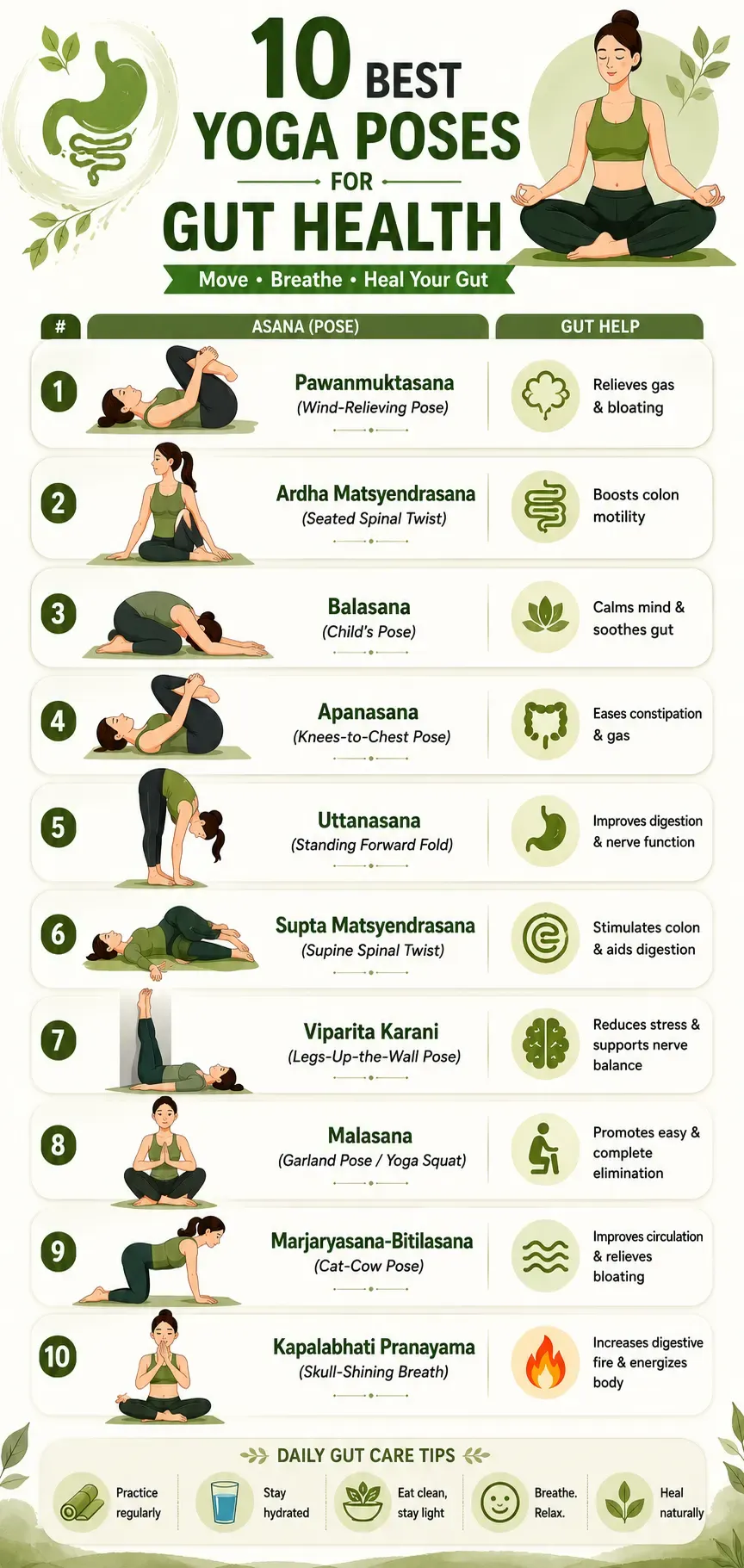
10 Best Yoga Poses For Gut Health: The Core Asanas
The best yoga poses for gut health target the abdominal organs through compression, twisting, and inversion. Mool Health's gut wellness team recommends the following yoga asanas for gut health, ranked by the body area they primarily target.
When the main concern is tightness or trapped air after meals, first understand what bloating means so you can track whether poses are helping gas movement or general discomfort.
Best Yoga Poses For Gut Health (Full List)
1. Pawanmuktasana (Wind-Relieving Pose) Lie on your back and draw one or both knees to the chest. This directly compresses the ascending and descending colon, stimulating gas expulsion and peristalsis. Hold for 30-60 seconds per side.
2. Ardha Matsyendrasana (Seated Spinal Twist) A seated twist that compresses the ascending colon on the right and the descending colon on the left. Alternating sides in sequence supports full-colon motility. This is one of the most studied yoga asanas for gut health in IBS research.
3. Balasana (Child's Pose) A forward fold that gently compresses the stomach and small intestine while simultaneously activating the parasympathetic nervous system through the elongation of the spine. Particularly effective for bloating and acid reflux.
4. Apanasana (Knees-to-Chest Pose) Targets the lower intestine and sigmoid colon. Especially useful for constipation and gas in the lower digestive tract. Combine with gentle rocking for enhanced stimulation.
5. Uttanasana (Standing Forward Fold) Inverts the abdominal organs, reversing gravitational pressure on the gut and stimulating the vagus nerve. Best practised on an empty stomach.
6. Supta Matsyendrasana (Supine Spinal Twist) A recumbent twist ideal for beginners. Provides the colon-stimulating benefits of seated twists with lower spinal load. Begin on the left side to follow the natural direction of the colon.
7. Viparita Karani (Legs-Up-the-Wall Pose) A mild inversion that shifts blood flow away from the digestive organs momentarily, then returns it on release - a flushing effect. Strongly activates the parasympathetic nervous system and reduces cortisol.
8. Malasana (Garland Pose / Yoga Squat) A deep squat that opens the hips and places the colon in its most anatomically efficient position for elimination. The squat position can make elimination feel easier for some people because it changes the angle of the anorectal canal.
9. Marjaryasana-Bitilasana (Cat-Cow Pose) Alternates spinal flexion and extension, creating a gentle pumping action on the abdominal organs. Effective as a warm-up before a full gut-health yoga sequence.
10. Kapalabhati Pranayama (Skull-Shining Breath) A breathing exercise rather than a pose - involves rapid, rhythmic exhalations that create strong abdominal contractions. Directly stimulates the digestive organs and is commonly used in Ayurvedic practice to increase digestive fire.
How to Get Started with Yoga For Gut Health: Step-by-Step Guide
Mool Health recommends the following approach for anyone beginning a yoga for digestion and gut health practice.
If your goal is bowel regularity, it also helps to understand what is constipation before relying only on morning poses.
Prerequisites
- •A yoga mat
- •Comfortable, non-restrictive clothing
- •An empty or nearly empty stomach (wait 2-3 hours after a large meal)
- •20-30 minutes of uninterrupted time
Step-by-Step Beginner Routine
Step 1: Set your intention and breathe (3 minutes) Begin lying on your back. Take 10 slow diaphragmatic breaths - inhale for 4 counts, hold for 4, exhale for 6. This initiates parasympathetic activation before the poses begin, which is why it matters: the gut responds to the nervous system state before it responds to movement.
Step 2: Cat-Cow warm-up (2 minutes) Move through 10-15 Cat-Cow cycles on hands and knees. This warms the spine, loosens the abdominal fascia, and begins gentle organ stimulation.
Step 3: Apanasana - Knees to Chest (2 minutes) Draw both knees to the chest and rock gently side to side for 60 seconds. Then extend each leg alternately for 30 seconds per side. This targets the lower colon and is particularly effective for morning constipation.
Step 4: Supine Spinal Twist - both sides (3 minutes) Starting on the left side, lower both knees to the floor while keeping shoulders flat. Hold 60-90 seconds. Repeat on the right. This follows the natural clockwise direction of the colon.
Step 5: Child's Pose (2 minutes) Hold for 90-120 seconds with full, deep breaths. Focus on expanding the belly downward into the thighs on each inhale.
Step 6: Seated Spinal Twist - Ardha Matsyendrasana (3 minutes) Perform on both sides. The mechanical compression effect is strongest when the twist is held for 60+ seconds per side.
Step 7: Malasana - Yoga Squat (2 minutes) Hold for 60-90 seconds. Use a folded blanket under the heels if the ankles are tight. This pose positions the colon for efficient elimination and is best practised within 30 minutes of waking.
Step 8: Legs-Up-the-Wall - Viparita Karani (5 minutes) End the sequence with this restorative pose. It consolidates the parasympathetic shift and allows the digestive organs to settle.
Step 9: Savasana with belly breathing (3 minutes) Lie flat. Place one hand on the belly. Take slow, full breaths to close the practice.
Common Mistakes to Avoid
Practising immediately after eating: Yoga poses that compress the abdomen after a full meal can cause nausea and acid reflux. Always allow 2-3 hours after a large meal.
Holding the breath during twists: Breathing should remain continuous and slow during all twisting poses. Breath-holding activates the sympathetic nervous system and reduces the parasympathetic benefits.
Doing twists in the wrong direction: For colon stimulation, always begin twists on the left side and move to the right. This follows the anatomical path of the large intestine.
Expecting instant results from a single session: Bloating relief may occur in one session; structural improvements in IBS symptoms typically require 8-12 weeks of consistent practice.
Yoga For Gut Health vs. Alternatives: An Honest Comparison
Several approaches claim to improve digestive function. Mool Health presents the following objective comparison to help you understand where yoga for gut health fits relative to other options.
For people whose burning or regurgitation worsens after meals, symptoms may be closer to acid reflux than a simple motility issue.
If symptoms seem linked to diet diversity, antibiotics or long-term gut imbalance, the gut microbiome may need attention along with movement and breathwork.
| Approach | Mechanism | Time to Results | Suitable For | Limitations |
|---|---|---|---|---|
| Yoga for gut health | Nervous system + physical compression + cortisol reduction | 1 session (bloating); 8-12 weeks (IBS) | Stress-IBS, bloating, constipation, general health | Requires consistency; not a medical treatment |
| Dietary changes | Microbiome modification, reduced irritants | 2-4 weeks | Most gut conditions | Requires sustained restriction; not holistic |
| Probiotics | Microbiome supplementation | 4-8 weeks | Dysbiosis, post-antibiotic recovery | Limited effect without dietary and lifestyle support |
| Medication (e.g., antispasmodics) | Symptomatic relief only | Hours to days | Acute flares, severe IBS | Does not address root cause; side effects possible |
| Gut-directed psychotherapy (CBT) | Gut-brain axis regulation | 8-16 weeks | Severe stress-IBS overlap | Requires professional access; time-intensive |
| Walking / general exercise | Motility stimulation | 1-2 weeks | Mild constipation, general health | Less targeted than yoga; minimal parasympathetic effect |
Which Is Best For Your Situation?
- •Best yoga for gut health use case: Stress-related IBS, chronic bloating, constipation, acid reflux without structural cause
- •Combine yoga with: Dietary fibre adjustments and probiotics for synergistic microbiome support
- •Yoga alone is insufficient for: Inflammatory bowel disease (IBD), coeliac disease, structural gut disorders - always consult a gastroenterologist for these conditions
Yoga for Gut Health: Best Practices and Expert Tips from Mool Health
Mool Health's gut wellness team identifies the following best practices for anyone using yoga for digestion and gut health. These tips keep the routine practical, safe and easier to repeat.
8 Practical Best Practices
- •Practise in the morning on an empty stomach. Morning practice helps set a calmer nervous-system tone before meals and bowel movements.
- •Keep the routine gentle during bloating or reflux. Avoid aggressive crunching, forceful twists or fast flows when the abdomen feels painful or full.
- •Use breathwork before movement. Start with slow belly breathing so the gut responds to a rest-and-digest state before compression poses begin.
- •Hold twists long enough to matter. Gentle holds of 45 to 90 seconds usually work better than rushing through poses.
- •Do not practise immediately after heavy meals. Wait 2 to 3 hours after a large meal to reduce nausea and reflux risk.
- •Pair yoga with food tracking. Poses can help motility, but trigger foods, meal timing and hydration still matter.
- •Modify during pain, pregnancy or injury. Use props, reduce depth and avoid poses that strain the abdomen or lower back.
- •Stay consistent for 8 to 12 weeks. Occasional sessions may ease gas, but bowel regularity and stress-linked symptoms need repeated practice.
When Should You Avoid or Modify Yoga For Gut Health?
Yoga is generally safe when practised correctly, but some situations need modification or medical guidance. Gut-focused poses create abdominal pressure, so they are not suitable for every symptom pattern.
| Situation | What To Avoid | Safer Approach |
|---|---|---|
| Severe abdominal pain | Deep twists, strong compression and forceful breathing | Stop practice and seek medical evaluation if pain is severe or unusual |
| Active acid reflux or nausea | Forward folds, deep compression and practice after meals | Use upright breathing or gentle walking instead |
| Pregnancy | Deep closed twists, lying flat for long periods and abdominal pressure | Use pregnancy-safe yoga under trained guidance |
| Recent abdominal surgery or hernia | Core pressure, Kapalabhati and deep squats | Resume only after medical clearance |
| Inflammatory bowel disease flare | Strong sequences during pain, diarrhoea or fatigue | Use restorative poses only with clinician guidance |
| Dizziness or high blood pressure concerns | Long inversions or breath retention | Choose supported, slow breathing practices |
What Results Can You Expect From Yoga For Gut Health?
The timeline depends on your symptom pattern, consistency and whether food triggers or medical conditions are also present. Yoga is support, not an instant cure.
| Timeframe | What You May Notice |
|---|---|
| Single session | Less trapped gas, calmer breathing and reduced abdominal tightness in some people |
| 1 to 4 weeks | Better bowel routine, less stress-related bloating and improved awareness of triggers |
| 8 to 12 weeks | More stable IBS or constipation patterns when combined with diet and lifestyle changes |
| 3 months and beyond | Improved stress resilience, better body awareness and a more sustainable digestion routine |
When Should You See a Doctor for Gut Symptoms?
Do not use yoga to delay medical care if symptoms are severe, persistent or unusual. Some digestive problems need diagnosis and treatment.
- •See a doctor for unexplained weight loss, blood in stool, black stools or persistent vomiting.
- •Get medical advice for severe abdominal pain, fever, dehydration or symptoms waking you at night.
- •Consult a clinician if constipation, diarrhoea, reflux or bloating continues for more than 2 to 4 weeks despite changes.
- •Seek care if swallowing is difficult, food feels stuck or reflux is frequent.
- •People with IBD, coeliac disease, ulcers, pregnancy-related concerns or recent surgery should use yoga only with appropriate guidance.
Mool Health’s Perspective on Yoga For Gut Health
Mool Health views yoga for gut health as a strong support habit, especially when stress, constipation, bloating and gut-brain axis patterns are involved. It is not a replacement for diagnosis, diet changes or medical treatment when red flags are present.
The best results come when yoga is combined with regular meals, hydration, fibre balance, sleep, food-trigger tracking and a personalised understanding of gut health. A routine that is gentle, consistent and matched to symptoms is more useful than a difficult routine done rarely.
A broader understanding of gut health can help connect yoga with food tolerance, stool pattern, stress and sleep.
Gut Symptoms Keep Coming Back?
Yoga can support digestion, but recurring bloating, constipation, acidity or IBS-like symptoms need a clearer gut pattern. Take Mool Health’s free gut test.
Medical Disclaimer
This article is for general educational purposes only and does not diagnose, treat or cure any condition. Yoga should be modified or avoided during severe pain, pregnancy unless guided, recent surgery, hernia, active inflammatory bowel disease flare, dizziness, uncontrolled blood pressure or worsening reflux. Consult a qualified healthcare professional if symptoms are severe, persistent, recurrent or include weight loss, blood in stool, black stools, fever, dehydration, persistent vomiting or difficulty swallowing.
Key Takeaways
Guide to yoga for gut health, benefits, poses, breathing, routine, safety, red flags and how yoga supports digestion and stress-linked symptoms.
Your gut is unique your healing should be too.

Disclaimer
The content provided by Mool Health is for educational and informational purposes only and should not be considered a substitute for professional medical advice, diagnosis, or treatment.