
Digestion of Starch: Where It Starts and How It Works
Starch digestion begins in the mouth with salivary amylase, pauses in the stomach due to acid, and resumes in the small intestine where it is broken down into glucose for absorption.
Quick Answer
The digestion of starch does not start in the stomach. It starts in the mouth, where salivary amylase begins breaking starch into maltose and dextrins. In the stomach, acid inactivates salivary amylase, so starch digestion pauses and then resumes in the small intestine.
- The statement digestion of starch starts in the stomach is false.
- Starch digestion begins in the mouth with salivary amylase, also called ptyalin.
- The stomach does not produce a starch-digesting enzyme, and its acidic pH stops amylase activity.
- Starch digestion resumes in the small intestine through pancreatic amylase and brush border enzymes.
- The final absorbable product of starch digestion is glucose, which enters the bloodstream through the small intestine.
Is It True or False That Digestion of Starch Starts in the Stomach?
The statement "digestion of starch starts in the stomach" is false. Starch digestion starts in the mouth (oral cavity), not the stomach. this is one of the most commonly misunderstood facts in basic digestive physiology - and it appears frequently in biology exams precisely because it tests conceptual clarity.
The correct fact: Starch digestion begins in the mouth via salivary amylase, continues briefly as food travels down the oesophagus, pauses in the stomach due to low pH, and is completed in the small intestine by pancreatic amylase.
What Is Starch and Why Does Digestion Matter?
Starch is a complex carbohydrate (polysaccharide) made of long chains of glucose units. It is the primary energy-storage molecule in plants and the most common carbohydrate in the human diet - found in rice, wheat, potatoes, legumes, and corn.
In the human digestive system, starch moves through the mouth, stomach, small intestine, and large intestine in a sequence that decides how completely it is broken down.
The body cannot absorb starch directly. Starch must first be broken down into simple sugars (primarily glucose) through enzymatic digestion before the small intestine can absorb it into the bloodstream. This process involves multiple organs, enzymes, and pH environments working in sequence.
Key terms defined:
- Salivary amylase (ptyalin): An enzyme in saliva that breaks starch into maltose and dextrins
- Pancreatic amylase: An enzyme secreted by the pancreas into the small intestine that completes starch breakdown
- Maltase, sucrase, isomaltase: Brush border enzymes in the small intestine that split disaccharides into glucose
- Polysaccharide: A long-chain carbohydrate like starch or glycogen
- Monosaccharide: A single sugar unit like glucose - the final absorbable form
How Does Starch Digestion Actually Work? A Step-by-Step Breakdown
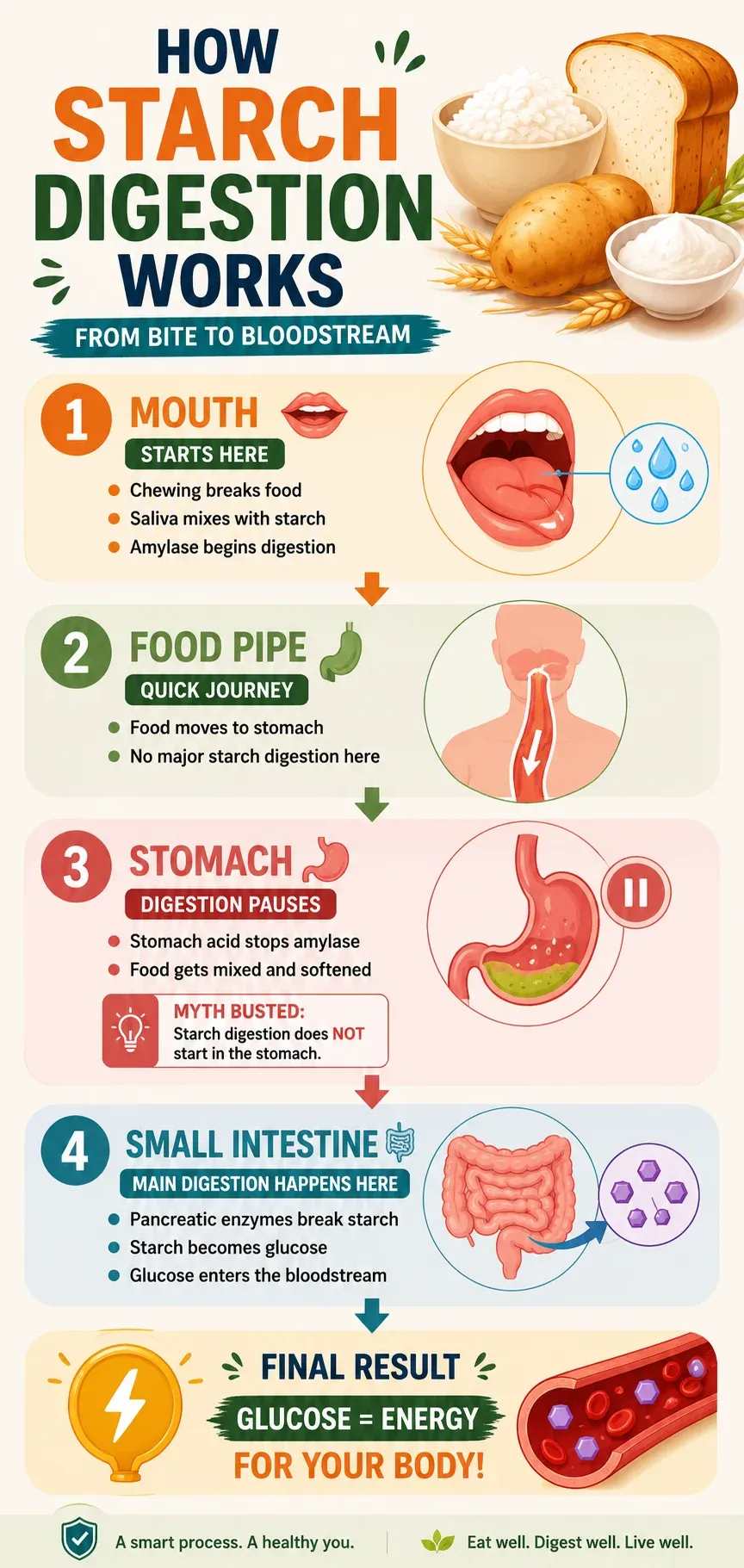
Starch digestion follows a precise multi-stage process across four distinct sites in the digestive tract. The complete pathway is outlined the complete pathway below:
This starch pathway is one part of the larger stages of digestion, where food is chewed, mixed, broken down by enzymes, absorbed, and finally eliminated.
Step 1 - Mouth (Oral Cavity): Where Starch Digestion Truly Starts
- Food enters the mouth and is mechanically broken down by chewing (mastication)
- The salivary glands secrete saliva containing salivary amylase (ptyalin)
- Salivary amylase cleaves the α-1,4 glycosidic bonds in starch chains
- Starch is partially converted into maltose (a disaccharide) and dextrins (shorter polysaccharide fragments)
- This process begins within seconds of chewing
Why this matters: Approximately 30-40% of starch can be partially digested during the time food remains in the mouth and travels down the oesophagus, depending on how thoroughly you chew.
Step 2 - Oesophagus: Digestion Continues Briefly
- Salivary amylase remains active in the food bolus as it travels through the oesophagus
- No new enzymes are added at this stage
- Transit time is approximately 8-10 seconds
Step 3 - Stomach: Why Starch Digestion Pauses Here
The stomach does not produce any starch-digesting enzyme. The stomach's primary function is protein digestion (via pepsin and hydrochloric acid).
- Gastric acid (HCl) creates a highly acidic environment with a pH of 1.5-3.5
- Salivary amylase is a pH-sensitive enzyme that becomes inactivated at this low pH
- Starch breakdown therefore stops in the stomach
- The stomach churns food into a semi-liquid mass called chyme, which helps prepare starch for the next stage
This is why "digestion of starch starts in the stomach" is false. The stomach actually interrupts starch digestion rather than initiating it.
Step 4 - Small Intestine: Where Starch Digestion Is Completed
- Chyme moves from the stomach into the duodenum (the first section of the small intestine)
- The pancreas releases pancreatic amylase into the duodenum via the pancreatic duct
- Pancreatic amylase breaks remaining starch and dextrins into maltose and short oligosaccharides
- Brush border enzymes on the intestinal wall (maltase, isomaltase, sucrase) split these into individual glucose molecules
- Glucose is absorbed through intestinal cells (enterocytes) into the bloodstream via active transport
- The liver receives absorbed glucose via the portal vein and regulates blood glucose accordingly
Where Does Starch Digestion Occur? Organ-by-Organ Summary
| Organ | Enzyme Involved | What Happens to Starch | pH |
|---|---|---|---|
| Mouth | Salivary amylase (ptyalin) | Starch → Maltose + Dextrins | 6.5-7.5 |
| Oesophagus | Salivary amylase (residual) | Partial digestion continues | ~7.0 |
| Stomach | None | Digestion pauses; amylase inactivated | 1.5-3.5 |
| Small intestine (duodenum) | Pancreatic amylase | Dextrins → Maltose + oligosaccharides | 7.0-8.5 |
| Small intestine (brush border) | Maltase, isomaltase | Maltose → Glucose (absorbed) | 7.0-8.5 |
| Large intestine | Bacterial fermentation | Resistant starch partially fermented | Variable |
What Are the Two Types of Starch and How Are They Digested Differently?
Not all starch behaves the same way in the digestive tract. There are two primary forms relevant to digestion:
Rapidly Digestible Starch (RDS)
- Found in: white bread, white rice, cooked potatoes, processed cereals
- Broken down quickly by salivary and pancreatic amylase
- Causes a rapid rise in blood glucose (high glycaemic index)
- Fully absorbed in the small intestine within 20-30 minutes
Slowly Digestible Starch (SDS)
- Found in: legumes, whole grains, al dente pasta, unprocessed cereals
- Digested at a slower rate due to physical structure and fibre barriers
- Produces a gradual glucose release - lower glycaemic index
- Associated with better blood sugar control and sustained energy
Resistant Starch (RS)
- Found in: cooked-then-cooled rice and potatoes, green bananas, raw oats
- Resists digestion in the small intestine entirely
- Fermented in the large intestine by gut bacteria
- Produces short-chain fatty acids (SCFAs) - butyrate, propionate, acetate
- Supports gut health and may reduce colon cancer risk
Because resistant starch changes how gut bacteria ferment carbohydrates, people with constipation should increase high-resistant-starch foods gradually and monitor gas or stool changes.
What Happens If Starch Is Not Properly Digested?
Impaired starch digestion can occur for several physiological reasons. The following outcomes may occur the following outcomes when starch digestion is disrupted:
When these symptoms keep returning, they may be part of broader digestion problems rather than a one-time reaction to a starch-heavy meal.
Common causes of impaired starch digestion:
- Deficiency or absence of salivary amylase (rare, but observed in some medical conditions)
- Pancreatic insufficiency - insufficient pancreatic amylase production (seen in chronic pancreatitis or cystic fibrosis)
- Rapid gastric emptying - food moves too quickly through the stomach before mechanical breakdown is complete
- Brush border enzyme deficiency (e.g., maltase-glucoamylase deficiency)
Consequences of poor starch digestion:
- Undigested starch reaches the large intestine in excess
- Gut bacteria ferment the excess starch, producing gas (hydrogen, methane, carbon dioxide)
- Symptoms may include bloating, flatulence, abdominal cramping, and loose stools
- Chronic malabsorption can lead to nutrient deficiencies and unintended weight loss
How Long Does Starch Digestion Take From Start to Finish?
Starch digestion timeline varies by food type, meal size, and individual physiology. The following estimates apply to a typical mixed meal containing moderate starch content:
If starch-heavy meals regularly feel heavy for hours, the pattern may overlap with slow digestion, especially when bloating, fullness, or delayed hunger appears after meals.
| Stage | Location | Approximate Duration |
|---|---|---|
| Initial breakdown begins | Mouth | 30 seconds - 2 minutes |
| Transit through oesophagus | Oesophagus | 8-10 seconds |
| Gastric processing (churning) | Stomach | 2-4 hours |
| Pancreatic enzyme activity | Duodenum/Jejunum | 1-3 hours |
| Glucose absorption | Small intestine | Begins ~20 min post-meal |
| Resistant starch fermentation | Large intestine | 12-24 hours |
Total time from eating to glucose absorption: typically 2-5 hours for most dietary starches, depending on meal composition, fibre content, and cooking method.
What the Research Says About Starch Digestion
Several established studies and nutrition authorities have documented the mechanism of starch digestion. Key findings cited by key findings include:
- NCERT Biology (Class 10, Chapter 6): Explicitly states that carbohydrate digestion (including starch) begins in the mouth via salivary amylase. This is the primary source for Indian board exam questions on this topic.
- FAO/WHO Carbohydrate Report (2007): Identified resistant starch as a functionally distinct dietary component with measurable effects on glycaemic response and gut microbiota composition.
- Studies in the Journal of Nutrition (2019): Found that thorough chewing (>30 chews per bite) increased salivary amylase contact time and reduced post-meal blood glucose spikes by approximately 15-20% compared to rapid eating.
- Research in Gut Microbes (2020): Demonstrated that resistant starch fermentation in the large intestine produces butyrate, a short-chain fatty acid that may reduce inflammation and support colonocyte (colon cell) health.
Limitation: Most mechanistic studies on starch digestion use controlled laboratory conditions. Individual variation in amylase activity, gut motility, and microbiome composition means results in real-world dietary contexts may differ.
Practical Tips to Support Healthy Starch Digestion
The following practices may help the following evidence-informed practices to optimise starch digestion and glucose management:
- Chew food thoroughly - aim for 20-30 chews per mouthful to maximise salivary amylase contact time with starch
- Choose whole food starch sources - whole grains, legumes, and unprocessed cereals contain fibre that slows starch digestion and lowers the glycaemic impact
- Cook and cool starchy foods - cooling cooked rice or potatoes increases resistant starch content by up to 3-4 times, supporting gut health
- Pair starch with protein and fat - this slows gastric emptying and reduces the rate of glucose absorption, moderating blood sugar response
- Avoid eating in a rush - rapid eating shortens oral digestion time, reducing the contribution of salivary amylase and increasing digestive burden on the small intestine
- Stay hydrated - adequate saliva production depends on hydration; dehydration can reduce salivary amylase secretion
- Starch digestion begins in the mouth, not the stomach - the statement "digestion of starch starts in the stomach" is false
- Salivary amylase (ptyalin) is the enzyme responsible for initiating starch breakdown in the oral cavity
- The stomach plays no role in enzymatic starch digestion - its acidic pH inactivates salivary amylase
- Starch digestion is completed in the small intestine by pancreatic amylase and brush border enzymes
- The final product of starch digestion is glucose, absorbed through the small intestinal wall into the bloodstream
- Three types of starch - rapidly digestible, slowly digestible, and resistant starch - each behave differently in the digestive tract
- Chewing thoroughly, choosing whole grain starches, and pairing starch with protein and fat can meaningfully support healthy starch digestion and blood glucose management
Key Takeaways
Starch digestion begins in the mouth with salivary amylase, pauses in the stomach due to acid, and resumes in the small intestine where it is broken down into glucose for absorption.
Your gut is unique your healing should be too.

FAQs
Digestion of starch starts in the mouth (oral cavity). The salivary glands secrete an enzyme called salivary amylase (also known as ptyalin), which begins breaking starch into maltose and dextrins. This process begins within seconds of chewing and continues until food reaches the acidic environment of the stomach.
This statement is false . Starch digestion begins in the mouth, not the stomach. The stomach does not produce any enzyme capable of digesting starch, and its highly acidic environment (pH 1.5-3.5) actively inactivates salivary amylase. Meaningful starch digestion resumes only in the small intestine, where pancreatic amylase is secreted.
Starch does not undergo enzymatic digestion in the stomach. While the stomach mechanically churns food and mixes it with gastric acid, no starch-digesting enzymes are produced there. Salivary amylase activity, which may have started in the mouth, is halted in the stomach due to low pH. Digestion of starch resumes in the duodenum.
Salivary amylase (also called ptyalin) is the enzyme that digests starch in the mouth. It is produced by three pairs of salivary glands: the parotid, submandibular, and sublingual glands. Salivary amylase works optimally at a neutral to slightly alkaline pH of 6.7-7.0.
The final product of starch digestion is glucose , a monosaccharide. Starch is progressively broken down from polysaccharides to oligosaccharides, then to maltose (a disaccharide), and finally to individual glucose molecules by brush border enzymes in the small intestine. Glucose is then absorbed into the bloodstream.
Starch that is not digested in the small intestine - primarily resistant starch - passes into the large intestine. Here, the gut microbiota ferment it, producing short-chain fatty acids including butyrate, propionate, and acetate. These by-products support colon cell health and may reduce systemic inflammation over time.
Starch digestion pauses in the stomach because the stomach's acidic environment (pH 1.5-3.5) denatures and inactivates salivary amylase. Enzymes are highly pH-sensitive proteins, and salivary amylase functions only in a near-neutral pH range (6.7-7.0). The stomach also produces no amylase of its own, so there is no enzymatic pathway for starch digestion at this stage.
Board exams - particularly CBSE, ICSE, and NEET - frequently test starch digestion with true/false questions such as "Digestion of starch starts in the stomach - true or false?" The correct answer is always false . Questions may also ask which organ initiates starch digestion (mouth), which enzyme is involved (salivary amylase), and where digestion is completed (small intestine).
Disclaimer
The content provided by Mool Health is for educational and informational purposes only and should not be considered a substitute for professional medical advice, diagnosis, or treatment.