
Role of Saliva in Digestion: Why It Matters for Gut Health
This guide explains how saliva starts digestion, breaks down starch, supports swallowing, protects oral health, and affects gut comfort.
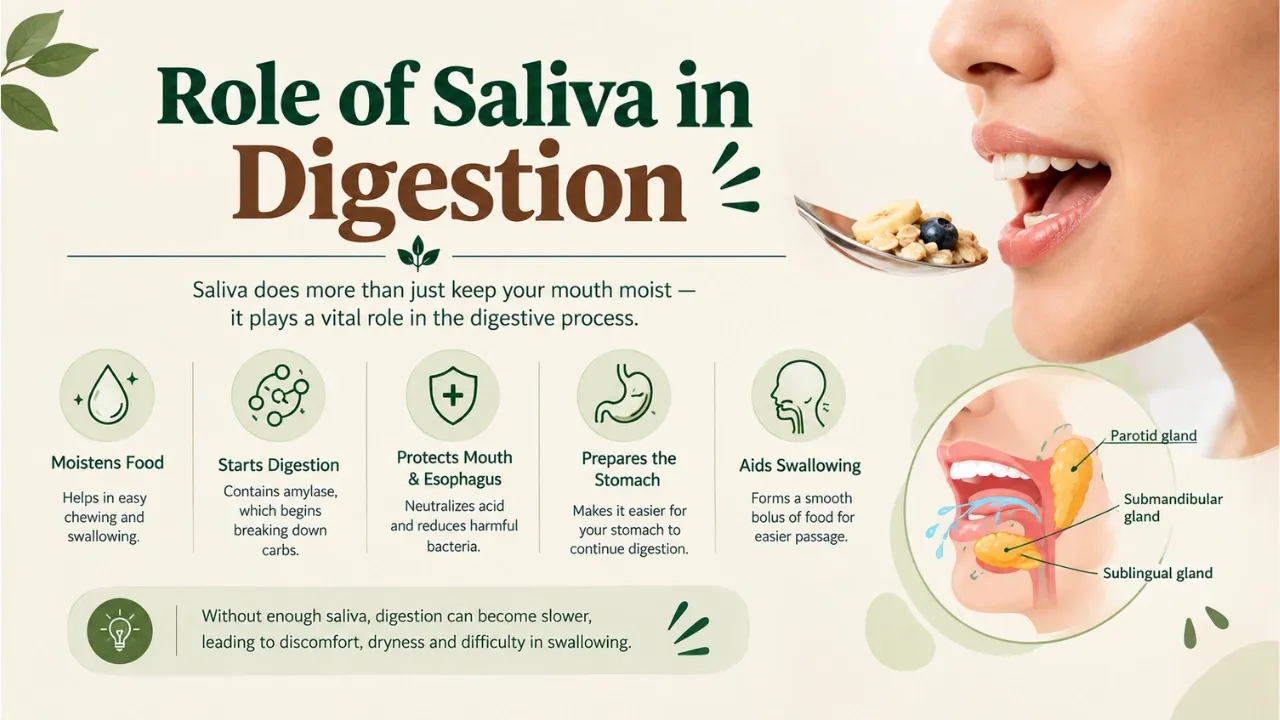
Quick Answer
The role of saliva in digestion is to moisten food, start starch digestion through salivary amylase, form a soft bolus for swallowing, and protect the mouth and gut from harmful bacteria. Saliva begins working within the first 30 seconds of chewing.
- Saliva helps digest carbohydrates, especially starch.
- Salivary amylase starts breaking starch into maltose in the mouth.
- Mucus in saliva helps form a smooth bolus for swallowing.
- Low saliva production can make digestion, swallowing, and oral health worse.
- Chewing slowly and staying hydrated support healthy saliva flow.
Saliva does more than keep your mouth moist. It is the first digestive fluid your body produces, and digestion cannot begin properly without it.
When you chew food, saliva moistens it, starts enzymatic breakdown of starch, binds food particles into a swallowable bolus, and protects your digestive tract from harmful bacteria. Without adequate saliva, food reaches the stomach poorly prepared, placing extra burden on every downstream digestive organ.
What Is Saliva?
Saliva is a clear digestive fluid produced by salivary glands located in the mouth. These glands release saliva continuously throughout the day. On average, the body produces around 1 to 1.5 litres of saliva daily.
Saliva contains water, enzymes, mucus, electrolytes, and antimicrobial compounds that support digestion and oral health.
The Three Salivary Glands: Which One Does What?
Saliva does not come from a single source. Three pairs of salivary glands produce it, each contributing a slightly different type of secretion.
| Gland | Location | Primary Secretion | Key Role |
|---|---|---|---|
| Parotid glands | In front of each ear | Watery, amylase-rich | Starch digestion |
| Submandibular glands | Under the jaw | Mixed, watery and mucus | General lubrication and digestion |
| Sublingual glands | Under the tongue | Thick, mucus-dominant | Bolus binding and throat lubrication |
The parotid glands are responsible for most of the salivary amylase. This is why eating something starchy, like a cracker or roti, produces more watery, enzyme-rich saliva than eating something fatty.
What Is the Role of Saliva in the Digestion of Food?
The role of saliva in digestion of food begins immediately when food enters the mouth. Understanding what is the role of saliva in digestion helps explain why proper chewing matters so much.
| Function | How It Helps Digestion | Outcome |
|---|---|---|
| Food lubrication | Moistens food particles | Easier swallowing |
| Enzyme action | Breaks down starch | Early carbohydrate digestion |
| Taste perception | Dissolves food molecules | Improves taste detection |
| Oral protection | Neutralizes acids | Protects teeth and gums |
How Saliva Breaks Down Food: Step by Step
Digestion is not only a stomach event. It begins in the mouth and continues in the stomach and intestines. Here is how saliva works on food.
- Sensory trigger: The sight, smell, or thought of food activates the autonomic nervous system. The salivary glands begin secreting saliva before a single bite is taken.
- Moistening and lubrication: As you chew, saliva coats food particles. Mucin acts as a lubricant, reducing friction and helping food travel smoothly down the oesophagus.
- Enzymatic starch breakdown: Salivary amylase binds to starch molecules and breaks them into dextrins and maltose. This is why saliva helps in the digestion of carbohydrates.
- Bolus formation: Saliva binds chewed food into a compact, smooth mass called a bolus. The tongue moves this bolus to the back of the mouth for swallowing.
- Oral pH buffering: Saliva maintains oral pH around 6.2 to 7.4, helping enzyme activity and protecting teeth from acid damage.
- Antimicrobial defence: Saliva contains lysozyme, lactoferrin, and secretory immunoglobulin A, which help control harmful bacteria before they reach the gut.
Key Components of Saliva
Salivary Amylase
This enzyme begins breaking down complex carbohydrates into simpler sugars while food is still in the mouth.
Mucus
Mucus lubricates food and helps form a soft bolus that can be swallowed easily.
Electrolytes
Electrolytes maintain pH balance and support enzyme function.
Antibacterial Compounds
Saliva contains substances that help control bacteria in the mouth.
Why Saliva Is Important for Digestion
The importance of saliva in digestion lies in the fact that it is the only digestive fluid capable of acting in the mouth. If it fails, every downstream organ gets a harder job.
- It initiates carbohydrate digestion before food reaches the stomach.
- It enables smooth, safe swallowing by binding food into a cohesive bolus.
- It protects teeth and gums by neutralising acids produced by oral bacteria.
- It enhances taste and appetite by dissolving food molecules.
- It provides the first line of antimicrobial defence against pathogens entering through food.
When saliva is insufficient, even the earliest stage of digestion is compromised. This may affect nutrient absorption and contribute to gas and bloating causes linked to poorly broken-down food.
What Happens When Saliva Production Is Low?
Reduced saliva production can lead to dry mouth, also called xerostomia. When saliva levels drop, the digestive process in the mouth becomes less efficient.
- Difficulty swallowing dry foods
- Increased tooth decay
- Reduced taste sensation
- Poor digestion due to inadequate food breakdown
Poor oral digestion can also increase the risk of acidity and reflux further down the digestive tract.
Adequate Saliva vs Low Saliva: How Each Affects Your Digestion
| Digestive Stage | Adequate Saliva | Low Saliva |
|---|---|---|
| Food breakdown in mouth | Starch digestion begins within 30 seconds | Minimal enzymatic activity |
| Swallowing | Smooth bolus formation | Difficult, especially for dry foods |
| Stomach load | Mouth pre-digests a portion | Stomach works harder |
| Oral pH | Buffered at 6.2 to 7.4 | Acid accumulates and enamel risk rises |
| Gut microbiome impact | Fewer pathogens pass the oral barrier | More bacteria and fungi may enter the gut unchecked |
| Taste and appetite | Food molecules reach taste buds better | Food tastes flatter |
Who Is Most at Risk for Low Saliva?
- People taking antihistamines, antidepressants, diuretics, or blood pressure medicines
- Individuals with autoimmune conditions like Sjögren's syndrome
- Cancer patients undergoing head and neck radiation therapy
- People who are chronically dehydrated or breathe mainly through their mouth
- People under prolonged high stress
Factors That Influence Saliva Production
Hydration
Dehydration reduces saliva secretion and affects oral lubrication. Consistent hydration supports saliva flow and overall gut health.
Stress
Chronic stress can suppress saliva production through nervous system changes. This is one reason stress may affect digestion from the very first bite.
Medications
Some medications can reduce saliva production as a side effect. If dry mouth started after a new medicine, discuss it with your doctor.
Circadian Rhythm Disruption
Sleep irregularities may influence digestive secretions, including saliva.
Ayurveda-Informed Understanding
In Ayurveda, digestion is governed by Jatharagni, the digestive fire that transforms food into nourishment. But Agni does not ignite in the stomach alone. The mouth is considered the first seat of Samana Vata, which governs the movement and assimilation of food downward through the digestive tract.
Saliva in Ayurvedic physiology corresponds to the initial expression of Kledaka Kapha, the moistening and lubricating sub-dosha that softens food and prepares it for transformation. When Kledaka Kapha is in balance, the mouth stays appropriately moist and food is well-lubricated.
The Ayurvedic prescription aligns closely with modern research: eat mindfully, chew thoroughly, drink warm water, favour moist and cooked foods when digestion is weak, and avoid eating under stress. These practices support salivary secretion and broader digestive function.
How to Support Healthy Saliva Production Naturally
- Chew food slowly and thoroughly: Mechanical stimulation from chewing is the strongest trigger for salivary gland activation. Aim for 20 to 30 chews per mouthful for dense foods.
- Stay consistently hydrated: Saliva is mostly water. Mild dehydration reduces both saliva volume and its lubricating quality.
- Use sugar-free options if needed: Sugar-free gum or lozenges can stimulate saliva between meals for people prone to dry mouth.
- Manage chronic stress: The parasympathetic nervous system drives saliva secretion. Slow breathing, mindful eating, and sleep support this pathway.
- Reduce caffeine and alcohol: Both can contribute to dehydration and lower saliva volume.
- Breathe through the nose during meals: Mouth breathing dries oral tissues and reduces the mucus layer that supports saliva distribution.
What the Research Says: Evidence on Saliva and Digestive Health
The science of salivary digestion is well-established. Research shows that people with higher salivary amylase activity break down starch faster at the oral stage and may even perceive starchy foods as sweeter.
Stimulated saliva production during meals can rise far above resting levels, especially when food is chewed thoroughly. This confirms that slow chewing is directly linked to better enzymatic activity.
Dry mouth is also common and often underdiagnosed. Reviews suggest that xerostomia affects many adults, especially older adults and people taking medicines that suppress saliva output.
Newer research is also exploring saliva as a diagnostic fluid. Salivary biomarkers such as cortisol, amylase activity, and inflammatory markers may reflect broader health and stress status.
A Root-Cause Approach: Mool Health's Perspective
Mool Health evaluates digestive health by examining early digestion processes including saliva production, chewing habits, and gut health and microbiome balance. Through Gut Test assessment, Prakruti analysis, and lifestyle review, the focus is on identifying patterns that affect digestion efficiency.
The approach supports gut barrier health, digestive rhythm, and microbiome balance. When symptoms such as persistent dry mouth or digestive discomfort occur, individuals are advised to consult qualified healthcare professionals.
What This Means for You
Saliva is your body's first active digestive tool. The quality of every digestive step that follows depends on what happens in your mouth.
By slowing down, chewing thoroughly, and staying hydrated, many people notice improved digestive comfort within 2 to 4 weeks because the mouth starts doing its job fully.
- Spend at least 20 minutes eating one meal this week without screens or rushing.
- Aim for 25 chews per mouthful on solid foods for 7 days.
- Drink water 20 to 30 minutes before meals to support saliva secretion.
- Check medication side effects for dry mouth if symptoms are persistent.
- If dry mouth persists despite hydration and habit changes, discuss salivary gland assessment with a healthcare professional.
If your digestive symptoms go beyond the mouth into persistent gut discomfort, irregular bowel patterns, or unexplained fatigue, a systematic evaluation of your full digestive profile may help identify what habit changes alone cannot fix.
Key Takeaways
This guide explains how saliva starts digestion, breaks down starch, supports swallowing, protects oral health, and affects gut comfort.
Your gut is unique your healing should be too.

Disclaimer
The content provided by Mool Health is for educational and informational purposes only and should not be considered a substitute for professional medical advice, diagnosis, or treatment.