
Digestion and Absorption of Carbohydrates: A Complete Guide
A complete guide to carbohydrate digestion, absorption, enzymes, transporters, fibre, resistant starch, metabolism and digestion issues.
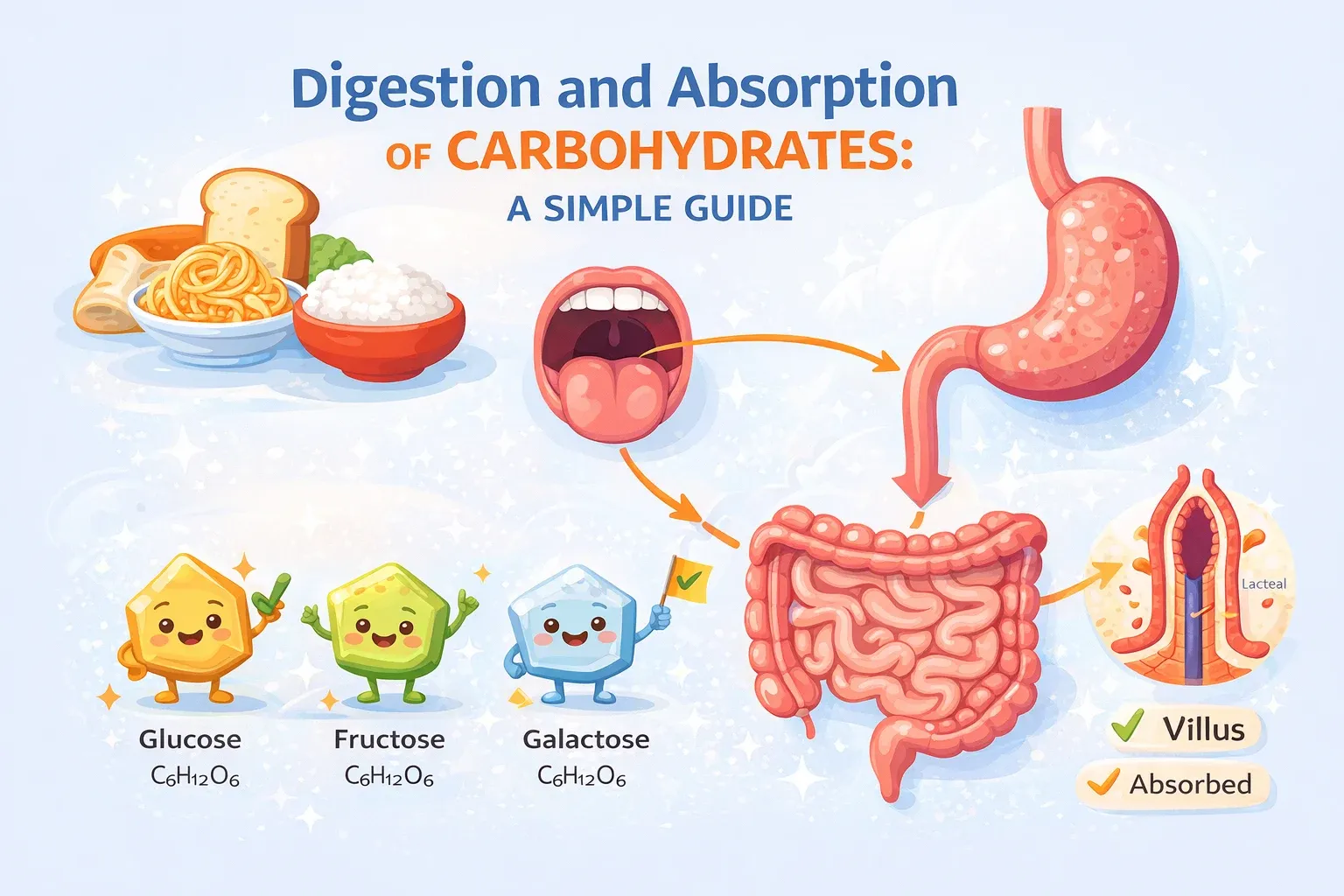
Quick Answer
Carbohydrate digestion and absorption is a precisely coordinated, multi-stage process involving at least six enzymes, three organs, and two distinct transport mechanisms. Digestion begins in the mouth within seconds of chewing and completes in the small intestine within 1-4 hours. Glucose reaches peak blood concentration roughly 30-60 minutes after a meal, depending on the carbohydrate type and meal composition.
- Starts in: Mouth, where salivary amylase begins starch digestion
- Main digestion site: Small intestine, with pancreatic amylase and brush border enzymes
- Absorbed as: Glucose, fructose and galactose
- Key transporters: SGLT1, GLUT2 and GLUT5
- Not fully absorbed: Fibre and resistant starch, which are fermented by gut bacteria
Carbohydrate digestion and absorption is a precisely coordinated, multi-stage process involving at least six enzymes, three organs, and two distinct transport mechanisms. Digestion begins in the mouth within seconds of chewing and completes in the small intestine within 1-4 hours. Glucose reaches peak blood concentration roughly 30-60 minutes after a meal, depending on the carbohydrate type and meal composition.
What Are Carbohydrates and Why Does Digestion Matter?
Carbohydrates are one of the body's three primary macronutrients and the preferred source of cellular energy. They are found in grains, fruits, vegetables, legumes, dairy, and added sugars. Before the body can use any of this energy, carbohydrates must first be broken down into simple sugars and transported across the intestinal wall into the bloodstream.
There are two main structural categories:
- Simple carbohydrates - 1-2 sugar units (monosaccharides and disaccharides), found in table sugar, honey, fruit juice, and white bread
- Complex carbohydrates - long chains of sugar units (polysaccharides), found in oats, brown rice, lentils, sweet potato, and vegetables
Both types are ultimately broken down into glucose, fructose, or galactose. However, the speed, enzyme requirements, and metabolic effects differ substantially between them. According to Mool Health's gut health team, understanding this difference is the first step toward managing energy levels, blood sugar stability, and digestive comfort.
Simple vs Complex Carbohydrates: How Digestion Differs
The structural complexity of a carbohydrate directly determines how quickly it breaks down, how fast glucose enters the blood, and how sustained the resulting energy release is.
| Feature | Simple Carbohydrates | Complex Carbohydrates |
|---|---|---|
| Structure | 1-2 sugar units (mono/disaccharides) | Long chains of sugar units (polysaccharides) |
| Examples | Table sugar, honey, white bread, fruit juice | Oats, brown rice, lentils, sweet potato |
| Enzymes required | Sucrase, lactase, maltase | Salivary amylase, pancreatic amylase, brush border enzymes |
| Digestion speed | 15-60 minutes | 1-4 hours |
| Blood sugar impact | Rapid spike, rapid drop | Gradual rise, sustained energy |
| Glycaemic Index (GI) | High GI (typically >70) | Low to medium GI (typically 20-55) |
| Effect on gut bacteria | Refined simple carbs may reduce microbial diversity | High-fibre complex carbs feed beneficial gut bacteria |
| Best for | Quick energy recovery (post-exercise) | Sustained energy, blood sugar stability, gut health |
Citable summary: Complex carbohydrates take 1-4 hours to digest and produce a lower, steadier blood sugar rise than simple carbohydrates, which reach the bloodstream in 15-60 minutes.
What Is the Glycaemic Index and Why Does It Matter for Carbohydrate Absorption?
The Glycaemic Index (GI) is a numerical scale from 0 to 100 that measures how quickly a carbohydrate-containing food raises blood glucose compared to pure glucose (GI = 100). A lower GI means slower digestion and more gradual glucose absorption - producing steadier energy and reduced insulin spikes.
GI is influenced by several factors beyond carbohydrate type:
- Cooking method - heat gelatinises starch granules, making them more accessible to amylase and raising GI
- Meal composition - protein and fat slow gastric emptying, reducing the glucose absorption rate
- Food processing - refined and ultra-processed foods typically have higher GI than whole-food equivalents
- Ripeness - riper fruit has higher GI because starch has already converted to simple sugars
Low-GI diets are consistently associated with better long-term blood sugar control and reduced risk of type 2 diabetes, according to comprehensive reviews published in the American Journal of Clinical Nutrition. Mool Health's dietary guidance takes GI into account alongside fibre content and meal composition when assessing carbohydrate load.
How Does Carbohydrate Digestion Work? The Step-by-Step Mechanism
Carbohydrate digestion is a sequential relay across five organs. Each stage passes partially broken-down carbohydrates to the next. Here is exactly how it works and why each step is necessary.
Stage 1 - Mouth (0-5 minutes): Where Complex Carbohydrate Digestion Begins
Digestion of complex carbohydrates begins in the mouth the moment chewing starts. Salivary glands release salivary amylase (ptyalin), which cleaves long starch chains in foods like rice, bread, and potatoes into shorter chains called dextrins and maltose.
Salivary amylase functions only in the neutral-to-alkaline pH range of the mouth (pH 6.7-7.0). This means thorough chewing matters - the longer starch is exposed to salivary amylase, the more pre-digestion occurs before food reaches the stomach. A plain cracker tastes sweeter the longer it is chewed because salivary amylase is actively converting starch into sugar.
Stage 2 - Stomach (5-60 minutes): Digestion Slows Down
When partially digested food (now called chyme) enters the stomach, the highly acidic environment (pH 1.5-3.5) rapidly inactivates salivary amylase. Carbohydrate digestion slows to nearly a halt here.
The stomach's role at this stage is primarily mechanical: its muscular walls churn chyme into a finer consistency and regulate how quickly material passes into the small intestine via the pyloric sphincter. This controlled release prevents a sudden flood of glucose into the bloodstream.
Stage 3 - Small Intestine (60 minutes to 4 hours): Where Most Digestion Occurs
This is where the primary chemical work happens. When chyme enters the duodenum, two processes restart carbohydrate digestion:
- Pancreatic amylase is secreted from the pancreas into the duodenum, continuing starch breakdown into maltose and short oligosaccharides - picking up exactly where salivary amylase stopped.
- Brush border enzymes - embedded in the intestinal wall itself - complete the final steps:
- Maltase - breaks maltose into two glucose molecules
- Sucrase - breaks sucrose into glucose and fructose
- Lactase - breaks lactose (milk sugar) into glucose and galactose
- Isomaltase - breaks branch points of starch chains
By the time digestion is complete, all digestible carbohydrates have been reduced to three monosaccharides: glucose, fructose, and galactose. These are the only forms small enough to cross the intestinal wall.
Citable summary: The digestion of complex carbohydrates begins in the mouth and is completed in the small intestine, converting starch into glucose in under four hours.
How Long Does Carbohydrate Digestion Take?
Digestion speed varies significantly by carbohydrate type, fibre content, and meal composition.
| Carbohydrate Type | Example Foods | Time to Reach Bloodstream |
|---|---|---|
| Simple sugars (monosaccharides) | Glucose drinks, honey | 15-30 minutes |
| Simple carbohydrates (disaccharides) | Table sugar, white bread | 30-60 minutes |
| Complex carbohydrates (low fibre) | White rice, refined pasta | 60-120 minutes |
| Complex carbohydrates (high fibre) | Oats, legumes, whole grains | 2-4 hours |
| Resistant starch and fibre | Cooked-and-cooled rice, lentils | Partially fermented by gut bacteria; not absorbed as glucose |
Dietary fibre slows digestion by forming a gel matrix around carbohydrate molecules, physically delaying enzyme access. This is one reason high-fibre meals produce a gentler blood sugar rise than low-fibre meals containing the same total carbohydrate load.
How Are Carbohydrates Absorbed? Transport Mechanisms Explained
Once digestion converts carbohydrates to monosaccharides, absorption begins in the small intestine. Glucose, fructose, and galactose do not passively leak through the intestinal wall - each requires a specific protein transporter embedded in enterocyte (intestinal cell) membranes.
How Does Glucose Enter the Bloodstream?
Glucose uses a two-step transport system:
- SGLT1 (Sodium-Glucose Linked Transporter 1) - On the gut-facing side of the enterocyte, SGLT1 co-transports glucose and sodium ions into the cell. This is active transport requiring ATP, because glucose is moved against its concentration gradient. Galactose uses the same SGLT1 transporter.
- GLUT2 (Glucose Transporter 2) - On the blood-facing side of the enterocyte, GLUT2 releases glucose and galactose into the portal bloodstream via facilitated diffusion. At high luminal glucose concentrations, GLUT2 can also temporarily appear on the gut-facing side to accelerate absorption.
How Is Fructose Absorbed Differently?
Fructose crosses the enterocyte via GLUT5, a facilitated diffusion transporter that requires no energy and no sodium co-transport. Fructose absorption is therefore slower and more easily saturated than glucose absorption.
At high doses - such as large amounts of fruit juice or high-fructose corn syrup - GLUT5 becomes overwhelmed, leaving unabsorbed fructose to pass into the colon, where gut bacteria ferment it, producing gas, bloating, and loose stools. This is the physiological basis of fructose malabsorption.
What Happens After Sugars Enter the Portal Blood?
All three monosaccharides travel via the portal vein to the liver:
- Glucose is used for immediate hepatic energy, stored as glycogen, or released into the bloodstream to maintain blood glucose levels
- Fructose is almost entirely metabolised in the liver and does not require insulin for uptake - but excess fructose can contribute to fat synthesis (de novo lipogenesis)
- Galactose is converted to glucose-1-phosphate in the liver and enters the same metabolic pathways as glucose
Insulin, released by pancreatic beta cells in response to rising blood glucose, signals muscle and fat cells to absorb glucose from the bloodstream - preventing blood sugar from staying elevated after a meal.
Citable summary: Glucose is absorbed via SGLT1 on the gut wall and exits into the portal vein via GLUT2; fructose uses GLUT5 and is metabolised almost entirely in the liver.
Fibre and Resistant Starch: The Carbohydrates That Are Not Fully Absorbed
Not every carbohydrate is designed to be absorbed as glucose. Dietary fibre and resistant starch take a fundamentally different digestive path - and this difference is central to understanding carbohydrate nutrition.
Dietary fibre consists of plant cell wall components - cellulose, hemicellulose, pectin, inulin - that human digestive enzymes cannot break down. Fibre passes through the stomach and small intestine essentially intact and reaches the large intestine (colon), where it becomes fuel for the gut microbiome.
Resistant starch is starch that resists digestion in the small intestine. It forms when starchy foods like rice, potatoes, or pasta are cooked and then cooled - a process called retrogradation - which causes starch molecules to crystallise into a structure that amylase cannot easily access. Eating cooked-and-cooled rice raises blood sugar more slowly than freshly cooked rice, with some estimates suggesting a 10-35% lower glycaemic response.
What Does the Gut Microbiome Do With Fibre?
When fibre and resistant starch reach the colon, resident gut bacteria ferment them into short-chain fatty acids (SCFAs) - primarily butyrate, propionate, and acetate. These SCFAs:
- Serve as the primary energy source for colonocytes (colon lining cells), maintaining intestinal barrier integrity
- Signal the pancreas to modulate insulin secretion
- Reduce systemic inflammation by suppressing pro-inflammatory cytokines
- Help regulate appetite via gut hormones GLP-1 and PYY
The WHO recommends at least 25-30 grams of dietary fibre per day. Adequate fibre intake is associated not just with digestive regularity, but with blood sugar control, cardiovascular health, and reduced colorectal cancer risk. According to Mool Health's nutritional team, fibre and resistant starch intake are among the most direct levers available for supporting both gut microbiome diversity and metabolic stability.
Citable summary: Fibre and resistant starch bypass small-intestine absorption and are fermented in the colon into short-chain fatty acids that directly support gut health, blood sugar regulation, and inflammation control.
Digestion, Absorption, and Metabolism of Carbohydrates: How They Connect
Digestion, absorption, and metabolism are three sequential but interconnected processes. Each one depends on the previous.
| Process | What Happens | Where It Occurs |
|---|---|---|
| Digestion | Carbohydrates broken down into monosaccharides by enzymes | Mouth and small intestine |
| Absorption | Monosaccharides transported across intestinal wall into portal blood | Small intestine (enterocytes) |
| Metabolism | Glucose used for energy, stored as glycogen, or converted to fat | Liver, muscle, adipose tissue |
For comparison, the other macronutrients follow different pathways:
| Macronutrient | Primary Digestion Site | End Products |
|---|---|---|
| Carbohydrates | Mouth and small intestine | Glucose, fructose, galactose |
| Proteins | Stomach and small intestine | Amino acids |
| Fats | Small intestine | Fatty acids and glycerol |
Any disruption to the digestion or absorption stage directly affects what reaches metabolism. Undigested carbohydrates that pass into the colon are fermented by bacteria rather than metabolised for energy - producing gas and other byproducts rather than ATP.
What Happens When Carbohydrate Digestion Is Impaired?
Efficient carbohydrate digestion requires the right enzymes, the right gut environment, and a balanced gut microbiome. When any element is disrupted, symptoms follow.
Common Causes of Impaired Carbohydrate Digestion
- Enzyme deficiency - Lactase deficiency (lactose intolerance) affects an estimated 65-70% of the global adult population to some degree, according to the National Institutes of Health. Without sufficient lactase, lactose passes undigested into the colon, where bacterial fermentation produces hydrogen gas, bloating, and loose stools.
- Gut dysbiosis - The gut microbiome ferments resistant starch and dietary fibre into short-chain fatty acids that fuel colon cells and regulate blood sugar. When beneficial bacteria are depleted, SCFA production is impaired and digestive instability follows.
- Small intestinal bacterial overgrowth (SIBO) - When bacteria colonise the small intestine abnormally, they begin fermenting carbohydrates before absorption can occur, causing bloating, gas, and nutritional deficiencies.
- Pancreatic insufficiency - Conditions such as chronic pancreatitis or advanced type 2 diabetes can reduce pancreatic amylase output, severely impairing complex carbohydrate digestion.
- Rapid gastric emptying (dumping syndrome) - When food moves too quickly from the stomach to the small intestine, glucose is absorbed too fast, causing reactive hypoglycaemia 1-3 hours after eating.
Signs That Carbohydrate Digestion May Be Compromised
- Persistent bloating or gas after starchy or sugary meals
- Sharp energy crash 1-2 hours after eating
- Loose stools or urgency after dairy or high-fructose foods
- Brain fog shortly after high-carbohydrate meals
- Unexplained fatigue despite adequate caloric intake
These symptoms do not always indicate a serious condition - stress, poor sleep, and dietary imbalances can produce similar effects. When symptoms are persistent, they may reflect deeper gut health or enzyme function disruption that warrants structured investigation.
Citable summary: Impaired carbohydrate digestion - from enzyme deficiency, gut dysbiosis, or pancreatic insufficiency - produces bloating, energy crashes, and loose stools because undigested sugars reach the colon and are fermented by bacteria.
What Factors Affect Carbohydrate Digestion and Absorption?
Several biological and lifestyle factors directly influence how well carbohydrates
Several biological and lifestyle factors directly influence how well carbohydrates are digested, absorbed, and metabolised. These factors can change how fast glucose enters the blood, how much gas forms in the colon, and how comfortable digestion feels after a meal.
| Factor | How It Affects Carbohydrate Digestion | Practical Example |
|---|---|---|
| Fibre content | Slows enzyme access and glucose absorption | Oats raise blood sugar more slowly than refined cereal |
| Food processing | Breaks down food structure and increases digestion speed | Fruit juice absorbs faster than whole fruit |
| Meal composition | Protein and fat slow gastric emptying | Rice with dal and vegetables absorbs slower than plain white rice |
| Cooking and cooling | Can increase resistant starch formation | Cooked-and-cooled rice may produce a lower glycaemic response |
| Gut microbiome | Ferments fibre and resistant starch into short-chain fatty acids | Better microbial diversity supports gut comfort and blood sugar regulation |
| Enzyme availability | Determines whether sugars are fully broken down | Low lactase can cause lactose-related gas and loose stools |
How to Support Healthy Carbohydrate Digestion
Healthy carbohydrate digestion is not about avoiding carbohydrates completely. It is about choosing better carbohydrate quality, pairing foods intelligently, and supporting the gut environment that helps digestion work smoothly.
- Choose more whole grains, pulses, fruits, vegetables, and resistant starch sources instead of relying only on refined carbohydrates.
- Pair carbohydrates with protein, healthy fats, and fibre to slow glucose absorption and improve satiety.
- Chew slowly because salivary amylase starts starch digestion in the mouth.
- Include fibre gradually if you are not used to it, because sudden fibre increase can cause gas and bloating.
- Track symptoms after dairy, fruit juice, sweets, refined flour, and large starchy meals if you experience bloating or loose stools.
- Support gut bacteria with diverse plant foods and consistent meal timing.
- Seek medical advice if carbohydrate-rich meals repeatedly cause severe bloating, diarrhoea, unexplained fatigue, weight loss, or persistent digestive discomfort.
Mool Health’s Perspective on Carbohydrate Digestion
Mool Health views carbohydrate digestion as more than a calorie or blood sugar topic. It is closely connected to enzyme function, gut bacteria, fibre intake, meal composition, and digestive symptoms such as gas, bloating, urgency, fatigue, and energy crashes.
If carbohydrate-rich meals repeatedly trigger discomfort, the issue may not be carbohydrates alone. It may involve low fibre diversity, enzyme deficiency, lactose intolerance, fructose malabsorption, gut dysbiosis, fast eating, poor sleep, stress, or broader digestion problems. A structured gut-health approach helps identify which pattern is affecting you.
Key Takeaways
A complete guide to carbohydrate digestion, absorption, enzymes, transporters, fibre, resistant starch, metabolism and digestion issues.
Your gut is unique your healing should be too.

Disclaimer
The content provided by Mool Health is for educational and informational purposes only and should not be considered a substitute for professional medical advice, diagnosis, or treatment.