
Heartburn Symptoms & Causes: A Complete Guide
Heartburn symptoms include chest burning, sour taste and regurgitation. Explore common causes, GERD risks, warning signs and when to seek medical care.

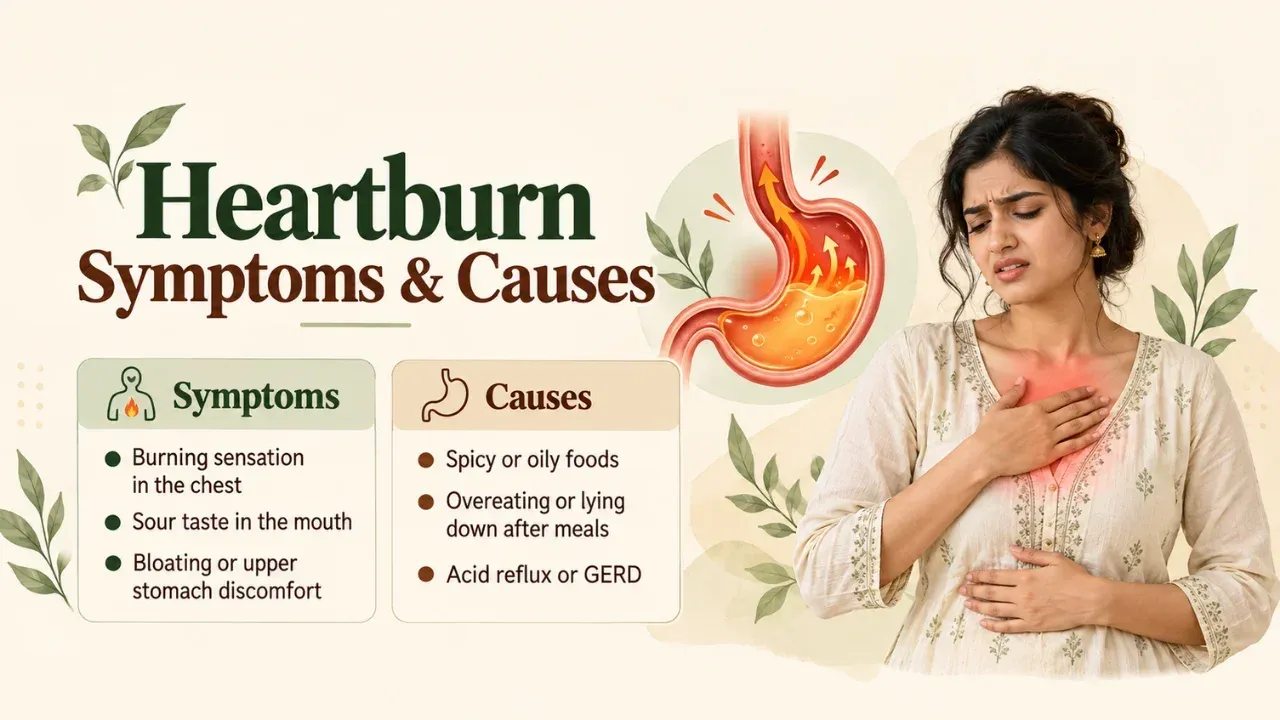
Quick Answer:
Heartburn is a burning pain in the chest caused by stomach acid flowing back into the oesophagus. The symptoms of heartburn typically worsen after eating, when lying down, or when bending over. Understanding heartburn causes and symptoms helps you manage the condition early and avoid long-term complications.
What Are the Symptoms of Heartburn?
Heartburn symptoms include a distinct set of sensations that most people can identify once they know what to look for. The primary symptom is a burning feeling in the chest, just behind the breastbone, that usually begins after eating and may last from a few minutes to several hours.
Common heartburn symptoms include:
- A burning sensation in the chest that may rise toward the throat
- A sour, acidic, or bitter taste in the back of the mouth or throat
- Difficulty swallowing or a sensation of food being stuck in the chest
- Worsening discomfort when lying down, bending forward, or exercising after meals
- Regurgitation, a feeling of acid or food coming back up into the mouth
- A persistent cough or hoarseness, particularly in the morning
- Bloating or nausea after meals
According to Mool Health's gastroenterology team, heartburn symptoms that occur two or more times per week may indicate a chronic condition such as gastro-oesophageal reflux disease (GERD). In most patients, symptoms are worse at night or within 1-2 hours of a large meal.
Also read: Heartburn
When Should You See a Doctor About Heartburn?
Occasional heartburn, affecting roughly 20-40% of adults in Western populations at some point, is common and typically manageable with lifestyle changes [1]. However, certain patterns of heartburn symptoms signal the need for medical evaluation.
See a doctor if you experience any of the following:
- Heartburn symptoms occurring more than twice per week
- Symptoms that do not improve with over-the-counter antacids after 2 weeks
- Difficulty swallowing or pain when swallowing
- Persistent nausea or vomiting
- Unintended weight loss
- Black, tarry, or bloody stools, a sign of internal bleeding
- Chest pain that is new or severe, particularly with exertion
Mool Health advises that frequent or untreated heartburn may lead to complications including oesophagitis (inflammation of the oesophagus), oesophageal stricture, or Barrett's oesophagus, a condition associated with an increased risk of oesophageal cancer. Early diagnosis typically prevents these outcomes.
Seek emergency care immediately if:
- Chest pain is severe or crushing
- Pain spreads to the arm, neck, or jaw
- You experience sudden dizziness or shortness of breath alongside chest discomfort
What Causes Heartburn?
Heartburn causes centre on the failure of the lower oesophageal sphincter (LES), a ring of muscle between the oesophagus and the stomach, to close properly after food passes through. When the LES is weakened or relaxes abnormally, stomach acid flows back into the oesophagus, producing the characteristic burning sensation.
The most common causes of heartburn include:
- Weakened lower oesophageal sphincter (LES): The LES may not seal tightly, allowing acid backflow. Certain foods and medications directly relax this muscle.
- Hiatal hernia: When the upper part of the stomach pushes through the diaphragm into the chest cavity, it disrupts the LES mechanism. Studies suggest hiatal hernias are present in up to 50% of people with GERD [2].
- Dietary triggers: Fatty or fried foods, spicy foods, citrus fruits, tomatoes, chocolate, caffeine, and alcohol are among the most frequently reported heartburn causes.
- Overeating: Large meals increase stomach pressure and the likelihood of acid reflux.
- Eating close to bedtime: Lying down within 2-3 hours of eating reduces the effect of gravity that normally keeps acid in the stomach.
- Certain medications: Non-steroidal anti-inflammatory drugs (NSAIDs) such as ibuprofen, aspirin, certain blood pressure medications, and some antidepressants can relax the LES or irritate the oesophageal lining.
- Pregnancy: Rising progesterone levels relax the LES, and the growing uterus places upward pressure on the stomach, two simultaneous causes of heartburn during pregnancy.
How Heartburn and GERD Occur
Heartburn occurs because the oesophagus lacks the protective mucous lining that shields the stomach from acid. When stomach acid, primarily hydrochloric acid with a pH as low as 1.5-3.5, makes repeated contact with oesophageal tissue, it causes irritation and inflammation.
The process follows a clear sequence:
- The LES relaxes inappropriately: Triggered by food, pressure, or a structural defect such as a hiatal hernia.
- Gastric acid refluxes upward: Stomach contents, including acid and digestive enzymes, enter the lower oesophagus.
- Oesophageal tissue is exposed to acid: The unprotected lining becomes irritated, producing the burning sensation known as heartburn.
- Nerve signals are activated: Acid contact stimulates pain receptors in the oesophageal wall, sending signals perceived as chest burning or throat discomfort.
- Repeated exposure leads to inflammation: If reflux occurs frequently, the oesophageal lining becomes chronically inflamed, a condition called oesophagitis.
GERD (gastro-oesophageal reflux disease) is the chronic form of acid reflux, diagnosed when reflux-related symptoms occur at least twice per week or when endoscopy confirms oesophageal damage. Mool Health's clinical team notes that GERD affects approximately 13-20% of the global adult population and is one of the most commonly managed gastrointestinal conditions worldwide [3].
A common misconception is that heartburn is caused by excess stomach acid alone. In many patients, what causes heartburn everyday is not overproduction of acid but a dysfunctional LES that fails to contain normal acid levels within the stomach.
What Are the Risk Factors for Heartburn?
Several conditions and lifestyle factors increase the likelihood of experiencing frequent heartburn symptoms. Mool Health identifies the following as the most clinically significant risk factors:
Lifestyle risk factors:
- Obesity: Excess abdominal fat increases intra-abdominal pressure, forcing acid upward. People with a BMI above 30 are significantly more likely to develop GERD [4].
- Smoking: Nicotine relaxes the LES and reduces saliva production. Saliva helps neutralise acid in the oesophagus.
- Alcohol consumption: Alcohol both relaxes the LES and stimulates acid production.
- High-fat or high-calorie diet: Fatty foods delay gastric emptying, keeping the stomach full and acidic for longer.
- Sedentary behaviour: Physical inactivity is associated with slower gastric motility.
Medical and physiological risk factors:
- Pregnancy: Progesterone-mediated LES relaxation and uterine pressure are direct causes of heartburn during the second and third trimesters. Up to 80% of pregnant women report heartburn symptoms at some point during pregnancy [5].
- Hiatal hernia: Disrupts the anti-reflux barrier at the gastro-oesophageal junction.
- Connective tissue disorders: Conditions such as scleroderma may affect oesophageal motility.
- Delayed gastric emptying (gastroparesis): When the stomach empties slowly, prolonged acid contact increases reflux risk.
- Zollinger-Ellison syndrome: A rare condition causing excessive acid production, representing an uncommon but serious cause of heartburn.
Medications that increase heartburn risk:
- NSAIDs (ibuprofen, naproxen, aspirin)
- Calcium channel blockers
- Certain antibiotics
- Bisphosphonates (used for osteoporosis)
- Tricyclic antidepressants
What Complications Can Heartburn Cause?
When heartburn causes go unaddressed and acid reflux becomes chronic, the repeated exposure of oesophageal tissue to stomach acid can lead to serious medical complications. Mool Health recommends prompt evaluation if heartburn symptoms persist beyond two weeks without improvement.
Key complications of chronic heartburn and GERD:
- Oesophagitis: Inflammation of the oesophageal lining, causing pain, bleeding, and difficulty swallowing. Erosive oesophagitis is identified in approximately 30% of patients undergoing endoscopy for GERD symptoms [6].
- Oesophageal stricture: Repeated acid damage leads to scarring and narrowing of the oesophagus, making swallowing progressively more difficult. This typically develops after years of untreated reflux.
- Barrett's oesophagus: Chronic acid exposure causes the normal oesophageal cells to be replaced by cells resembling those of the intestinal lining, a condition known as intestinal metaplasia. Barrett's oesophagus affects approximately 5-15% of people with chronic GERD and carries an elevated risk of oesophageal adenocarcinoma [7].
- Oesophageal adenocarcinoma: The most serious complication of long-term GERD and Barrett's oesophagus. While the absolute risk remains low, its incidence has risen significantly over recent decades.
- Chronic laryngitis and respiratory complications: Acid reaching the throat and airways can cause hoarseness, chronic cough, asthma exacerbations, and recurrent chest infections.
- Dental erosion: Acidic regurgitation that reaches the mouth can erode tooth enamel over time.
- Sleep disruption: Nocturnal heartburn symptoms affect sleep quality in a significant proportion of GERD patients, with downstream effects on mood, cognition, and overall health.
Complications are largely preventable with timely diagnosis and appropriate management. Mool Health advises that patients with Barrett's oesophagus undergo regular endoscopic surveillance, typically every 3-5 years, to monitor for cellular changes.
References
[1] Dent J, et al. Epidemiology of gastro-oesophageal reflux disease: a systematic review. Gut. 2005;54(5):710-717.
[2] Pandolfino JE, et al. Hiatal hernia and the lower oesophageal sphincter. American Journal of Gastroenterology. 2006.
[3] El-Serag HB, et al. Update on the epidemiology of gastro-oesophageal reflux disease: a systematic review. Gut. 2014;63(6):871-880.
[4] Hampel H, et al. Meta-analysis: obesity and the risk for gastroesophageal reflux disease. Annals of Internal Medicine. 2005;143(3):199-211.
[5] Richter JE. Review article: the management of heartburn in pregnancy. Alimentary Pharmacology & Therapeutics. 2005;22(9):749-757.
[6] Vakil N, et al. The Montreal definition and classification of gastroesophageal reflux disease. American Journal of Gastroenterology. 2006;101(8):1900-1920.
[7] Hvid-Jensen F, et al. Incidence of adenocarcinoma among patients with Barrett's oesophagus. New England Journal of Medicine. 2011;365(15):1375-1383.
Key Takeaways
- Heartburn symptoms include a burning chest sensation, sour taste, regurgitation, and difficulty swallowing, typically worsening after meals or when lying down.
- The primary cause of heartburn is a weakened or dysfunctional lower oesophageal sphincter (LES) that allows stomach acid to flow back into the oesophagus.
- Common heartburn causes include fatty foods, caffeine, alcohol, smoking, obesity, pregnancy, hiatal hernia, and certain medications such as NSAIDs.
- GERD is diagnosed when heartburn symptoms occur at least twice per week or when oesophageal damage is confirmed, affecting an estimated 13-20% of adults globally.
- Pregnancy causes heartburn in up to 80% of women due to hormonal LES relaxation and uterine pressure on the stomach.
- Chronic untreated heartburn can lead to oesophagitis, oesophageal stricture, Barrett's oesophagus, and in rare cases, oesophageal cancer.
- See a doctor if heartburn symptoms occur more than twice per week, do not respond to antacids within 2 weeks, or are accompanied by swallowing difficulty or unintended weight loss.
Your gut is unique your healing should be too.

FAQs
Sitting upright, drinking a glass of water, or taking an antacid can provide short-term relief for heartburn-related chest pain. Avoiding lying down after eating and elevating the head of the bed by 15-20 cm may reduce nocturnal symptoms. If chest pain is severe or accompanied by arm or jaw pain, seek emergency medical care immediately.
The most common causes of heartburn are a weakened lower oesophageal sphincter, dietary triggers such as fatty foods and caffeine, overeating, obesity, smoking, and certain medications. In many patients, what causes heartburn everyday is a combination of dietary habits and a structurally compromised LES rather than a single factor.
Yes. Pregnancy is a direct cause of heartburn in many women. Rising progesterone levels relax the lower oesophageal sphincter, and the expanding uterus increases abdominal pressure. Up to 80% of pregnant women experience heartburn symptoms, most commonly during the second and third trimesters. Symptoms typically resolve after delivery.
Water, low-fat milk, and non-citrus herbal teas such as chamomile or ginger tea may help soothe heartburn symptoms. Drinks to avoid include coffee, alcohol, carbonated beverages, and citrus juices, as these are established heartburn causes that worsen acid reflux.
Daily heartburn typically indicates GERD rather than occasional reflux. Persistent causes of heartburn every day may include a hiatal hernia, chronic LES dysfunction, ongoing dietary triggers, obesity, or continuous use of medications that relax the LES. Daily heartburn warrants medical evaluation, as it can lead to oesophageal complications if untreated.
Heartburn symptoms are typically a burning sensation in the chest, often worsened by food and relieved by antacids. Heart attack pain is more often described as pressure or crushing, may radiate to the arm, neck, or jaw, and is typically accompanied by sweating, shortness of breath, or nausea. When in doubt, always seek emergency medical assessment.
Disclaimer
The content provided by Mool Health is for educational and informational purposes only and should not be considered a substitute for professional medical advice, diagnosis, or treatment.