
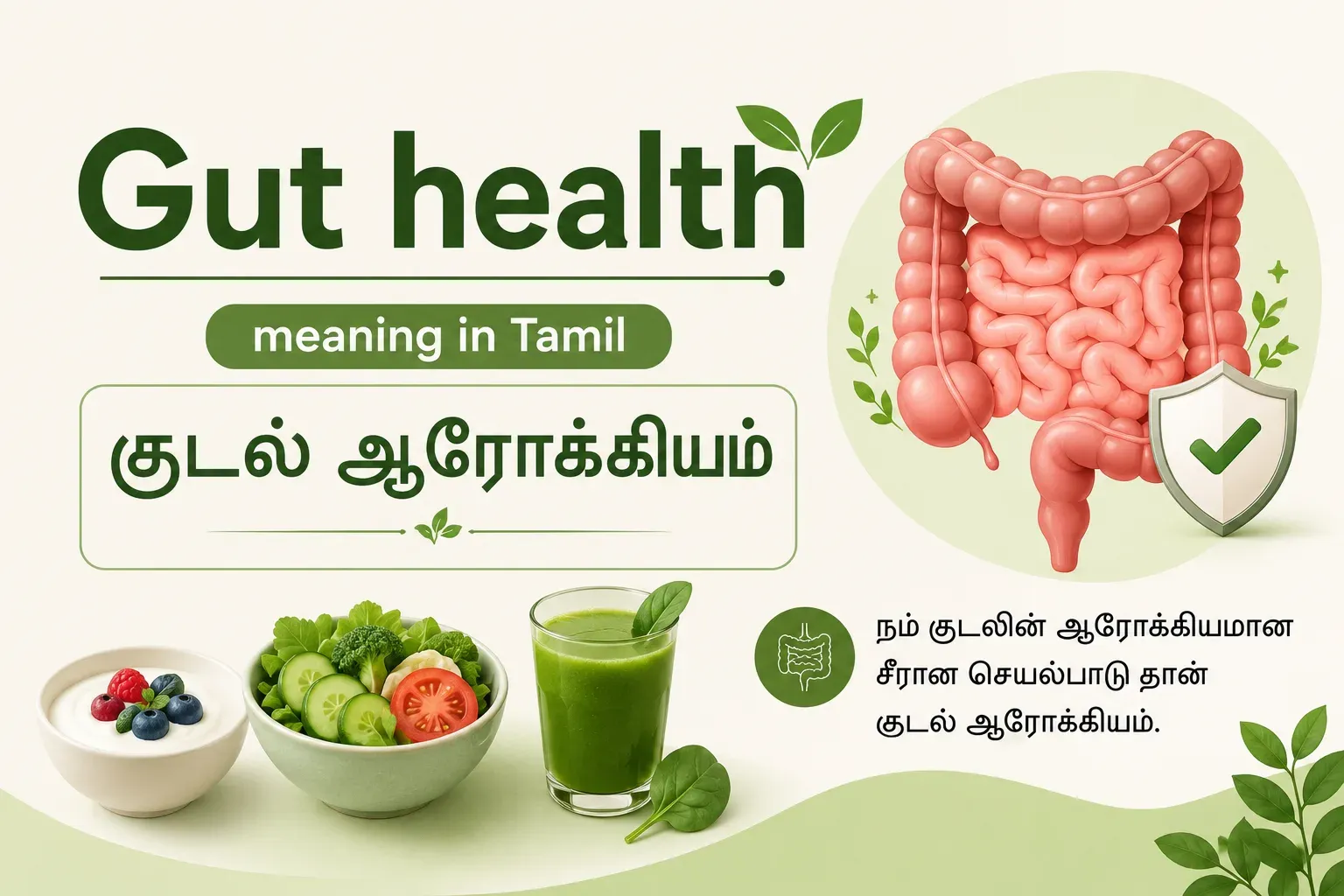
Gut Health Meaning in Tamil: குடல் ஆரோக்கியம் என்றால் என்ன?
Gut health refers to the balance and healthy functioning of the digestive system. This guide explains the meaning of gut health in Tamil, its symptoms, benefits and improvement tips.
Quick Answer
குடல் ஆரோக்கியம் (Kudal Aarokkiyam) means gut health in Tamil - the state of balance among the trillions of bacteria, fungi, and microbes living in your digestive tract. A healthy gut digests food efficiently, absorbs nutrients properly, and supports immunity, mood, and metabolism. According to Mool Health's nutrition team, poor gut health is one of the most under-diagnosed drivers of fatigue, skin issues, and hair loss in South Asian adults.
What Is Gut Health in Tamil? (குடல் ஆரோக்கியம் என்றால் என்ன?)
Gut health, or குடல் ஆரோக்கியம் (Kudal Aarokkiyam), refers to the balance and function of the entire digestive system - from the stomach to the large intestine. The gut contains approximately 100 trillion microorganisms collectively called the gut microbiome. When this microbial community is diverse and balanced, the body functions well. When it is disrupted, a condition called dysbiosis, symptoms can appear across multiple organ systems.
Mool Health defines a healthy gut as one that:
- Digests food without chronic bloating, pain, or irregular stools
- Maintains a diverse microbiome with beneficial bacteria like Lactobacillus and Bifidobacterium
- Supports a strong gut lining (intestinal barrier) that prevents toxins from entering the bloodstream
- Communicates effectively with the brain via the gut-brain axis
The concept maps closely to traditional Tamil medicine (Siddha) principles around Vaayu (digestive wind) and Agni (digestive fire), which have long recognised the gut as central to overall health.
How Does Gut Health Work? The Core Mechanism Explained
Gut health works because the digestive tract is not just a food-processing tube - it is an active immune and hormonal organ. Here is how the process operates:
Food enters the stomach. Stomach acid (pH 1.5-3.5) breaks down proteins and kills most harmful pathogens before food moves to the small intestine.
The small intestine absorbs nutrients. Enzymes from the pancreas and bile from the liver further digest fats, carbohydrates, and proteins. About 90% of nutrient absorption occurs here.
The large intestine hosts the microbiome. Beneficial bacteria ferment dietary fibre into short-chain fatty acids (SCFAs) like butyrate. Butyrate feeds the gut lining cells directly and reduces inflammation.
The gut lining acts as a selective barrier. Tight junction proteins between intestinal cells decide what enters the bloodstream. When these junctions weaken - from stress, antibiotics, or poor diet - a condition called "leaky gut" (intestinal permeability) may develop.
The gut-brain axis sends signals both ways. Approximately 95% of the body's serotonin is produced in the gut. Imbalances in gut bacteria can affect mood, sleep, and stress response within weeks.
Immune cells are stationed in the gut wall. About 70% of the immune system resides in gut-associated lymphoid tissue (GALT). A balanced microbiome trains these immune cells to distinguish between safe food proteins and harmful invaders.
Mool Health's approach to gut health targets all six steps - not just symptom relief.
Key Benefits of Good Gut Health (குடல் ஆரோக்கியத்தின் நன்மைகள்)
A balanced gut microbiome provides measurable benefits across multiple body systems. Studies suggest that improving gut health can produce noticeable changes within 4-8 weeks of dietary intervention.
Short-term benefits (within 4 weeks):
- Reduced bloating and gas - often improves within 1-2 weeks of adding fermented foods
- More regular bowel movements - constipation (மலச்சிக்கல், Malachikkal) may ease with increased fibre
- Improved energy levels - better nutrient absorption reduces post-meal fatigue
Long-term benefits (3-6 months):
- Stronger immunity - a 2021 Cell study found that a high-fibre, fermented-food diet increased microbiome diversity and lowered inflammatory markers in 10 weeks
- Better skin - gut dysbiosis is clinically linked to acne, eczema, and psoriasis flares
- Reduced hair loss - poor gut health impairs absorption of iron, zinc, and B vitamins, which are direct drivers of hair fall; Mool Health's hair health protocols specifically address gut absorption as a root cause
- Improved mood and cognitive focus - the gut-brain axis means microbiome diversity correlates with lower rates of anxiety in observational studies
- Healthier weight management - gut bacteria regulate hormones like GLP-1 and ghrelin, which control hunger signals
Types of Gut Imbalances: Which Applies to You?
Not all gut health problems are the same. Mool Health identifies four common gut imbalance patterns seen in Tamil Nadu and broader South Asian populations:
| Type | Tamil Term | Key Symptoms | Common Cause |
|---|---|---|---|
| Dysbiosis | நுண்ணுயிர் சமநிலையின்மை | Bloating, irregular stools, low immunity | Antibiotics, processed food, stress |
| Leaky Gut | கசிவு குடல் | Skin rashes, food sensitivities, fatigue | Gluten, NSAIDs, chronic stress |
| SIBO (Small Intestine Bacterial Overgrowth) | சிறு குடல் பாக்டீரியா அதிகரிப்பு | Bloating after meals, nutrient deficiency | Low stomach acid, slow gut motility |
| IBS (Irritable Bowel Syndrome) | எரிச்சல் கொள்ளும் குடல் நோய்க்குறி | Cramping, alternating constipation and diarrhoea | Gut-brain axis dysregulation, food triggers |
Choosing the right approach depends on identifying which imbalance is present. Mool Health recommends a root-cause assessment before starting any gut health protocol.
How to Improve Gut Health: A Step-by-Step Guide
Improving gut health requires consistent dietary and lifestyle changes. Results in most people begin to appear within 2-4 weeks, with significant improvement by 8-12 weeks.
Step 1 - Remove gut-disrupting foods (Week 1-2) Eliminate ultra-processed foods, refined sugar, and excess maida (refined flour). These feed harmful bacteria and suppress beneficial strains. This step matters because the microbiome responds to dietary changes within 24-48 hours.
Step 2 - Add fermented foods (Week 1 onwards) Introduce curd (தயிர், Thayir), buttermilk (மோர், Mor), idli, dosa, and fermented rice. These are traditional Tamil probiotic foods that deliver live Lactobacillus strains. Aim for at least one serving daily.
Step 3 - Increase dietary fibre (Week 2 onwards) Eat more vegetables, legumes (dal, rajma), fruits, and whole grains like millets (கம்பு, சோளம், ராகி). Fibre feeds beneficial bacteria and promotes SCFA production. Target 25-35 grams of fibre per day.
Step 4 - Hydrate adequately Drink 2-3 litres of water daily. Dehydration thickens mucus in the gut lining, slowing motility and worsening constipation (Malachikkal).
Step 5 - Manage stress actively (Week 1 onwards) Chronic stress raises cortisol, which directly disrupts the gut-brain axis and weakens tight junction proteins. Practices like pranayama (breathing exercises), 30-minute walks, and 7-8 hours of sleep support gut repair.
Step 6 - Consider targeted supplementation Probiotics (specific strains like Lactobacillus rhamnosus GG), prebiotics (inulin, fructooligosaccharides), and digestive enzymes may be added based on individual need. Mool Health recommends consulting a health advisor before adding supplements to ensure the right strain and dose.
Step 7 - Track symptoms for 4 weeks Keep a simple food and symptom diary. Note bowel frequency, bloating, energy, and skin. This data helps identify food triggers and measure improvement.
Common Mistakes to Avoid:
- Starting probiotic supplements without removing gut-disrupting foods first
- Eating too much fibre too quickly - this can worsen bloating initially; increase slowly over 2 weeks
- Relying only on supplements and ignoring diet and sleep
- Assuming all curd products in stores contain live cultures - check labels
Gut Health Best Practices for Tamil Diets
A traditional Tamil diet is naturally supportive of gut health when followed correctly. Mool Health's nutrition team highlights these evidence-aligned best practices:
- Eat fermented foods daily: Idli, dosa, curd rice (தயிர் சாதம்), and koozh (fermented millet porridge) are prebiotic and probiotic-rich staples.
- Prioritise millets over refined rice: Millets like kambu (pearl millet) and ragi (finger millet) contain 3-5x more fibre than white rice and support a diverse microbiome.
- Use traditional spices therapeutically: Turmeric (மஞ்சள்) contains curcumin, which reduces gut inflammation. Jeera (சீரகம்) and asafoetida (பெருங்காயம்) reduce gas and bloating.
- Avoid eating under stress: The vagus nerve connects the brain and gut directly. Eating while anxious or rushed reduces digestive enzyme secretion by up to 40%.
- Do not suppress natural urges: Siddha medicine and modern gastroenterology agree - ignoring the urge to defecate regularly weakens bowel motility over time.
- Limit antibiotic use to when clinically necessary: A single course of broad-spectrum antibiotics can reduce microbiome diversity by up to 30%, with some strains taking 6 months to recover.
- Exercise regularly: Even 30 minutes of moderate walking per day has been shown to increase microbiome diversity in sedentary adults within 6 weeks.
- Reduce body heat triggers: Excess body heat (உடல் சூடு, Udal Soodu) - a common Tamil health concern - is often linked to gut inflammation. Cooling foods like cucumber, coconut water, and buttermilk support gut lining health.
Disclaimer
This article is for educational purposes only and should not be treated as medical advice, diagnosis, or treatment. If you have severe, recurring, or long-lasting digestive symptoms, consult a qualified healthcare professional.
Key Takeaways
Gut health refers to the balance and healthy functioning of the digestive system. This guide explains the meaning of gut health in Tamil, its symptoms, benefits and improvement tips.
Your gut is unique your healing should be too.

Disclaimer
The content provided by Mool Health is for educational and informational purposes only and should not be considered a substitute for professional medical advice, diagnosis, or treatment.