
How Digestion Works: Problems, Remedies and Gut Health Tips
A complete pillar guide explaining digestion, common problems, natural improvement tips, sleeping position, yoga and Mool Health’s gut-first approach.
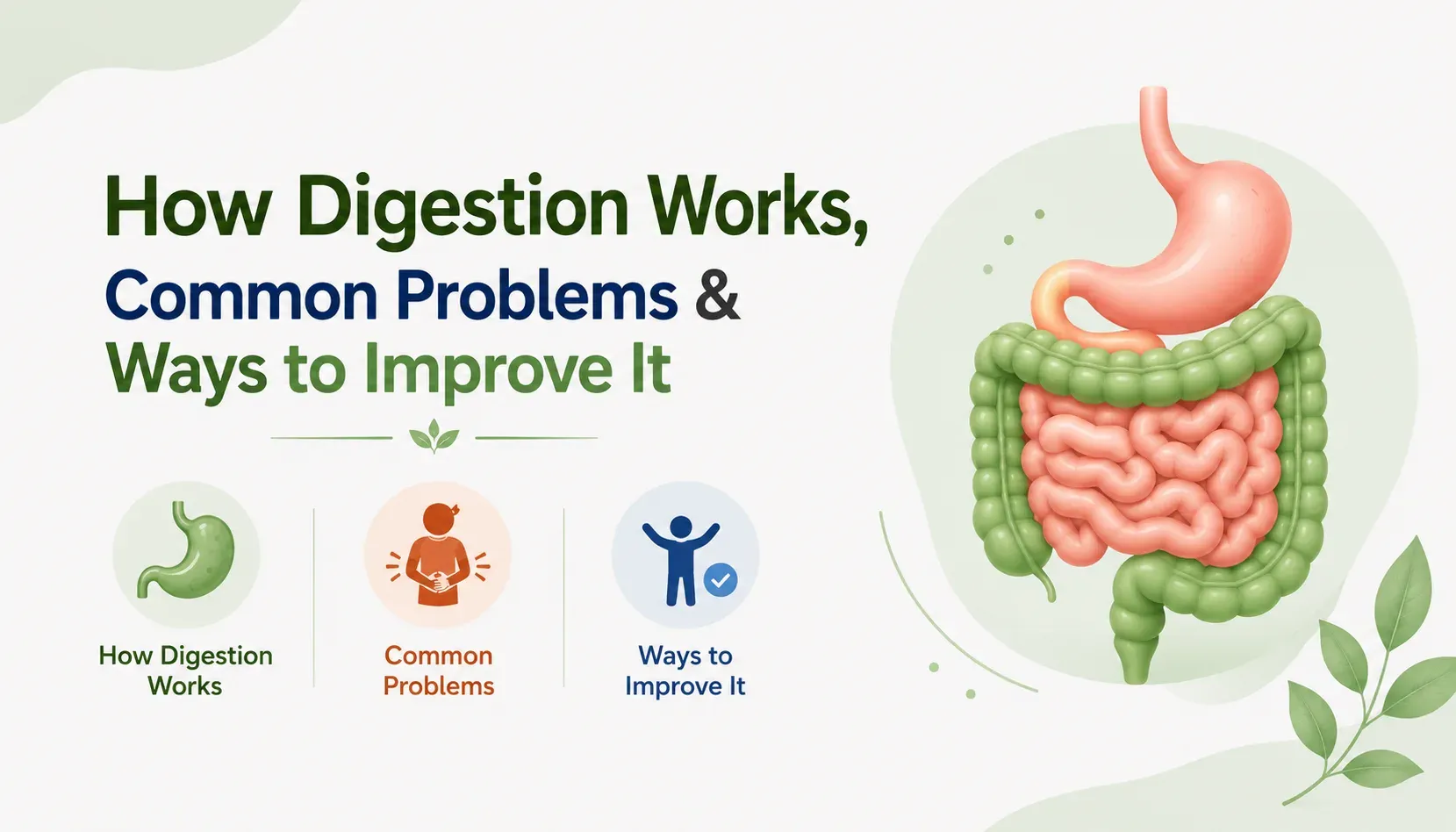
Quick Answer
Your digestive system breaks down the food you consume into essential nutrients your body uses for energy storage, tissue growth, cell repair, and overall survival. The digestive system relies on a 30-foot tract in which the muscular contractions and digestive juices transform the food physically and chemically.
Digestion is the biological process by which the body breaks down food into smaller, water-soluble components. When this system functions well, it supports your immune system and contributes to overall health.
Many people experience digestive discomfort every day, from bloating and acidity to constipation and stomach pain. What you eat and how your body processes it are equally important. Understanding digestion can help you make informed choices that support better gut health and overall wellness.
The Process of Digestion
Digestion occurs in the digestive process, which takes place within your gastrointestinal (GI) tract. The digestion process includes mechanical and chemical breakdown that occurs through chewing and churning of food, followed by enzymes and acids that break it down, enabling the absorption of vital nutrients, with undigested waste expelled.
Without digestion, even the healthiest meal would be useless because your body wouldn't be able to access the nutrients inside it. Here’s a short overview of how the process of digestion takes place:
| Organ | Step | How It Breaks Down Your Food |
|---|---|---|
| Mouth | Ingestion | Chewing grinds food and mixes it with saliva to create a soft, easy-to-swallow mix. |
| Oesophagus | Transport | Muscle contractions (peristalsis) move food down the oesophagus and into the stomach. The lower oesophageal sphincter then closes to prevent backflow. |
| Stomach | Breakdown | Strong acids churn food into a smooth liquid, starting the protein breakdown. |
| Small Intestine | Absorption | Enzymes break down food into tiny pieces, allowing the small intestine’s lining to absorb vital nutrients and vitamins directly into your bloodstream. |
| Large Intestine | Elimination | The body reclaims leftover water and packs away solid waste for removal. |
Digestion Problem
Digestion problems are health conditions in which the body has difficulty digesting and absorbing food. You might face digestive issues affecting the oesophagus, stomach, intestines, liver, gallbladder, and pancreas.
| Digestive Organ / Gland | Types of Digestion Problems |
|---|---|
| Oesophagus (Food Pipe) | Acid reflux (GERD), swallowing problems, and inflammation. |
| Stomach | Gastritis, stomach ulcers, indigestion, and gastroparesis. |
| Small Intestine | Celiac disease, Crohn's disease, and poor nutrient absorption. |
| Large Intestine (Colon) | Irritable Bowel Syndrome (IBS), constipation, diarrhoea, and colitis. |
| Liver | Fatty liver disease, hepatitis, and liver failure. |
| Gallbladder | Gallstones, gallbladder inflammation, and blocked bile ducts. |
| Pancreas | Pancreatitis (inflammation), lack of digestive enzymes. |
How to Improve Digestion?
When persistent digestive issues occur, the problem doesn't simply lie in what you eat or how you live; it's the underlying condition of your gut. Healing starts by addressing core internal imbalances rather than working on symptoms with temporary lifestyle fixes.
Lifestyle changes support gut health, but for ongoing or chronic symptoms, they may not be enough on their own to provide lasting relief from chronic bloating, gas, or acidity.
When lifestyle is not the sole cause of gut and digestion issues, making minor adjustments fails to cure all discomfort. So, to improve digestion, you need to focus on the root cause and address the issue beyond surface-level dietary rules.
A few things that can significantly help to improve digestion are:
- Maintain microbiome balance: When beneficial bacteria are depleted, the gut is vulnerable to harmful pathogens. Increasing beneficial gut bacteria through diet or targeted supplementation can help restore microbiome balance, which may reduce symptoms like gas and bloating.
- Activate your digestive enzymes: When the digestive enzyme cycle slows down, the body may fail to produce or utilise the enzymes necessary to break down food effectively. Supporting your body's enzyme production through diet, targeted supplementation, or treating the underlying cause helps it break down food and absorb nutrients more efficiently.
- Repair the gut mucosal barrier: A weakened or irritated gut lining can lead to recurring discomfort, regardless of diet quality, lifestyle, or habits. Take doctor-recommended medications that repair and strengthen your delicate inner lining to stop recurring pain and discomfort.
How to Improve Digestion Naturally at Home?
Fixing core gut health is the best way to solve all your digestion problems. But if your digestive problems stem from certain lifestyle habits, you can try a few home remedies that help reduce inflammation, naturally soothe and support your digestive tract, and target symptoms.
A few healthy, sustainable practices that you can try out at home to naturally improve digestion are:
- Hydrate Well: Staying well hydrated supports digestion. Some people find warm water easier on the stomach, though evidence that warm vs cold water affects digestion is limited. Avoid chugging large amounts of water right before or during a meal to prevent diluting your natural digestive enzymes.
- Practice Mindful Eating: Make sure you chew your food thoroughly to reduce strain on your stomach, since digestion begins in the mouth. Try to eat in a calm environment, away from screens and other distractions.
- Maintain Consistent Timings: Align your meals with natural daylight hours and stick to consistent meal intervals to keep your gut's rhythm stable. Keep your dinner light.
- Utilise Soothing Ayurvedic Herbs: You can incorporate time-tested, chemical-free herbs such as Sunth (dry ginger), Jeera (cumin), and Yashtimadhu (liquorice). They help to stimulate your digestive fire, prevent bloating and heal the stomach lining.
- Move After Meals: Take gentle, short walks after eating to stimulate metabolism and improve gut mobility without overtaxing your system. Avoid lying down immediately after meals.
- Manage Stress Early: Chronic stress disrupts gut function through the gut-brain axis, triggering inflammation, altering gut motility, and weakening the gut lining, all of which can worsen digestive symptoms. Reducing stress helps in improving digestion and overall wellness.
- Prioritise Restful Sleep: When you sleep for seven to eight hours each night, it allows the digestive system to rest, your gut repairs its mucosal lining and regulates the gut microbiome by balancing its bacteria while you sleep.
Best Sleeping Position for Digestion
Sleeping position matters a lot for your digestion, as posture can affect how your body heals or processes overnight. Experts widely recommend sleeping on the left side, as this position uses gravity to aid digestion and alleviate acid reflux. This posture also enhances blood circulation and supports optimal lymphatic drainage.
Some key benefits of sleeping on the left side for digestion are:
- Keeps stomach acid down: Due to the anatomical position of the stomach and the lower oesophageal sphincter, lying on your left side positions the stomach lower than the oesophagus, significantly reducing the risk of acid reflux and night-time heartburn.
- Speeds up stomach emptying: Because the stomach is situated naturally on the left side of your body, this posture lets gravity help food empty from the stomach and enter the small intestine more smoothly.
- Eases gas and bloating: Sleeping on your left side helps align the stomach and the small intestine so that trapped gas can gather in the upper part of the stomach. This makes it much easier to release the gas through natural burping, thereby reducing overnight bloating and gastric discomfort.
- Promotes excretion in the morning: Sleeping on your left side allows gravity to gently guide waste into the descending colon, which naturally rests on the left side of your body, encouraging an easier bowel movement when you wake up.
Yoga for Digestion
Yoga aids digestion by providing a gentle, mechanical internal massage to the organs, boosting blood flow, and activating the parasympathetic nervous system to relieve bloating and constipation. While yoga cannot detox the organs or alter their biological functions, it helps improve blood flow, stimulate digestion, and reduce stress.
A few yoga asanas that you can practice for effective digestion are:
Vajrasana (Thunderbolt Pose)
- To sit in Vajrasana, kneel on the mat, keeping your knees together and feet flat.
- Bring your big toes together, part your heels, and lower your hips to sit comfortably between them with a straight back.
- This pose is safe to practice immediately after eating, as it directs blood flow to the lower abdomen, aiding the breakdown of heavy meals.
Pawanmuktasana (Wind-Relieving Pose)
- Lie flat on your back, hug your knees tightly to your chest with clasped hands, and exhale as you lift your head to touch your chin or nose to your knees.
- Initially, you might not be able to touch your chin or nose, but with practice, you'll build the flexibility to do it.
- This gently compresses the abdomen to effectively release trapped gas and reduce bloating.
Bhujangasana (Cobra Pose)
- Lie flat on your stomach, place your palms under your shoulders, and inhale as you gently lift your chest off the floor while keeping your pelvis and lower body down.
- This stretches the abdomen and tones the internal organs, which massages vital organs like the liver, stomach, and intestines.
- It improves digestion by gently compressing and stimulating the secretion of digestive juices.
Ardha Matsyendrasana (Sitting Half Spinal Twist)
- Sit with your legs crossed, place your right foot outside your left knee, and twist your upper body to the right while hugging your knee with your left arm.
- The twisting motion wrings out the digestive tract to promote gut motility.
- This asana rotates the spine to ease stiffness, improve posture, and squeeze the abdomen to stimulate the liver and kidneys, thereby improving digestion.
Note - Skip this pose or consult a doctor if you have severe back or spine injuries, or have undergone abdominal, hip, or knee surgery recently, have a hernia or have peptic ulcers. Avoid deep twists if you are pregnant.
Malasana (Garland Pose)
- Squat deeply with your feet slightly wider than your hips, press your elbows against your inner knees, and bring your palms together at your chest with a straight back.
- This is a powerful pose for digestion because it uses gravity and deep compression to move waste through your body.
- This asana stimulates the digestive tract and helps relieve pelvic congestion or constipation.
Pranayama (Deep Diaphragmatic Breathing)
- Sit comfortably with one hand on your chest and the other on your belly, inhale deeply through your nose to expand your stomach, and exhale slowly as your belly sinks back in.
- Deep diaphragmatic breathing activates the parasympathetic nervous system, often called the rest-and-digest response, which promotes optimal digestive function.
Mool Health’s Perspective on Digestion
Mool Health approaches digestion as a whole system rather than as a collection of isolated symptoms. When you experience digestive issues, it is rarely a lifestyle problem or the fault of a single food item. It is more about why digestion is poor in the first place.
The Mool Health Gut Test helps identify whether you need enzymes, probiotics, fibre, Ayurvedic digestive support, or a broader gut-health plan. We focus on an approach that works on the root cause by blending modern science with Ayurvedic principles.
Key Takeaways
A complete pillar guide explaining digestion, common problems, natural improvement tips, sleeping position, yoga and Mool Health’s gut-first approach.
Your gut is unique your healing should be too.

FAQs
Digestion is a biological process that involves the mechanical digestion, the physical breakdown of food into smaller pieces, and the chemical digestion, when digestive enzymes and stomach acids break down complex macronutrients into smaller absorbable molecules.
Drink warm ginger tea , peppermint tea, buttermilk, or kokum sarbat right after a meal. These drinks help your stomach break down food, reduce bloating, and cool down signs of acidity.
One widely used model describes seven steps of digestion: ingestion, mechanical digestion, chemical digestion, propulsion, absorption, assimilation, and excretion.
According to the 4-stage model of digestion, the key stages of digestion are: Ingestion: taking food in, Digestion: breaking it down, Absorption: soaking up nutrients, Elimination: the removal of waste from the body.
The main organs of digestion are the gastrointestinal (GI) tract, which includes the mouth, oesophagus, stomach, small intestine, and large intestine, and the accessory organs, which are the liver, pancreas and gallbladder.
No, the digestion of starch does not start in the stomach. It actually begins right in the mouth, where the saliva helps break down complex carbohydrates (starch), initiating digestion by moistening and lubricating food, making it easier to swallow.
Disclaimer
The content provided by Mool Health is for educational and informational purposes only and should not be considered a substitute for professional medical advice, diagnosis, or treatment.