
Sandesh Pol's Journey from Irregularity to Feeling Better
Sandesh’s gut health journey shows how Mool Health’s personalised gut test, targeted kit, coaching, and small lifestyle changes helped improve bloating and irregularity.
Ayurvedic Physician & Medical Operations Lead at Mool
Published on 8,September 2026
Updated on 8,September 2026
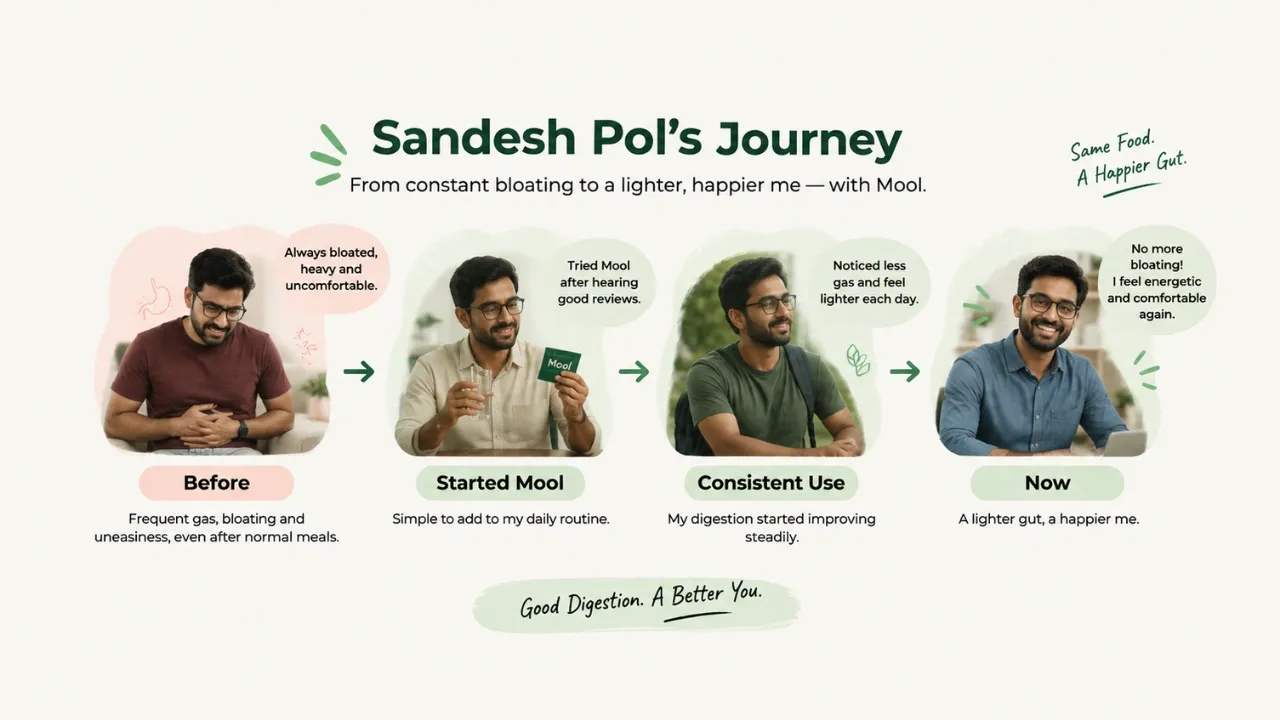
Sandesh had been irregular for years. Not occasionally — consistently. Bloating after every meal, sluggish mornings, and a gut that felt like it was working against him. He had tried fibre supplements, cut out certain foods, and read enough articles to diagnose himself with everything and nothing at the same time. Then a colleague mentioned Mool Health.
This is what happened next.
"I Just Wanted to Feel Normal Again"
Sandesh wasn't looking for a transformation story. He was looking for answers.
He was 34, working long hours in Pune, eating whatever was convenient, and dealing with bloating and irregular bowel movements that had become his baseline. He had normalised the discomfort to the point where he stopped noticing it — until he couldn't ignore it anymore.
A friend mentioned that Mool Health offered a gut test online. No clinic visit. No waiting room. Just a test taken through the Mool Health website that would actually look at what was happening inside his gut, not just guess based on symptoms.
He decided to try it.
What the Mool Health Gut Test Actually Showed
The gut test on the Mool Health website was straightforward. Sandesh answered detailed questions about his diet, digestion, lifestyle, sleep, stress levels, and symptoms. It wasn't a generic quiz — it felt specific. The questions asked things he hadn't been asked before, like how his energy felt after eating versus before, and whether his irregularity was more about frequency or consistency.
Within a short time, Mool Health generated a personalised gut health report based on his responses.
The report identified three key patterns in Sandesh's case:
- Low dietary fibre intake from consistently skipping vegetables and eating refined carbohydrates
- Disrupted meal timing that was affecting his gut's natural rhythm
- High stress load that was likely contributing to gut motility issues
For the first time, Sandesh had a picture of what was actually going on — not a self-diagnosed list of possibilities, but a structured, personalised assessment from Mool Health that connected the dots between his habits and his symptoms.
The Mool Health Kit: Built Around His Results
Based on his gut test results, Mool Health generated a personalised Mool Health Kit — a set of targeted supplements and dietary support designed specifically for the issues identified in his assessment.
This is an important distinction: the Mool Health Kit was not an off-the-shelf product. It was built around what Sandesh's gut actually needed, based on the test he had taken. Someone with different results would receive a different kit.
Sandesh didn't have to guess what to take or research which supplement was "best for bloating." Mool Health had already done that work based on his specific profile.
But he wasn't just handed a kit and left to figure it out.
The Coach Made the Difference
After his gut test results were ready, Sandesh was connected with a Mool Health coach.
The coach walked him through his report — what the findings meant in plain language, why those specific items were included in his Mool Health Kit, and what dietary and lifestyle changes would work alongside the kit to produce real results.
This part surprised Sandesh. He had expected a product recommendation. What he got was a conversation.
The coach explained, for example, that his irregular bowel movements were likely linked to both low fibre and inconsistent mealtimes — and that the kit would address the fibre gap, but that eating at more consistent times would significantly speed up improvement. This kind of specific, causal explanation — X is happening because Y — was exactly what Sandesh had been missing from every generic article he had read.
The coach also made clear that the decision to buy the Mool Health Kit was entirely Sandesh's. There was no pressure. The gut test and the coaching conversation were available regardless.
Sandesh decided to buy the kit.
What Weeks 1 and 2 Looked Like
Sandesh started his Mool Health Kit and made three changes the coach had suggested:
- Added one serving of vegetables to lunch every day
- Fixed his dinner time to 8:00 PM instead of whenever he got home
- Took his Mool Health Kit supplements consistently, morning and night
The first week felt mostly the same. He had been told to expect this — his gut needed time to adjust, and changes in gut rhythm typically take 7–14 days to become noticeable. He stayed consistent.
By the end of week two, something shifted. His mornings felt slightly easier. The bloating after lunch was still present but less intense. He was going to the bathroom more regularly — not perfectly, but noticeably more predictably than before.
He messaged his Mool Health coach. The coach confirmed this was a typical early sign of progress and adjusted one recommendation based on how Sandesh's body had responded.
Month One: The Fog Started Lifting
By the end of the first month, Sandesh noticed changes he hadn't even listed as goals.
- Regularity improved significantly. He was no longer spending mornings anxious about whether his gut would cooperate.
- Bloating reduced by what felt like 60–70%. Meals that used to leave him uncomfortable were no longer doing that consistently.
- Morning energy was better. He attributed this partly to better sleep — less gut discomfort at night meant less disrupted rest.
- Mental clarity improved. This one surprised him. Research suggests the gut-brain axis can influence cognitive function and mood [1], and Sandesh felt this anecdotally.
He hadn't changed his entire diet. He hadn't joined a gym. He had made three targeted changes, used his Mool Health Kit consistently, and stayed in contact with his coach.
What the Research Says About Personalised Gut Interventions
Sandesh's experience isn't unusual. Studies on gut health increasingly suggest that personalised interventions outperform generic dietary advice because they target the specific imbalances present in an individual's gut profile.
Key evidence supporting personalised gut health approaches:
- A 2015 study published in Cell found that identical foods caused significantly different blood sugar responses in different individuals, suggesting that personalised dietary guidance is more effective than universal guidelines [1].
- Research on dietary fibre and gut motility consistently shows that increasing fibre intake can improve bowel regularity within 2–4 weeks in individuals with low baseline intake [2].
- Studies on the gut-brain axis indicate that gut microbiome health is associated with mood, energy levels, and cognitive clarity — areas Sandesh noticed improving [3].
Mool Health's approach — test first, then build a personalised kit, then coach the individual through it — aligns with this evidence base. Generic solutions tend to produce generic (and often inconsistent) results.
Month Three: A Different Baseline
At the three-month mark, Sandesh did something he hadn't done in years: he stopped thinking about his gut on a daily basis.
That sounds small. It isn't.
When digestive irregularity is your norm, it occupies mental space constantly — before meals, during meals, in the morning, when you're out. By month three, Sandesh had re-established a baseline where his gut worked predictably enough that he no longer tracked it anxiously.
He described it simply: "I just feel normal. That's all I wanted."
His Mool Health coach confirmed that at this stage, many users transition from an active correction phase to a maintenance phase — where the habits are embedded, the gut has re-regulated, and the focus shifts to sustaining rather than improving.
Is Sandesh's Experience Typical? What to Realistically Expect
Mool Health's approach is designed to be personalised, so results vary depending on individual gut health, consistency with the kit, dietary habits, and stress levels. That said, based on the Mool Health framework, here is a realistic timeline:
| Timeframe | What Typically Happens |
|---|---|
| Week 1–2 | Adjustment period; some early changes in frequency or bloating |
| Week 3–4 | Noticeable improvement in regularity; reduced post-meal discomfort |
| Month 2 | Energy and mood improvements often become apparent |
| Month 3 | New baseline established; gut functions more predictably |
| Month 3+ | Maintenance phase; habit-based sustaining of results |
Results depend heavily on consistency. Sandesh's coach emphasised this from the start — the Mool Health Kit works best when paired with the dietary adjustments identified in the gut test. The kit alone, without any lifestyle change, is less effective than the kit combined with even small, targeted habit shifts.
Who Is the Mool Health Approach Right For?
Based on Sandesh's experience and the Mool Health framework, this approach works best for people who fit certain patterns.
Ideal For
- People with chronic digestive irregularity that hasn't resolved with generic supplements
- Individuals who want to understand the why behind their symptoms, not just mask them
- Those willing to make small but consistent dietary and lifestyle adjustments alongside a kit
- People who want personalised guidance rather than a one-size-fits-all protocol
Less Suited For
- Those expecting instant results without any lifestyle changes
- Individuals with acute gastrointestinal conditions that require medical diagnosis and treatment
- People who are unwilling to take the gut test seriously or engage with the coaching process
Mool Health is not a quick fix. It is a structured, personalised process — and that's exactly why it worked for Sandesh.
Key Takeaways
- The gut test comes first. Sandesh's results were personalised because the Mool Health gut test mapped his specific symptoms, habits, and lifestyle before any recommendation was made.
- The Mool Health Kit is not generic. Each kit is generated based on individual test results, which is why it addressed Sandesh's actual issues rather than common symptoms.
- Coaching bridges the gap between diagnosis and action. Without the Mool Health coach explaining the why behind each recommendation, Sandesh may have followed the kit less consistently.
- Small, targeted changes compound. Sandesh made three specific adjustments — not a lifestyle overhaul — and saw significant improvement within 4–8 weeks.
- Results take consistency, not perfection. Early weeks showed minimal change; sustained results appeared by week 4 and continued improving through month 3.
Your gut is unique your healing should be too.

Disclaimer
The content provided by Mool Health is for educational and informational purposes only and should not be considered a substitute for professional medical advice, diagnosis, or treatment.