
Prebiotic vs Probiotic: What's the Difference for Gut Health?
This blog on Prebiotic vs Probiotic explains the key differences between prebiotics and probiotics, how they support gut health, their benefits, and how to choose the right option for a healthier digestive system.
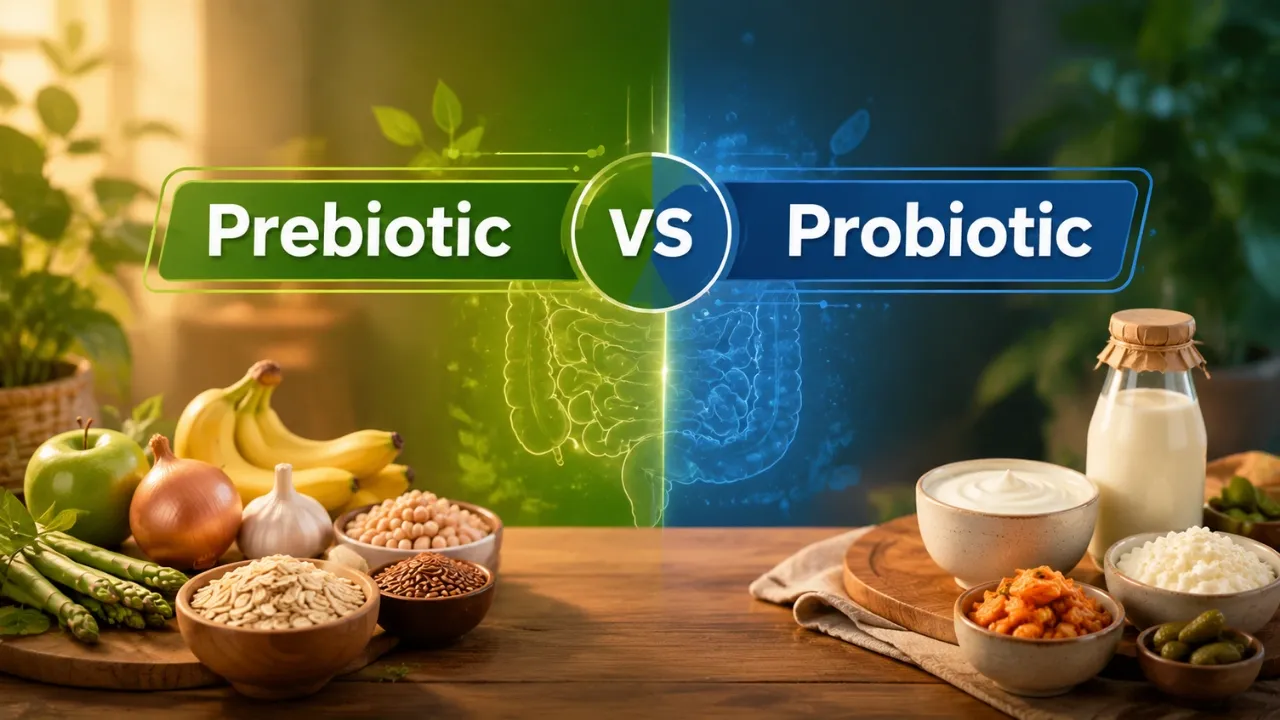
✏️ Quick Answer
Prebiotics are non-digestible fibers that feed beneficial gut bacteria, while probiotics are live beneficial bacteria that directly populate your gut. Both support digestive health but through different mechanisms. Understanding the prebiotic vs probiotic difference helps you choose the right approach, or use both together, for better gut health outcomes.
- Prebiotics: Feed existing beneficial bacteria , found in garlic, onion, banana, oats
- Probiotics: Add new live beneficial bacteria , found in curd, kefir, kimchi, yoghurt
- Synbiotics: Both combined , the most effective approach for most people
- Time to benefit: Probiotics work in 1-2 weeks; prebiotics in 2-4 weeks
- Best for most people: Food-first approach , supplements only for specific conditions
What Is the Prebiotic vs Probiotic Difference? A Complete Guide
The prebiotic vs probiotic meaning comes down to function: prebiotics are food for bacteria, probiotics are the bacteria themselves.
Prebiotics are dietary fibers and compounds , such as inulin, fructooligosaccharides (FOS), and galactooligosaccharides (GOS) , that pass undigested through the small intestine and ferment in the colon. This fermentation selectively feeds beneficial bacterial strains like Lactobacillus and Bifidobacterium.
Probiotics are live microorganisms , primarily bacteria and some yeasts , that, when consumed in adequate amounts, confer a measurable health benefit on the host. Common strains include Lactobacillus acidophilus, Bifidobacterium longum, and Saccharomyces boulardii. For guidance on choosing the right probiotic for digestive issues, see which probiotic is best for diarrhea.
Postbiotics are a third category: the bioactive compounds produced when probiotics ferment prebiotics. These include short-chain fatty acids (SCFAs) like butyrate, which directly nourish colon cells.
What Is Better: Prebiotics or Probiotics?
Neither is universally superior. According to the Mool Health nutrition science team, the right choice depends on your specific gut health goal:
- If your gut microbiome is already reasonably diverse, prebiotics may be sufficient to strengthen existing bacterial populations
- If you have recently taken antibiotics or have a depleted microbiome, probiotics may be more immediately effective at repopulating beneficial strains
- For most people, using both together , a combination called a synbiotic , produces the most consistent results
How Prebiotic vs Probiotic Works: The Complete Breakdown
Prebiotics and probiotics work through distinct but complementary biological pathways.
How Probiotics Work
- Colonization: Live bacteria from probiotic foods or supplements travel through the digestive tract. Stomach acid and bile salts destroy a portion; surviving strains reach the colon.
- Competitive exclusion: Beneficial bacteria compete with harmful pathogens for adhesion sites on the gut lining, physically reducing pathogen colonization.
- Immune modulation: Probiotic strains interact with intestinal epithelial cells and immune cells, stimulating production of secretory IgA and anti-inflammatory cytokines.
- Metabolite production: Probiotics produce bacteriocins (natural antibiotics), lactic acid, and SCFAs that lower gut pH, creating an environment hostile to harmful bacteria.
How Prebiotics Work
- Selective fermentation: Prebiotic fibers reach the colon undigested because the human body lacks enzymes to break them down in the small intestine.
- Bacterial fuel: Beneficial bacteria ferment these fibers, producing SCFAs , primarily butyrate, propionate, and acetate.
- Structural support: Butyrate directly fuels colonocyte (colon cell) regeneration and strengthens the intestinal barrier, reducing intestinal permeability. For more on intestinal permeability, see what is leaky gut syndrome.
- Microbiome shift: Regular prebiotic intake measurably increases the ratio of beneficial Bifidobacterium species within 2-4 weeks, according to fermentation studies.
How Synbiotics Work
When prebiotics and probiotics are taken together, prebiotics act as a preferential fuel source for the probiotic strains, improving their survival and colonization rate. Mool Health formulations that combine both components leverage this synbiotic effect to maximize gut microbiome impact.
Key Benefits of Prebiotic vs Probiotic: What You Actually Gain
Prebiotics and probiotics each offer distinct benefits. Some benefits overlap when both are used together.
Probiotic Benefits
- Reduced antibiotic-associated diarrhea: Meta-analyses suggest probiotics reduce this risk by approximately 51%
- Improved IBS symptoms: Studies show a 40-57% reduction in bloating and discomfort in patients with common IBS symptoms using specific Lactobacillus and Bifidobacterium strains
- Immune support: Regular probiotic intake may reduce the duration of upper respiratory infections by 1-2 days
- Vaginal microbiome health: Lactobacillus rhamnosus strains have shown efficacy in reducing recurrent bacterial vaginosis
- Mental health correlation: The gut-brain axis research shows associations between probiotic use and reduced anxiety scores, though evidence is still preliminary. For more on how stress and gut health interact, see our dedicated guide
Prebiotic Benefits
- Increased calcium absorption: Inulin-type fructans can increase calcium absorption by up to 20% in adolescents
- Improved bowel regularity: Prebiotic fibers add bulk and support transit time, reducing constipation in adults
- Blood sugar regulation: Fermentation of prebiotic fibers slows glucose absorption, supporting post-meal blood sugar stability
- Reduced appetite: SCFAs produced from prebiotic fermentation stimulate release of gut hormones PYY and GLP-1, which signal satiety
- Stronger gut barrier: Butyrate from prebiotic fermentation supports tight junction proteins that maintain intestinal wall integrity
Combined (Synbiotic) Benefits
- Faster microbiome rebalancing after antibiotic use
- More sustained probiotic colonization compared to probiotics alone
- Greater SCFA production, amplifying anti-inflammatory effects
How Long Does It Take to See Benefits?
- Probiotics: Digestive symptom improvement typically appears within 1-2 weeks of consistent use
- Prebiotics: Measurable changes in microbiome composition generally occur within 2-4 weeks
- Synbiotics: Full benefits may take 4-8 weeks of daily use, depending on baseline gut health and diet
Types of Prebiotics and Probiotics: Which Is Right for You?
Types of Prebiotics
| Prebiotic Type | Food Sources | Primary Benefit |
|---|---|---|
| Inulin | Chicory root, garlic, onion | Feeds Bifidobacterium; improves bowel regularity |
| Fructooligosaccharides (FOS) | Banana, asparagus, leek | Increases SCFA production |
| Galactooligosaccharides (GOS) | Legumes, human breast milk | Supports infant microbiome; reduces IBS symptoms |
| Resistant starch | Green banana, cooked and cooled rice or potato | Feeds diverse microbial species; improves insulin sensitivity |
| Pectin | Apple skin, citrus peel | Supports gut barrier; may reduce LDL cholesterol |
Types of Probiotics
| Probiotic Strain | Common Source | Primary Use Case |
|---|---|---|
| Lactobacillus acidophilus | Yogurt, kefir | Diarrhea prevention; vaginal health |
| Bifidobacterium longum | Fermented dairy, supplements | IBS; antibiotic recovery |
| Lactobacillus rhamnosus GG | Supplements | Antibiotic-associated diarrhea; childhood diarrhea |
| Saccharomyces boulardii | Supplements (yeast-based) | Traveler's diarrhea prevention; C. difficile prevention |
| Streptococcus thermophilus | Yogurt | Lactose digestion support |
Probiotic Food Types vs. Probiotic Supplements
- Probiotic foods (yogurt, kefir, kimchi, sauerkraut, miso) provide live cultures alongside nutritional cofactors. However, colony-forming unit (CFU) counts are variable and often lower than supplements. Curd (dahi) for gut is an accessible daily probiotic food for Indian households
- Probiotic supplements deliver standardized CFU counts (typically 1-50 billion CFU per dose) with verified strain identity. They are more reliable for therapeutic use
- Mool Health recommends a food-first approach for general wellness, with targeted supplementation for specific health conditions
Prebiotic vs Probiotic vs Alternatives: An Honest Comparison
| Factor | Prebiotics | Probiotics | Synbiotics | Postbiotics | Dietary Fiber Only |
|---|---|---|---|---|---|
| What it contains | Non-digestible fibers | Live microorganisms | Both prebiotics + probiotics | Metabolites from fermentation | Mixed plant fibers |
| Primary action | Feeds existing gut bacteria | Adds new beneficial bacteria | Feeds and replenishes bacteria | Delivers ready-made metabolites | Improves transit; feeds some bacteria |
| Speed of effect | 2-4 weeks | 1-2 weeks | 2-4 weeks | 1-2 weeks | 1-3 weeks |
| Ideal user | Adequate baseline microbiome | Post-antibiotic; IBS sufferers | Most users; comprehensive support | Sensitive guts; supplement-averse | General digestive health |
| Stability | Shelf-stable | Requires refrigeration (many types) | Requires refrigeration (many types) | Generally shelf-stable | Shelf-stable |
| Risk of side effects | Mild bloating initially | Rare; higher in immunocompromised | Mild bloating initially | Very low | Mild bloating initially |
| Cost (monthly) | Low to moderate | Moderate to high | Moderate to high | Moderate | Low |
Myth vs Reality
| Myth | Reality |
|---|---|
| "Probiotics permanently colonize your gut" | Most probiotic strains are transient. They support gut health during their passage but do not permanently establish. |
| "More CFUs always means better results" | Strain specificity matters more than CFU count. A well-researched strain at 5 billion CFU often outperforms a generic blend at 50 billion CFU. |
| "Prebiotics are just fiber" | Not all fiber is prebiotic. To qualify, a fiber must be selectively fermented by beneficial bacteria , not all dietary fibers meet this criterion. |
| "Probiotics are only for digestive problems" | Research supports probiotic roles in immune health, mental health (gut-brain axis), skin health, and metabolic function. |
Who Should Avoid Taking Probiotics?
Probiotics are generally safe for healthy adults. However, the following groups should consult a doctor before use:
- People with severely compromised immune systems (e.g., undergoing chemotherapy, organ transplant recipients)
- Critically ill or hospitalized patients
- Those with short bowel syndrome or central venous catheters
- Premature infants (only specific strains under medical supervision)
How to Get Started with Prebiotics and Probiotics: Step-by-Step Guide
Step 1: Assess Your Current Gut Health
Identify your primary goal , antibiotic recovery, IBS management, general wellness, or immune support. This determines whether to prioritize prebiotics, probiotics, or both. For long-term digestive resilience, see how to avoid gastric problems.
Step 2: Choose a Food-First Approach
Incorporate prebiotic-rich foods (garlic, onion, banana, oats, asparagus) and probiotic-rich foods (yogurt, kefir, kimchi, tempeh) into your daily meals before turning to supplements. This builds microbiome diversity naturally.
Step 3: Add Supplements If Needed
If food-based intake is insufficient or you have a specific condition, choose supplements with:
- Identified strain names (e.g., L. rhamnosus GG, not just "Lactobacillus")
- Verified CFU count at time of expiry, not just at manufacture
- Third-party testing certification
Step 4: Start Low, Go Slow
Begin with a low dose of prebiotics , especially inulin and FOS , to minimize initial bloating. Increase over 2-3 weeks as your gut adapts.
Step 5: Be Consistent for at Least 4 Weeks
Single-use or sporadic supplementation is unlikely to produce measurable results. Daily consistency for a minimum of 4 weeks is required to observe microbiome-level changes.
Step 6: Track and Adjust
Monitor changes in stool frequency, bloating, energy, and any specific symptoms you aimed to address. Reassess at 4 and 8 weeks.
Common Mistakes to Avoid
- Taking probiotics with hot liquids: Heat above 40°C (104°F) kills live cultures
- Stopping at first bloating: Mild gas and bloating in the first 1-2 weeks is a normal adaptation response, not a sign the product is harmful
- Choosing supplements based on price alone: The cheapest option rarely has verified strain identity or adequate CFU counts
- Ignoring diet: Supplements cannot compensate for a low-fiber diet. Prebiotics need dietary fiber to work effectively
Who Should Use Prebiotics vs Probiotics? Ideal Use Cases
| Profile | Prebiotics Ideal? | Probiotics Ideal? | Synbiotics Ideal? |
|---|---|---|---|
| Post-antibiotic recovery | Supportive | ✅ Yes , primary choice | ✅ Best option |
| IBS with bloating | ⚠️ Start very low dose | ✅ Yes , strain-specific | ✅ With medical guidance |
| General gut maintenance | ✅ Yes | ✅ Yes | ✅ Yes |
| Immunocompromised individual | ✅ Generally safe | ⚠️ Consult doctor first | ⚠️ Consult doctor first |
| Infant or young child | ✅ GOS (in formula) | ✅ Selected strains only | ✅ Under pediatric guidance |
| Traveler's diarrhea prevention | Limited evidence | ✅ S. boulardii or LGG | Moderate benefit |
| Type 2 diabetes management | ✅ Resistant starch | ✅ L. acidophilus strains | ✅ Emerging evidence |
| Healthy adult, no symptoms | ✅ Food sources first | ✅ Food sources first | Optional |
Real-World Use Cases: Synbiotic Strategies That Work
Use Case 1: Antibiotic Recovery
A course of broad-spectrum antibiotics can reduce gut microbial diversity by up to 30%. Starting probiotics (L. rhamnosus GG or S. boulardii) during antibiotic treatment and continuing for 2 weeks after, combined with prebiotic fiber from oats and banana, can substantially accelerate microbiome recovery.
Use Case 2: Managing IBS-C (Constipation-Predominant IBS)
Resistant starch and partially hydrolyzed guar gum (PHGG) , both prebiotics , combined with Bifidobacterium infantis 35624 have shown symptom improvement in IBS-C patients in controlled trials. Mool Health recommends this combination under clinical supervision for IBS management.
Use Case 3: Childhood Diarrhea
Lactobacillus rhamnosus GG reduces the duration of acute watery diarrhea in children by approximately 1 day and reduces hospitalization risk. Prebiotic GOS in infant formulas also supports establishment of a healthy microbiome in non-breastfed infants.
Use Case 4: Mental Health Support (Gut-Brain Axis)
Emerging research on the gut-brain axis suggests that specific probiotic strains (L. helveticus R0052 and B. longum R0175) may reduce cortisol levels and anxiety scores in adults under psychological stress. Prebiotic-rich diets also show associations with lower perceived stress, possibly through SCFA-mediated vagal nerve signaling.
Use Case 5: Bone Health in Adolescents
Prebiotic inulin-type fructans (8g/day) have been shown to increase calcium absorption by approximately 20% in adolescent girls, supporting peak bone mass development during a critical growth window. This represents an emerging role for prebiotics beyond digestive health.
Key Takeaways
This blog on Prebiotic vs Probiotic explains the key differences between prebiotics and probiotics, how they support gut health, their benefits, and how to choose the right option for a healthier digestive system.
Your gut is unique your healing should be too.

Disclaimer
The content provided by Mool Health is for educational and informational purposes only and should not be considered a substitute for professional medical advice, diagnosis, or treatment.