
Inflammatory Bowel Disease ICD-10: Types & Classification
Inflammatory Bowel Disease ICD-10 codes help classify and document conditions such as Crohn’s disease and ulcerative colitis. Learn the key ICD-10 codes, their meanings, diagnosis details, and how different types of IBD are coded.
Quick Answer
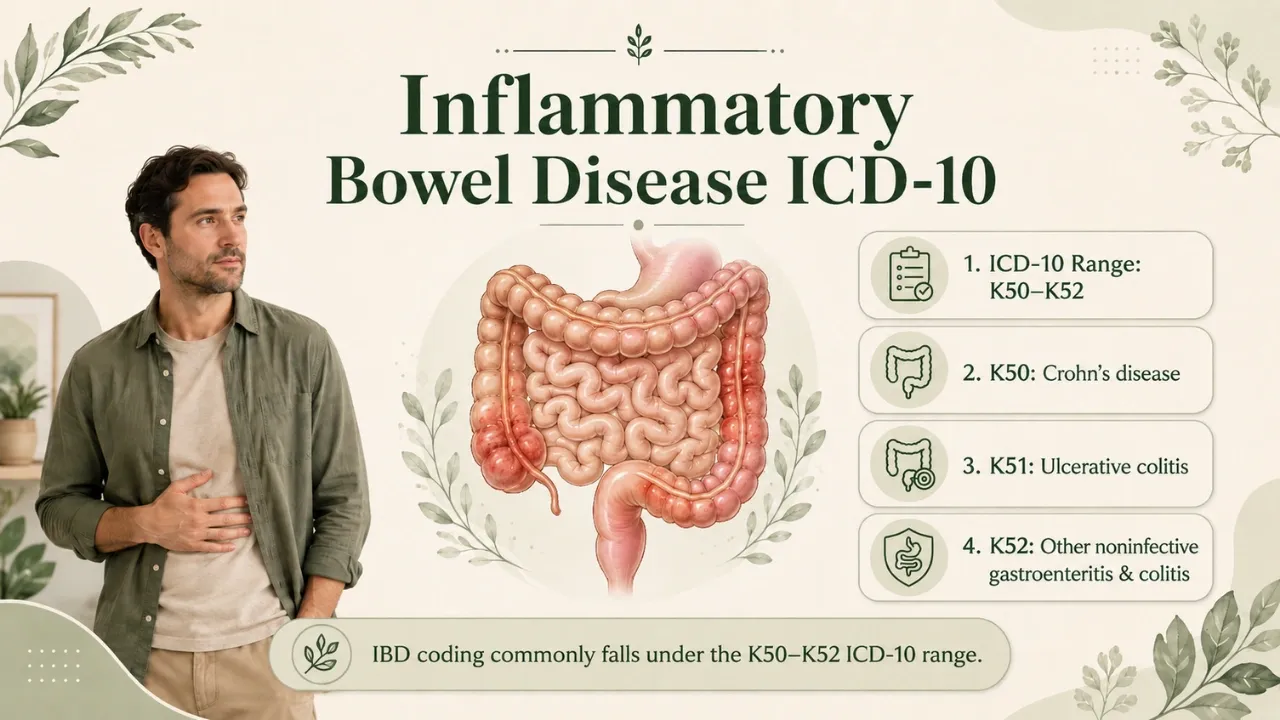
The ICD-10 codes used for inflammatory bowel disease span K50–K52: K50 for Crohn's disease, K51 for ulcerative colitis, and K52 for other noninfective gastroenteritis and colitis. More specific subcodes are selected according to disease location and complications.
Inflammatory Bowel Disease ICD-10 Code: Complete Guide
The ICD-10 code for inflammatory bowel disease (IBD) is K50–K52, covering Crohn's disease (K50), ulcerative colitis (K51), and other noninfective gastroenteritis and colitis (K52). These codes are used by clinicians, coders, and insurers to classify, document, and bill for IBD diagnoses accurately.
What Is the ICD-10 Code for Inflammatory Bowel Disease?
The ICD-10 code for inflammatory bowel disease falls under Chapter XI: Diseases of the Digestive System, block K50–K52. The World Health Organization's International Classification of Diseases, 10th Revision (ICD-10) assigns these codes to help standardise IBD documentation across hospitals, clinics, and insurance systems globally.
Core ICD-10 codes for IBD:
- K50 — Crohn's disease (regional enteritis)
- K50.0 — Crohn's disease of small intestine
- K50.1 — Crohn's disease of large intestine
- K50.8 — Other Crohn's disease
- K50.9 — Crohn's disease, unspecified
- K51 — Ulcerative colitis
- K51.0 — Ulcerative (chronic) pancolitis
- K51.2 — Ulcerative (chronic) proctitis
- K51.9 — Ulcerative colitis, unspecified
- K52 — Other noninfective gastroenteritis and colitis
In clinical practice, the fourth and fifth characters of the ICD-10 code specify disease location, severity, and any complications such as rectal bleeding or abscess.
What Is Inflammatory Bowel Disease? Definition and Meaning
Inflammatory bowel disease (IBD) is a group of chronic inflammatory conditions that affect the gastrointestinal (GI) tract. IBD primarily includes two conditions — Crohn's disease and ulcerative colitis — both involving abnormal immune responses that cause persistent inflammation in the digestive system.
Inflammatory bowel disease meaning in Hindi: IBD को हिंदी में "सूजन आंत्र रोग" कहते हैं। यह एक दीर्घकालिक बीमारी है जिसमें पाचन तंत्र में सूजन होती है।
According to Mool Health's gastroenterology team, IBD is not the same as irritable bowel syndrome (IBS). IBD causes measurable structural damage to the bowel wall, while IBS is a functional disorder with no visible inflammation.
Key facts about IBD:
- Affects an estimated 6.8 million people worldwide [1]
- Onset most commonly occurs between ages 15 and 35
- IBD is a lifelong, relapsing-remitting condition — not a temporary infection
- Both Crohn's disease and ulcerative colitis carry an increased risk of colorectal cancer over time
What Are the Three Types of Inflammatory Bowel Disease?
Inflammatory bowel disease is broadly classified into three main types, each with distinct ICD-10 codes and clinical features.
| Type | ICD-10 Code | Location Affected | Key Feature |
|---|---|---|---|
| Crohn's Disease | K50 | Any part of GI tract (mouth to anus) | Transmural (full-thickness) inflammation; skip lesions |
| Ulcerative Colitis | K51 | Colon and rectum only | Continuous mucosal inflammation; starts at rectum |
| Indeterminate Colitis | K52.3 | Colon | Features of both Crohn's and UC; difficult to classify |
Crohn's Disease (K50)
Crohn's disease can affect any segment of the GI tract. Inflammation in Crohn's is transmural, meaning it penetrates all layers of the bowel wall. This makes it more likely to cause complications such as fistulas, strictures, and abscesses. Approximately 30% of Crohn's patients require surgery within 10 years of diagnosis.
Ulcerative Colitis (K51)
Ulcerative colitis affects only the colon and rectum. Inflammation is mucosal — limited to the innermost lining — and spreads continuously from the rectum upward. In severe cases, surgery involving removal of the colon (colectomy) may be recommended.
Indeterminate Colitis (K52.3)
Indeterminate colitis is diagnosed when pathology findings do not clearly distinguish between Crohn's disease and ulcerative colitis. Around 5–15% of IBD cases fall into this category, according to gastroenterology literature [2].
What Are the Symptoms of Inflammatory Bowel Disease?
Inflammatory bowel disease symptoms vary by type and severity but typically include the following:
Common symptoms of IBD:
- Persistent diarrhoea, often with blood or mucus
- Abdominal cramping and pain, particularly in the lower or central abdomen
- Urgent need to defecate (tenesmus)
- Unexplained weight loss
- Fatigue and low energy
- Fever during flare-ups
- Anaemia due to chronic blood loss
Extraintestinal manifestations (affecting organs outside the gut) can also occur:
- Joint pain (arthropathy) — in approximately 20–30% of IBD patients
- Skin conditions such as erythema nodosum
- Eye inflammation (uveitis or episcleritis)
- Liver involvement (primary sclerosing cholangitis, more common in UC)
According to Mool Health's clinical team, symptom onset is often gradual, and many patients experience a delay of 18 months to 3 years between first symptoms and confirmed IBD diagnosis.
How Is Inflammatory Bowel Disease Diagnosed and Coded?
Accurate ICD-10 coding for inflammatory bowel disease requires a confirmed clinical diagnosis. The diagnostic process typically involves multiple steps.
Step-by-step diagnostic process:
- Clinical assessment — Review of symptoms, family history, and medication use
- Blood tests — Full blood count (anaemia), CRP and ESR (inflammation markers), faecal calprotectin (bowel inflammation marker; >250 µg/g is strongly indicative of IBD)
- Stool culture — To rule out infectious causes (important before assigning a K50–K52 code)
- Colonoscopy with biopsy — Gold standard for IBD diagnosis; provides visual and histological confirmation
- Imaging — MRI enterography or CT scan to assess disease extent and complications in Crohn's
- ICD-10 code assignment — Based on confirmed location, disease type, and presence of complications
Common coding errors to avoid:
- Using K52.9 (noninfective gastroenteritis, unspecified) when a confirmed Crohn's or UC diagnosis exists
- Failing to add a fifth character to specify complications (e.g., rectal bleeding, abscess)
- Coding IBD as IBS — these are distinct conditions with different codes
Mool Health recommends that clinical coders always reference the histopathology report before finalising an ICD-10 code for IBD.
ICD-10 Code for IBD vs. Related Conditions: Key Comparisons
| Condition | ICD-10 Code | Distinguishing Feature |
|---|---|---|
| Crohn's Disease | K50 | Transmural; any GI segment; skip lesions |
| Ulcerative Colitis | K51 | Mucosal; colon/rectum; continuous pattern |
| Irritable Bowel Syndrome (IBS) | K58 | No structural inflammation; functional disorder |
| Infectious Gastroenteritis | A00–A09 | Caused by bacteria, virus, or parasite |
| Microscopic Colitis | K52.8 | Normal colonoscopy; diagnosed on biopsy only |
| Diverticulitis | K57 | Inflamed pouches in colon wall; not autoimmune |
The ICD-10 code for inflammatory bowel disease (K50–K52) is distinct from IBS (K58) because IBD involves objective, measurable inflammation, while IBS does not. This distinction matters for treatment planning, insurance coverage, and specialist referral pathways.
Inflammatory Bowel Disease Treatment Overview
IBD is a chronic condition, and treatment aims to induce and maintain remission rather than cure the disease. According to Mool Health's clinical advisory panel, treatment is selected based on disease type, location, and severity.
IBD treatment categories:
- Aminosalicylates (5-ASA) — First-line for mild-to-moderate ulcerative colitis (e.g., mesalazine)
- Corticosteroids — Used for short-term flare control; not suitable for long-term use due to side effects
- Immunomodulators — Azathioprine, 6-mercaptopurine; reduce immune activity over 3–6 months
- Biologics — Anti-TNF agents (infliximab, adalimumab), vedolizumab, ustekinumab; used in moderate-to-severe IBD
- JAK inhibitors — Tofacitinib; approved for moderate-to-severe ulcerative colitis
- Surgery — Required in approximately 25–40% of UC patients and up to 70–80% of Crohn's patients over a lifetime
Inflammatory bowel disease treatment in Hindi: IBD का उपचार बीमारी की गंभीरता पर निर्भर करता है। इसमें दवाइयाँ (जैसे स्टेरॉयड, इम्यूनोमॉड्युलेटर, बायोलॉजिक्स) और कुछ मामलों में सर्जरी शामिल हो सकती है। उपचार का लक्ष्य सूजन को कम करना और रोग को नियंत्रण में रखना है।
Who Is Most Affected by Inflammatory Bowel Disease?
| Group | Relevance to IBD |
|---|---|
| Adults aged 15–35 | Peak age of onset for both Crohn's and UC |
| People with family history of IBD | First-degree relatives have 10–15× higher risk |
| Smokers | Smoking increases Crohn's risk; may reduce UC risk (complex relationship) |
| Urban populations | Higher IBD prevalence in industrialised countries |
| South Asian populations in India | Rising IBD incidence — UC more common than Crohn's in Indian patients [3] |
| IBD not ideal for self-diagnosis | Symptoms overlap with IBS, infections, and colorectal cancer |
According to data from Indian gastroenterology studies, UC incidence in India is rising, particularly in urban centres, making accurate ICD-10 coding increasingly relevant for Indian healthcare providers [3].
Research and Evidence: What Studies Say About IBD
Key findings from current IBD research:
- A 2023 global prevalence study estimated 6.8 million people live with IBD worldwide, with the highest burden in North America and Europe [1]
- Faecal calprotectin levels above 250 µg/g have a sensitivity of approximately 83% for detecting IBD in symptomatic adults [2]
- Indian data suggests UC prevalence of 44.3 per 100,000 population in certain urban regions, with incidence rising at approximately 18% per decade [3]
- Biologic therapies achieve clinical remission in 30–50% of patients with moderate-to-severe Crohn's disease within 12 weeks of induction [4]
- Early initiation of immunomodulators may reduce hospitalisation rates by up to 40% in Crohn's disease patients [4]
Mool Health's clinical team notes that while research is advancing rapidly, IBD remains a lifelong condition — early and accurate diagnosis, including correct ICD-10 classification, is foundational to good long-term outcomes.
Key Takeaways
- K50–K52 cover IBD: K50 for Crohn's disease, K51 for ulcerative colitis, and K52 for other noninfective colitis.
- IBD and IBS are different: IBD causes structural inflammation, while IBS is a functional disorder coded under K58.
- Use the most specific code: Coding depends on the confirmed disease type, location, and complications.
Your gut is unique your healing should be too.

Disclaimer
The content provided by Mool Health is for educational and informational purposes only and should not be considered a substitute for professional medical advice, diagnosis, or treatment.