
Which Side to Sleep on for Better Digestion: Left vs Right
Learn whether left or right-side sleeping is better for digestion, how sleep position affects nighttime reflux, and how long to wait after meals.
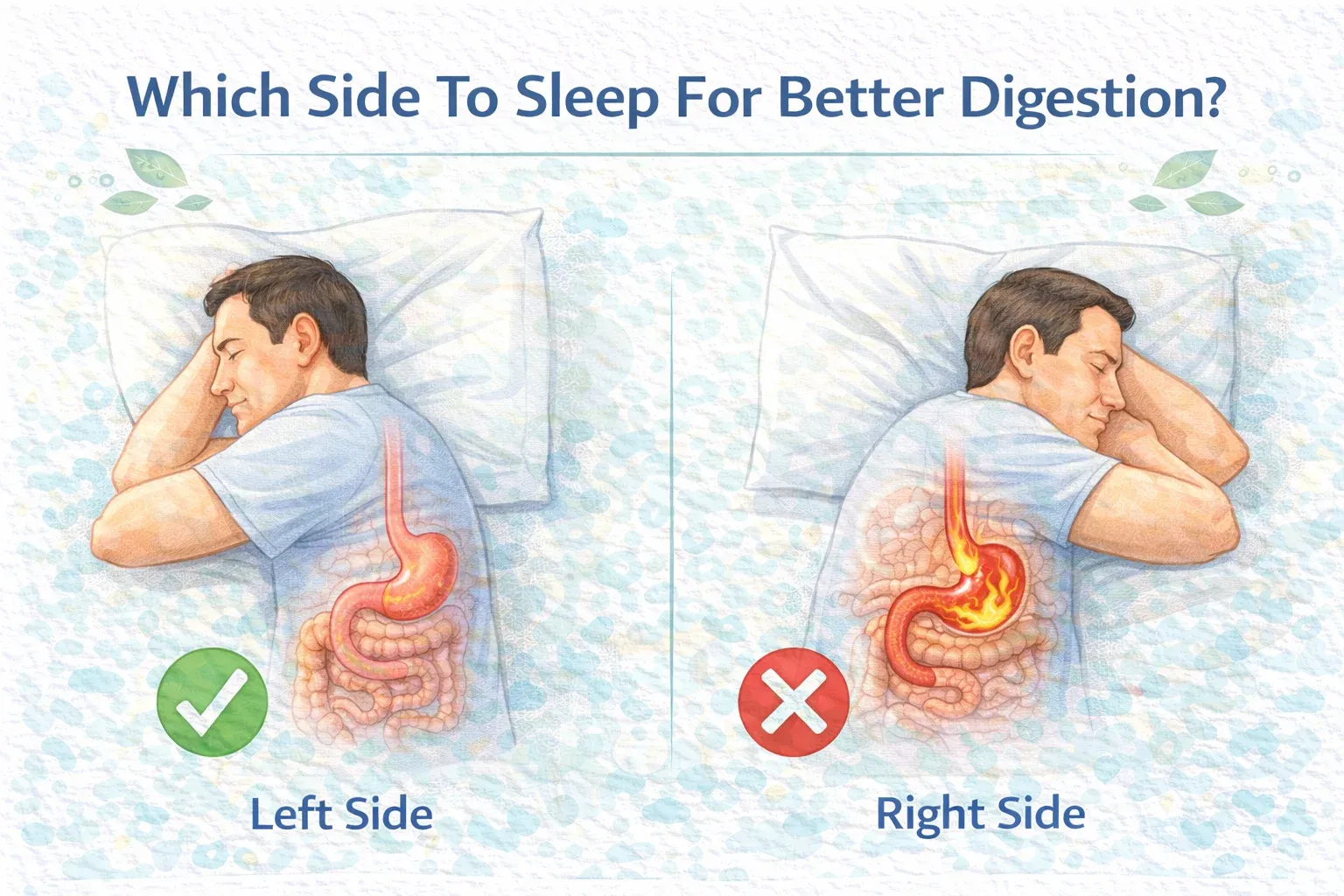
Quick Answer
For people with nighttime acid reflux or heartburn, sleeping on the left side is usually the better-supported option. It can reduce nighttime acid exposure compared with right-side or flat-back sleeping. For general digestion, meal timing and comfort still matter more than sleep position alone.
- Left-side sleeping is most useful for nighttime reflux and heartburn.
- Right-side or flat-back sleeping may worsen reflux in some people.
- Wait around 2-3 hours after a full meal before lying down when possible.
- A gentle walk after dinner and head-of-bed elevation can support reflux management.
- Persistent pain, vomiting, trouble swallowing, black stools, or weight loss need medical care.
The left side is the best side to sleep on for better digestion. Left-side sleeping uses gravity to keep stomach acid below the oesophagus, accelerates gastric emptying toward the pyloric valve, and supports waste movement through the descending colon. Both modern gastroenterology and Ayurveda's Vama Kukshi principle agree: for better digestion, which side to sleep on is not a matter of debate - it is the left.
At a glance:
- Best position: Left side - reduces acid reflux by up to 71%, accelerates gastric emptying
- May worsen reflux: Right side - acid pools near the oesophagus, gastric emptying fights gravity
- Back sleeping: Neutral, but worsens GERD when lying flat after meals
- Stomach sleeping: Worst overall - compresses all digestive organs, disrupts gut motility
- Ayurvedic term: Vama Kukshi - left-side sleeping after meals, prescribed in the Charaka Samhita
Why Your Sleep Position Directly Affects Digestion
Sleep position can affect nighttime reflux. Its effects on gastric emptying, bowel movement, and nutrient absorption are less certain and vary between people. The digestive system does not pause during sleep - the stomach continues emptying, the small intestine continues absorbing nutrients, and the colon continues moving waste toward elimination for the entire 6-8 hours you are in bed.
The position your body is in during this process either works with or against these digestive functions. Slow digestion symptoms - post-meal heaviness, bloating, morning acidity - are frequently worsened by sleeping in the wrong position night after night.
For people with reflux symptoms, changing sleep position is a simple, low-cost strategy worth trying. Yet most people think about what they eat and when they eat, without ever considering how their sleep position interacts with the anatomy of their digestive organs.
Did You Know? In Ayurveda, sleeping on the left side after meals is called Vama Kukshi (वाम कुक्षि) - described in some Ayurvedic traditions as a short left-side rest after meals. Modern research supports left-side sleeping mainly for nocturnal reflux; it does not validate every traditional mechanism.
What Is the Anatomy Behind Left-Side Sleeping and Digestion?
The stomach sits in the upper-left portion of the abdomen. Its natural exit - the pyloric valve, which allows food to move from the stomach into the small intestine - is positioned on the right side of the stomach.
When you sleep on the left side, gravity pulls the stomach downward and to the left, keeping gastric contents away from the oesophageal junction where acid reflux occurs. Simultaneously, food and stomach contents move naturally toward the pyloric valve on the right - which may be more favourable for reflux symptoms in some people.
The large intestine follows a specific anatomical path: it travels up the right side of the abdomen (ascending colon), across the top (transverse colon), and down the left side (descending colon) toward the sigmoid colon and rectum. Sleeping on the left side uses gravity to assist the movement of waste through this downward stretch - from the descending colon toward elimination.
This is why the left side is often recommended for nighttime reflux; however, the best sleep position still depends on symptoms, comfort, and medical conditions.
Which Side to Sleep On for Better Digestion: Full Position Comparison
The table below covers all four sleep positions - ranked for their impact on digestion, acid reflux, and gastric emptying.
| Sleep Position | Effect on Digestion | Acid Reflux / GERD | Gastric Emptying | Verdict |
|---|---|---|---|---|
| Left side ✅ | Gravity supports gastric flow toward pylorus; waste moves down descending colon | Significantly reduced - stomach acid stays below oesophagus | Faster - gravity-assisted | Best for digestion |
| Right side ❌ | Stomach contents pool near oesophageal junction; pylorus sits above gastric contents | Significantly worsened - acid flows toward oesophagus | Slower - working against gravity | May worsen reflux |
| Back (supine) ⚠️ | Neutral - no gravitational advantage or disadvantage | Worsens GERD - acid pools and flows freely when flat | Neutral | Avoid after meals |
| Stomach (prone) ❌❌ | Compresses all digestive organs; disrupts gut motility | Compresses stomach directly | Disrupted - organs compressed | Avoid entirely |
On which side to sleep for better digestion - the answer across every metric is the left side. The right side is the worst choice for anyone with acid reflux, bloating, or slow digestion.
What Are the Benefits of Sleeping on the Left Side for Digestion?
Sleeping on the left side is most clearly supported for nighttime reflux. Other potential digestion-related benefits are less certain.
1. Reduces Acid Reflux and GERD Left-side sleeping is the most clinically significant sleep position change for acid reflux. A landmark study published in The Journal of Clinical Gastroenterology (Khoury et al., 1999) found that patients sleeping on the left side had significantly fewer and shorter acid reflux episodes - with lower oesophageal acid exposure compared with right-side sleepers. Gravity keeps stomach acid pooled at the bottom of the stomach, away from the lower oesophageal sphincter (LES). On the right side, stomach contents pool directly near the LES, making reflux far more likely.
2. Accelerates Gastric Emptying The pyloric valve - the stomach's exit to the small intestine - is on the right side of the stomach. Left-side sleeping allows gravity to pull food naturally toward this exit, accelerating gastric emptying. For reflux, it is more important to avoid lying down soon after a large meal than to rely on position alone.
3. Supports Colon Motility and Prevents Constipation The descending colon runs down the left side of the body. Left-side sleeping allows gravity to assist the movement of waste through this final stretch toward the rectum. Many people who switch to consistent left-side sleeping notice improved morning bowel movements within 1-2 weeks - particularly those with slow gut motility and chronic constipation.
4. Supports Lymphatic Drainage The thoracic duct - the body's main lymphatic drainage channel - runs along the left side of the spine. Claims about lymphatic drainage and reduced intestinal inflammation from left-side sleeping are not well established in clinical research.
5. Reduces Morning Acidity Waking with acidity, heartburn, or a sour taste may be worse with right-side or flat-back sleeping in people with reflux. The combination of a flat sleep position, an extended fasting period, and gravity pooling acid near the LES drives this symptom. Left-side sleeping mitigates all three factors simultaneously.
Why Is Sleeping on the Right Side Bad for Digestion?
The right side is the worst sleeping position for digestion - and it is also the position many people naturally default to. Here is exactly why which side we have to sleep for better digestion should never be the right:
- Stomach acid pools near the LES - Lying on the right tilts the stomach so that gastric contents - including acid - pool near the lower oesophageal sphincter, dramatically increasing reflux frequency and duration during sleep
- Pyloric valve works against gravity - The pylorus sits above stomach contents when lying right, meaning food must work upward against gravity to exit the stomach, slowing emptying and increasing fermentation time
- Liver and gallbladder compression - The liver and gallbladder are on the right side; right-side sleeping places pressure on these organs, which can impair bile flow - particularly relevant after a high-fat dinner
- Ascending colon fights gravity - Waste in the ascending colon must move upward; right-side sleeping provides zero gravitational assistance, contributing to slower colon transit and constipation tendency
The right side may offer a minor benefit for people with certain cardiac conditions - but for anyone with any digestive concern, right-side sleeping is actively counterproductive.
What Does the Clinical Research Say About Left-Side Sleeping?
Left-side sleeping reducing acid reflux is one of the best-replicated findings in sleep gastroenterology - not folk wisdom.
The core finding: Sleeping on the left side is associated with shorter nocturnal oesophageal acid exposure and faster acid clearance compared with the right side or back sleeping.
Key studies:
- Khoury et al. (1999) - The American Journal of Gastroenterology - In GERD patients monitored via 24-hour pH monitoring, left-side sleepers showed significantly fewer reflux episodes, shorter acid clearance times, and dramatically lower oesophageal acid exposure than right-side sleepers. The difference was clinically substantial - not marginal.
- Fass et al. - The Journal of Clinical Gastroenterology - A broader systematic review confirmed that body position during sleep is an independent predictor of nighttime reflux severity, independent of meal timing, meal size, and PPI use.
- American College of Gastroenterology (ACG) Clinical Guidelines for GERD (2022) - Left-side sleeping and head-of-bed elevation are classified as first-line, non-pharmacological interventions for nighttime GERD - placed ahead of most over-the-counter antacids in the evidence hierarchy.
What the numbers mean practically:
- 71% reduction in oesophageal acid exposure: left side vs right side
- Faster acid clearance: gravity and oesophageal peristalsis align in the same direction on the left
- Lower oesophagitis risk: persistent reflux symptoms should be medically assessed because untreated GERD can injure the oesophagus
- Effect seen from night one: unlike dietary changes, the acid-reflux benefit of left-side sleeping is measurable in the first night of position change - no waiting period required
Note: These studies were conducted primarily in GERD patients. Individual results may vary based on severity, hiatal hernia presence, and medication use. Consult a gastroenterologist for personalised guidance.
Which Side to Sleep for Specific Digestive Conditions
The answer to which side is better to sleep for digestion shifts slightly in application depending on the condition - but left-side sleeping is most relevant for people with nighttime reflux; other conditions need individual management.
Acid Reflux and GERD Left side, consistently. Clinical studies confirm left-side sleeping reduces oesophageal acid exposure time by up to 71%. For severe GERD, combine left-side sleeping with a wedge pillow elevating the head 6-8 inches for maximum benefit.
Bloating and Gas Left side in a gentle foetal position - knees drawn slightly toward the chest. This combination uses gravity to move trapped gas through the intestinal tract while mild abdominal compression from the foetal posture encourages colon motility. This is the fastest sleep-position-based intervention for post-dinner bloating.
Constipation Left side. Gravity assists waste movement through the descending colon toward the rectum, improving overnight colonic transit. Consistent left-side sleeping typically produces noticeable improvement in morning bowel regularity within 1-2 weeks.
IBS (Irritable Bowel Syndrome) Sleep position is not a standard treatment for IBS. Some people find left-side sleeping comfortable, but IBS management should focus on individual triggers and clinician-guided care.
Pregnancy Side sleeping can be more comfortable later in pregnancy, and left-side positioning may help some people with reflux. Pregnant people should follow their obstetric clinician's advice for individual needs.
How Long Should You Wait After Eating Before Sleeping?
Knowing which side to sleep on for better digestion is only half the answer - timing is equally important. Even sleeping on the left side immediately after a large meal can cause reflux because the stomach is too full for position to fully compensate.
Post-meal sleep timing guidelines:
- Full meal → wait 2-3 hours minimum - The stomach empties approximately 50% of its contents in 2-3 hours for an average-sized meal. Sleeping before this point means the stomach is substantially full, increasing reflux risk regardless of position.
- Light snack → 60-90 minutes is acceptable - Smaller volume requires less emptying time. Left-side sleeping after 60-90 minutes is generally safe for light meals.
- Never lie flat immediately after eating - Even 15-20 minutes of sitting upright post-meal significantly reduces acid reflux compared to immediate recumbency.
- Take a short walk - A gentle post-meal walk can be a practical habit for comfort and may help some people manage reflux-related symptoms.
- Elevate your head if eating late - If sleeping within 2 hours of eating is unavoidable, elevate the head of the bed by 6-8 inches using a wedge pillow or bed risers.
A practical post-dinner routine:
- Eat dinner at least 2-3 hours before your target bedtime
- Sit in Vajrasana for 10-20 minutes immediately after dinner
- Take a gentle 10-minute walk
- Lie down on the left side when going to bed
This routine may help people who notice reflux or discomfort after late meals.
What Is Vajrasana and How Does It Support Digestion After Meals?
Vajrasana (वज्रासन) is the one yoga posture that can be safely practised immediately after eating - and that is precisely when it is most effective for digestion.
Definition: Vajrasana is a kneeling seated posture that compresses the lower limbs, redirects blood flow toward the digestive organs, and activates the vagus nerve - accelerating gastric emptying and reducing post-meal bloating.
How long to sit in Vajrasana after eating:
| Meal Size | Minimum Duration | Optimal Duration |
|---|---|---|
| Light snack | 5 minutes | 7-10 minutes |
| Regular meal | 10 minutes | 15-20 minutes |
| Heavy or late dinner | 10 minutes | 20-30 minutes |
Why Vajrasana works - the mechanism:
- Comfort and upright posture: Remaining upright after meals may feel better than lying flat for some people with reflux.
- Evidence limits: Specific claims about vagus nerve activation or faster gastric emptying have limited clinical evidence.
- Use your symptoms as a guide: Stop if the position causes pain, numbness, dizziness, or joint discomfort.
- Alternative: Sitting comfortably upright in a chair after meals is a reasonable option if kneeling is uncomfortable.
Who should avoid Vajrasana: People with knee joint problems, ligament injuries, recent knee surgery, ankle arthritis, or varicose veins in the lower legs. A substitute is sitting upright in a chair with feet flat on the floor for 10-15 minutes post-meal.
Vajrasana can be an optional comfort practice, but it does not replace meal timing, reflux treatment, or medical advice.
What Does Ayurveda Say About Which Side to Sleep for Better Digestion?
Ayurveda's recommendation for post-meal left-side sleeping - Vama Kukshi - predates modern gastroenterology by thousands of years and is remarkably aligned with current clinical evidence.
Ayurvedic traditions describe left-side rest after meals as part of daily routines. This cultural practice should be viewed separately from modern medical treatment recommendations.
The Ayurvedic mechanisms:
- Pitta support - Ayurvedic texts describe Pitta in relation to digestion; this is a traditional framework rather than a clinical anatomical explanation
- Apana Vayu support - Ayurvedic descriptions may associate left-side rest with elimination, though this is not a proven medical treatment for constipation
- Prescribed duration - Classical texts recommend lying on the left for 15-20 minutes
How to use this idea safely: Treat Vama Kukshi as a short period of left-side rest, not a substitute for medical care or for waiting before bed after a large meal. People with reflux may find it comfortable, but individual response varies.
Practical Left-Side Sleeping Setup
Changing position is easier when the setup is comfortable. The goal is to keep your spine neutral and reduce pressure on the shoulder and hip.
- Use a supportive pillow: Choose a pillow height that keeps your head aligned with your spine rather than tilted down or up.
- Place a pillow between your knees: This can reduce hip and lower-back strain when side sleeping.
- Try a gentle bend in the knees: A relaxed side-lying posture may feel more comfortable than curling tightly.
- Consider head-of-bed elevation for reflux: A wedge or bed risers may help people with nighttime reflux. Extra stacked pillows are usually less effective because they can bend the body at the waist.
- Do not force one position all night: Changing positions during sleep is normal. Focus on starting on the left side or returning to it when reflux symptoms wake you.
When Left-Side Sleeping May Not Be Comfortable
Left-side sleeping is not mandatory for everyone. Some people have shoulder pain, recent injury, breathing problems, pregnancy-related discomfort, or other conditions that make a particular position difficult. Comfort, sleep quality, and medical advice should take priority.
- People with shoulder injury, severe arthritis, or recent surgery may need a different position or a clinician's advice.
- People with obstructive sleep apnea should follow their sleep specialist's guidance because position needs can vary.
- During pregnancy, side sleeping may be more comfortable later in pregnancy, but persistent pain, breathlessness, dizziness, or sudden swelling should be discussed with an obstetric clinician.
- If reflux symptoms continue despite meal timing, left-side positioning, and head-of-bed elevation, speak with a clinician rather than relying only on sleep changes.
Medical Disclaimer
This article is for general health education only and does not replace medical advice, diagnosis, or treatment. The information is based on gastroenterology guidance and peer-reviewed studies on nocturnal reflux, meal timing, and sleep position. Left-side sleeping may help some people with nighttime reflux, but it is not a substitute for medical evaluation. Seek prompt care for chest pain, trouble swallowing, vomiting blood, black stools, unexplained weight loss, severe abdominal pain, or persistent symptoms.
Key Takeaways
- For people with nighttime acid reflux, sleeping on the left side is generally the most evidence-supported side position.
- The research is strongest for lower nighttime reflux and faster acid clearance, not for a guaranteed cure for every digestion problem.
- Right-side and flat-back sleeping may worsen reflux for some people, particularly after a late or heavy meal.
- Wait around 2-3 hours after a full meal before lying down when possible.
- A gentle post-meal walk and head-of-bed elevation may also help people with nighttime reflux.
- Comfort matters: do not force a position that causes shoulder, hip, neck, or breathing discomfort.
Understand Your Digestion Pattern
If reflux, bloating, constipation, or post-meal discomfort keeps returning, take a free gut health test to understand your symptoms better.
Your gut is unique your healing should be too.

FAQs
For people with nighttime acid reflux or heartburn, the left side is usually the better-supported option. It may reduce nighttime acid exposure compared with right-side or back sleeping.
Yes, research suggests left-side sleeping can reduce nocturnal reflux and help acid clear from the oesophagus faster than right-side or back sleeping. It works best alongside avoiding late meals and elevating the head of the bed when needed.
Right-side sleeping is not harmful for everyone, but it can worsen nighttime reflux in some people. If you notice heartburn, sour taste, cough, or chest burning at night, try switching to the left side and avoid lying down soon after meals.
After a full meal, waiting about 2-3 hours before lying down is a common reflux-management recommendation. A smaller snack may need less time, but people with frequent reflux should discuss personal triggers with a clinician.
Some people find left-side sleeping comfortable when they are constipated, but evidence that sleep position alone treats constipation is limited. Hydration, fibre changes, activity, and medical assessment for persistent symptoms are more important.
Side sleeping is often more comfortable in pregnancy, especially later on. Left-side sleeping may also help some people with reflux, but follow your obstetric clinician's guidance for your individual situation.
Vajrasana is commonly used as a comfortable upright post-meal posture in yoga traditions. Evidence for specific digestion benefits is limited, so treat it as an optional comfort practice rather than a medical treatment. Avoid it if it causes knee, ankle, or circulation discomfort.
See a clinician if reflux happens frequently, disrupts sleep, causes trouble swallowing, persistent vomiting, black stools, unexplained weight loss, chest pain, or symptoms that do not improve with basic lifestyle changes.
Disclaimer
The content provided by Mool Health is for educational and informational purposes only and should not be considered a substitute for professional medical advice, diagnosis, or treatment.