
Does Black Coffee Cause Acidity? The Complete Science-Backed Guide
A science-backed guide explaining why black coffee causes acidity, why empty-stomach coffee is worse, safer coffee choices and warning signs.
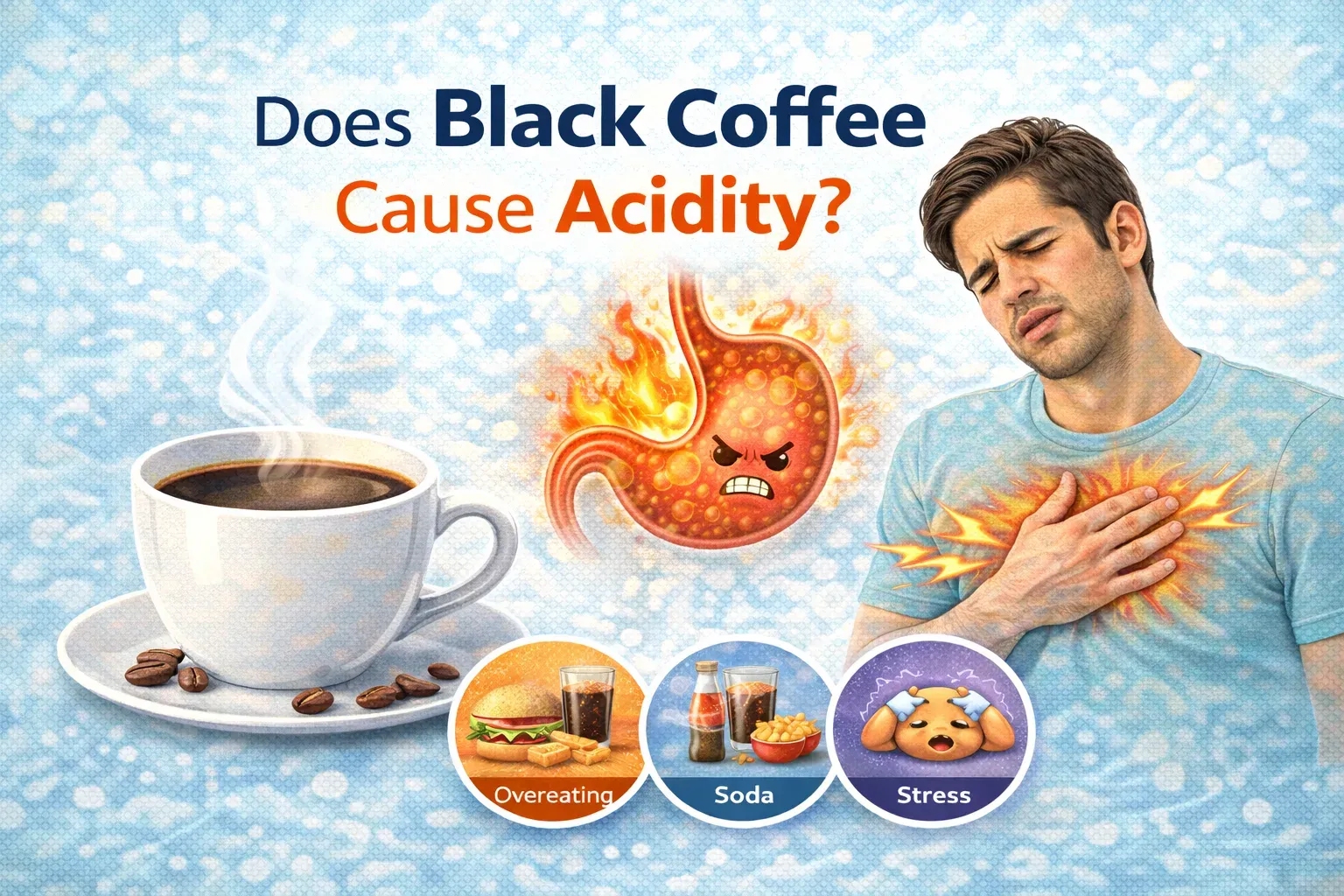
Quick Answer
Black coffee does cause acidity in most people - but one cup after a meal does not guarantee an acidity attack. The degree depends on when you drink it, how much you drink, and your gut's baseline condition. Black coffee has a pH between 4.5 and 5.5. Caffeine triggers extra hydrochloric acid (HCl) secretion, chlorogenic acids lower stomach pH directly, and both compounds relax the Lower Oesophageal Sphincter (LES) - the valve that stops acid from travelling upward. The result: heartburn, sourness, and a burning sensation 20-30 minutes after your cup.
- Main answer: Black coffee can cause acidity, especially on an empty stomach
- Why it happens: Caffeine, chlorogenic acids and LES relaxation can increase acid and reflux
- Highest-risk timing: First thing in the morning before food
- Better options: After-meal coffee, cold brew, smaller portions or coffee with milk
- Doctor needed: Frequent reflux, symptoms more than twice a week, swallowing trouble, black stools, vomiting or weight loss
Black coffee does cause acidity in most people - but one cup after a meal does not guarantee an acidity attack. The degree depends on when you drink it, how much you drink, and your gut's baseline condition.
Black coffee has a pH between 4.5 and 5.5. Caffeine triggers extra hydrochloric acid (HCl) secretion, chlorogenic acids lower stomach pH directly, and both compounds relax the Lower Oesophageal Sphincter (LES) - the valve that stops acid from travelling upward. The result: heartburn, sourness, and a burning sensation 20-30 minutes after your cup.
This guide explains the full science behind coffee and acidity - and gives you evidence-backed ways to keep drinking coffee without the acid aftermath.
Does Black Coffee Cause Acidity - The Direct Answer
Yes - black coffee causes acidity in most people through three simultaneous mechanisms: caffeine stimulates excess gastric acid secretion, chlorogenic acids directly lower stomach pH, and both caffeine and coffee acids relax the Lower Oesophageal Sphincter (LES), allowing acid to reflux upward.
Does black coffee on empty stomach cause acidity? Yes - significantly more so. An empty stomach has no food buffer to absorb the acid surge, making early morning black coffee one of the most reliable acidity triggers.
The effect varies by gut sensitivity, coffee strength, roast type, and individual acid tolerance. People with healthy stomach lining and strong LES tone tolerate moderate coffee well. People with weakened gut defences, GERD, or H. Pylori infection experience stronger and longer-lasting symptoms.
What Is Acidity - and What Causes It?
Acidity refers to a condition where excess stomach acid (hydrochloric acid, or HCl) is produced, or where existing acid travels upward into the oesophagus due to a weakened Lower Oesophageal Sphincter (LES). The result is heartburn, sourness, a burning sensation in the chest or throat, and sometimes nausea.
The stomach normally produces HCl to digest food. The LES acts as a one-way valve - it opens to allow food in and closes to keep acid down. Acidity occurs when this system is disrupted: too much acid, a weakened valve, or both.
Common causes of acidity include:
- Eating on an empty stomach or skipping meals
- Consuming acidic or spicy foods
- Caffeine and carbonated drinks
- Chronic stress (elevated cortisol raises acid production)
- H. Pylori infection (damages stomach mucus lining)
- Gut microbiome imbalance
- Lying flat immediately after eating
Black coffee triggers several of these mechanisms simultaneously - which is why does drinking black coffee cause acidity is one of the most searched digestive health questions in India.
What Is the pH of Black Coffee - Is It Acidic or Alkaline?
Black coffee is acidic. Its pH typically falls between 4.5 and 5.5, depending on the roast, brew method, and bean origin. Pure water sits at a neutral pH of 7.0 - making black coffee roughly ten times more acidic than water.
For context: the stomach's natural resting pH is 1.5-3.5. Black coffee does not make the stomach as acidic as hydrochloric acid - but it adds an acid load on top of what is already present, and it stimulates the stomach to produce more HCl in response.
| Beverage | Approximate pH | Acidity Classification |
|---|---|---|
| Stomach acid (HCl) | 1.5-3.5 | Highly acidic |
| Orange juice | 3.3-4.0 | Acidic |
| Black coffee | 4.5-5.5 | Acidic |
| Black tea | 4.9-5.5 | Mildly acidic |
| Cold brew coffee | 5.0-6.0 | Mildly acidic |
| Coconut water | 5.0-6.0 | Mildly acidic |
| Cow's milk | 6.5-7.0 | Near-neutral / slightly alkaline |
| Ginger tea | 6.5-7.0 | Near-neutral |
| Water | 7.0 | Neutral |
Dark roast coffee has a slightly higher pH (less acidic) than light roast - because the roasting process breaks down some of the chlorogenic acids. Cold brew is less acidic than hot-brewed coffee of the same bean, because cold water extracts fewer acidic compounds.
The bigger concern is not black coffee's own pH - it is the fact that black coffee triggers the stomach to produce additional acid far beyond what the coffee itself contains.
How Does Black Coffee Cause Acidity - The Science Behind It
Does drinking black coffee cause acidity? Yes - through four distinct mechanisms acting simultaneously. Black coffee contains multiple compounds that each act on the digestive system independently.
1. Caffeine Stimulates Gastric Acid Secretion
Caffeine acts directly on parietal cells in the stomach lining, stimulating them to produce more HCl via cyclic AMP activation. This mechanism is well-established in gastroenterology research. A standard cup of black coffee contains 80-120mg of caffeine - enough to produce a measurable increase in gastric acid output within 15-20 minutes of consumption. Even decaffeinated coffee causes some acid stimulation, but regular black coffee causes significantly more.
2. Chlorogenic Acids Lower Stomach pH Directly
Black coffee contains 150-350mg of chlorogenic acids per cup - natural phenolic compounds that are themselves acidic (pH 3.5-4.0). These acids lower the overall pH of the stomach contents, intensifying acidity beyond what caffeine alone produces. Darker roasts contain slightly fewer chlorogenic acids than lighter roasts, because the roasting process degrades them - one reason dark roast black coffee is sometimes better tolerated.
3. Coffee Relaxes the Lower Oesophageal Sphincter
Both caffeine and certain coffee acids relax the Lower Oesophageal Sphincter (LES) - the valve that prevents stomach acid from flowing back into the food pipe. A relaxed LES is the direct cause of acid reflux. This is why black coffee causes not just stomach acidity but also the characteristic heartburn and throat burning many coffee drinkers experience 20-30 minutes after their cup. Research published in the New England Journal of Medicine (Thomas et al., 1980) confirmed that both caffeinated and decaffeinated coffee lower LES pressure significantly.
4. Coffee Disrupts Gastric Motility
Initially, coffee stimulates gastric motility - food moves faster. But the acid surge that follows can cause gastric irritation that slows emptying in some people, leading to prolonged acid exposure and compounding acidity through the morning.
| Coffee Component | Mechanism | Effect on Acidity |
|---|---|---|
| Caffeine (80-120mg/cup) | Stimulates HCl secretion from parietal cells | Increases stomach acid directly |
| Chlorogenic acids (150-350mg/cup) | Inherently acidic; lower stomach pH | Raises acid concentration |
| N-methylpyridinium (NMP) | Stimulates proton pump in stomach lining | Increases acid production |
| Catechols | Stimulate gastric acid secretion independently | Adds to caffeine's acid effect |
| Caffeine + acids combined | Relax LES sphincter | Allows acid to reflux upward |
Does Black Coffee on Empty Stomach Cause Acidity - Why It Is Worse
Does black coffee on empty stomach cause acidity? Yes - and this is the scenario where black coffee causes the most severe acidity. Does black coffee in empty stomach cause acidity even for people without GERD? Yes - the mechanism is pharmacological and occurs regardless of pre-existing gut conditions.
When the stomach is empty, four risk factors combine simultaneously:
- No food buffer exists - food normally absorbs and dilutes gastric acid. On an empty stomach, the HCl surge from coffee acts directly on the stomach lining and lower oesophagus
- Gastric pH is already low in the morning - overnight fasting concentrates acid in the stomach. Black coffee on an empty stomach adds more acid on top of already-acidic conditions
- LES tone is at its weakest in the morning - overnight fasting and lying flat weaken LES tone. Morning black coffee relaxes it further, making acid reflux almost immediate in sensitive individuals
- Cortisol peaks between 6-9am - the morning stress hormone already stimulates some acid production. Black coffee on an empty stomach compounds this cortisol-driven acid surge
The same cup of black coffee causes roughly two to three times more acidity symptoms on an empty stomach versus after a light breakfast. Even people who tolerate black coffee well after meals often experience significant acidity when drinking it first thing in the morning.
Does black coffee cause acidity on empty stomach more than at other times? Yes - it is the single highest-risk timing combination. The convergence of overnight fasting, morning cortisol spike, weakened LES tone, and coffee's acid-stimulating compounds creates conditions for severe heartburn and gut lining irritation.
Does Black Coffee Cause Acidity in Everyone?
Does drinking black coffee cause acidity in every person? No - but most people experience some degree of acid effect. The intensity varies based on gut resilience.
People most likely to experience significant acidity from black coffee:
- People with pre-existing acid reflux or GERD
- Those with a weakened or damaged stomach mucus lining
- Individuals who drink black coffee first thing in the morning on an empty stomach
- People who drink more than 2 cups per day
- Those with H. Pylori infection (compromised stomach lining)
- People with chronic stress and elevated baseline cortisol
- Pitta-dominant individuals (Ayurvedic constitution prone to heat and acidity)
People who often tolerate black coffee without noticeable acidity typically have a robust stomach mucus lining, strong LES tone, a healthy gut microbiome, and well-managed stress levels. If you never experience acidity from black coffee, your digestive system is handling the acid load effectively. This is about gut resilience - a healthy gut can handle moderate coffee; a compromised gut cannot.
How Much Black Coffee Causes Acidity - Dose and Timing
Does black coffee cause acidity on empty stomach more at higher doses? Yes - the acidity effect of black coffee is dose-dependent. More caffeine and more chlorogenic acids mean more gastric acid stimulation and more sustained LES relaxation.
| Amount | Acidity Risk | Recommendation |
|---|---|---|
| 1 small cup (100ml) after a meal | Low for most people | Generally tolerable if gut is healthy |
| 1 standard cup (150-200ml) after a meal | Moderate | Fine for most; avoid if GERD is present |
| 1 cup on an empty stomach | High | Avoid - causes acidity in most people |
| 2+ cups per day | High | Significantly increases acid production and LES relaxation |
| Strong espresso on empty stomach | Very high | One of the highest acidity-triggering combinations |
One cup produces a finite, recoverable acid response. Two or three cups in a day sustain LES relaxation and acid elevation for several hours - giving the stomach lining less recovery time between exposures.
Does Black Coffee Cause More Acidity Than Coffee with Milk?
Yes - black coffee causes significantly more acidity than coffee with milk. Milk has three buffering effects that reduce coffee's acid impact:
- Milk proteins (casein) bind to coffee's chlorogenic acids - reducing the free acid content that lowers stomach pH
- Milk's slightly alkaline pH (6.5-7.0) buffers stomach acid - similar to why cold milk is used as an acidity home remedy
- Milk fat slows gastric emptying - reducing the rate at which coffee acids reach the stomach lining
The caffeine content is the same in both, but the acid load is substantially reduced when milk is added. People who switch from black coffee to coffee with a small amount of milk or a dairy alternative often notice significant improvement in acidity symptoms.
Cold brew coffee is also measurably less acidic than hot-brewed black coffee. A 2020 study by Rao and Fuller (Scientific Reports) found that cold brew had statistically significantly higher pH and lower titratable acidity than matched hot-brewed samples - confirming cold brew as the lower-acid option for acid-sensitive individuals.
What the Research Says About Black Coffee and Stomach Acid
The evidence on does black coffee cause acidity comes from gastroenterology research conducted over four decades. Key findings:
Caffeine directly stimulates gastric acid secretion. A foundational study published in Gut (Debas et al., 1971) demonstrated that caffeine stimulates parietal cells to produce hydrochloric acid via cyclic AMP activation. Even low doses of caffeine below the threshold for stimulant effect produce measurable increases in gastric acid output.
Decaffeinated coffee also raises acid - but less so. Research published in the Scandinavian Journal of Gastroenterology (Cohen & Booth, 1975) found that decaffeinated coffee still stimulated gastric acid secretion, confirming that chlorogenic acids and catechols contribute independently of caffeine.
Coffee on an empty stomach shows the strongest acid response. A 2022 review in Nutrients (Nehlig) found that coffee consumed without food produced significantly higher peak acid concentrations than coffee consumed after a meal. The buffering effect of food - particularly protein - directly reduces the gastric acid surge.
Cold brew is measurably less acidic. Rao and Fuller (Scientific Reports, 2020) confirmed cold brew has lower titratable acidity than matched hot-brewed coffee - making it a lower-acid option for sensitive individuals.
Coffee's effect on LES pressure is dose-dependent. Thomas et al. (NEJM, 1980) demonstrated that both caffeinated and decaffeinated coffee lowered LES pressure - the mechanism behind acid reflux after coffee consumption.
What the evidence does not support: coffee does not cause GERD in people with a healthy stomach - it is a trigger, not the underlying cause. Cutting coffee completely is not always necessary - timing, quantity, and roast type all modulate the acid effect.
Sources: Debas et al., Gut, 1971. Cohen & Booth, Scand. J. Gastroenterol., 1975. Nehlig, Nutrients, 2022. Rao & Fuller, Scientific Reports, 2020. Thomas et al., NEJM, 1980. Citation details should be independently verified against PubMed before clinical use.
Black Coffee and GERD - When Does Acidity Become a Medical Concern?
There is an important difference between occasional coffee-induced acidity and Gastro-Oesophageal Reflux Disease (GERD). GERD is a chronic condition where stomach acid regularly flows back into the oesophagus, causing damage to the oesophageal lining over time. GERD is diagnosed when reflux symptoms occur more than twice a week consistently.
| Factor | Occasional Coffee Acidity | GERD |
|---|---|---|
| Frequency | After specific coffee consumption | 2+ times per week regardless of coffee |
| Resolution | Resolves within 1-2 hours | Persists; may worsen at night |
| Trigger | Black coffee, especially on empty stomach | Multiple triggers (fatty food, lying down, stress) |
| Symptoms | Heartburn, mild sourness | Chronic heartburn, regurgitation, throat burning, cough |
| LES status | Temporarily relaxed by coffee | Structurally weakened |
| Action needed | Dietary adjustment (timing, method, amount) | Medical evaluation + structured gut treatment |
If you have diagnosed GERD, most gastroenterologists recommend eliminating or significantly reducing coffee until the condition is managed. Black coffee simultaneously increases acid production and weakens the LES - the exact two mechanisms that define GERD's pathophysiology.
During an active acidity episode, drinking black coffee adds acid to an already-compromised stomach lining and relaxes the LES further. Cold milk, jeera water, or fennel water are better choices during an active episode. Resume coffee only after symptoms have fully resolved - and after a meal.
Ayurvedic View - Why Black Coffee Aggravates Pitta
In Ayurveda, black coffee is classified as Ushna (hot), Tikshna (sharp/penetrating), and Rajasic - all qualities that directly increase Pitta dosha. Since Pitta governs digestion, metabolism, and acidity in the body, anything that increases Pitta also increases acid production and heat in the digestive system.
Drinking black coffee on an empty stomach is particularly problematic in Ayurvedic terms because morning (Kapha time: 6-10am) is when the body is in a building, nourishing phase. Introducing a sharp, hot, Pitta-stimulating drink before the digestive fire has been properly kindled with food disrupts the natural morning Agni balance - leading to acid rebound.
For Pitta-dominant individuals who frequently experience does black coffee in
Who Should Avoid Black Coffee for Acidity?
Black coffee is not equally problematic for everyone. Some people can tolerate one cup after food, while others may get acidity even with small amounts because their stomach lining, LES tone or gut sensitivity is already compromised.
You should avoid or limit black coffee if you:
- Have diagnosed GERD, frequent acid reflux or chronic heartburn
- Get burning, sour burps or throat irritation within 20-30 minutes of coffee
- Drink coffee first thing in the morning on an empty stomach
- Have gastritis, H. Pylori infection or a sensitive stomach lining
- Depend on 2 or more strong cups daily
- Notice acidity with stress, poor sleep or irregular meals
If coffee is the only trigger, timing and portion changes may be enough. If several foods trigger acidity, the issue may be broader gut sensitivity or reflux tendency rather than coffee alone.
How to Drink Black Coffee Without Acidity
If you do not want to stop coffee completely, the goal is to reduce acid load, protect the stomach lining and prevent reflux. These changes work best when followed consistently for 2-4 weeks.
- Never drink black coffee on an empty stomach. Eat a light breakfast first, such as banana, toast, soaked almonds, poha or idli.
- Reduce the cup size. A small 100 ml cup is easier on the stomach than a large 200-250 ml mug.
- Try cold brew. Cold brew is usually less acidic than hot-brewed black coffee because fewer acidic compounds are extracted.
- Choose medium or dark roast. Darker roasts generally contain fewer chlorogenic acids than light roasts.
- Avoid coffee during active acidity. When burning or reflux is already present, coffee can worsen symptoms.
- Do not lie down after coffee. Stay upright for at least 2 hours to reduce reflux risk.
- Track your threshold. Note timing, cup size, roast type, food intake and symptoms for 7 days.
Mool Health’s Perspective on Black Coffee and Acidity
Mool Health views black coffee as a trigger that can reveal an already sensitive digestive system. If one cup repeatedly causes burning, sourness, bloating or reflux, the deeper issue may involve stomach lining irritation, weak LES function, stress, irregular meals, gut microbiome imbalance or poor caffeine tolerance.
The practical approach is not always to quit coffee forever. First fix timing, dose, roast type and empty-stomach habits. If symptoms continue, evaluate the root digestive pattern rather than treating every episode with temporary relief.
Disclaimer
This article is for general educational purposes only and does not replace medical advice, diagnosis, or treatment. If acidity is frequent, severe, associated with chest pain, swallowing difficulty, vomiting, black stools, unexplained weight loss, or symptoms more than twice a week, consult a qualified healthcare professional.
Key Takeaways
A science-backed guide explaining why black coffee causes acidity, why empty-stomach coffee is worse, safer coffee choices and warning signs.
Your gut is unique your healing should be too.

Disclaimer
The content provided by Mool Health is for educational and informational purposes only and should not be considered a substitute for professional medical advice, diagnosis, or treatment.