
Indian Foods That Cause Bloating: Triggers, Swaps & Relief Tips
A complete guide to Indian foods that cause bloating, common triggers, better swaps, cooking tips, relief steps and when to seek help.
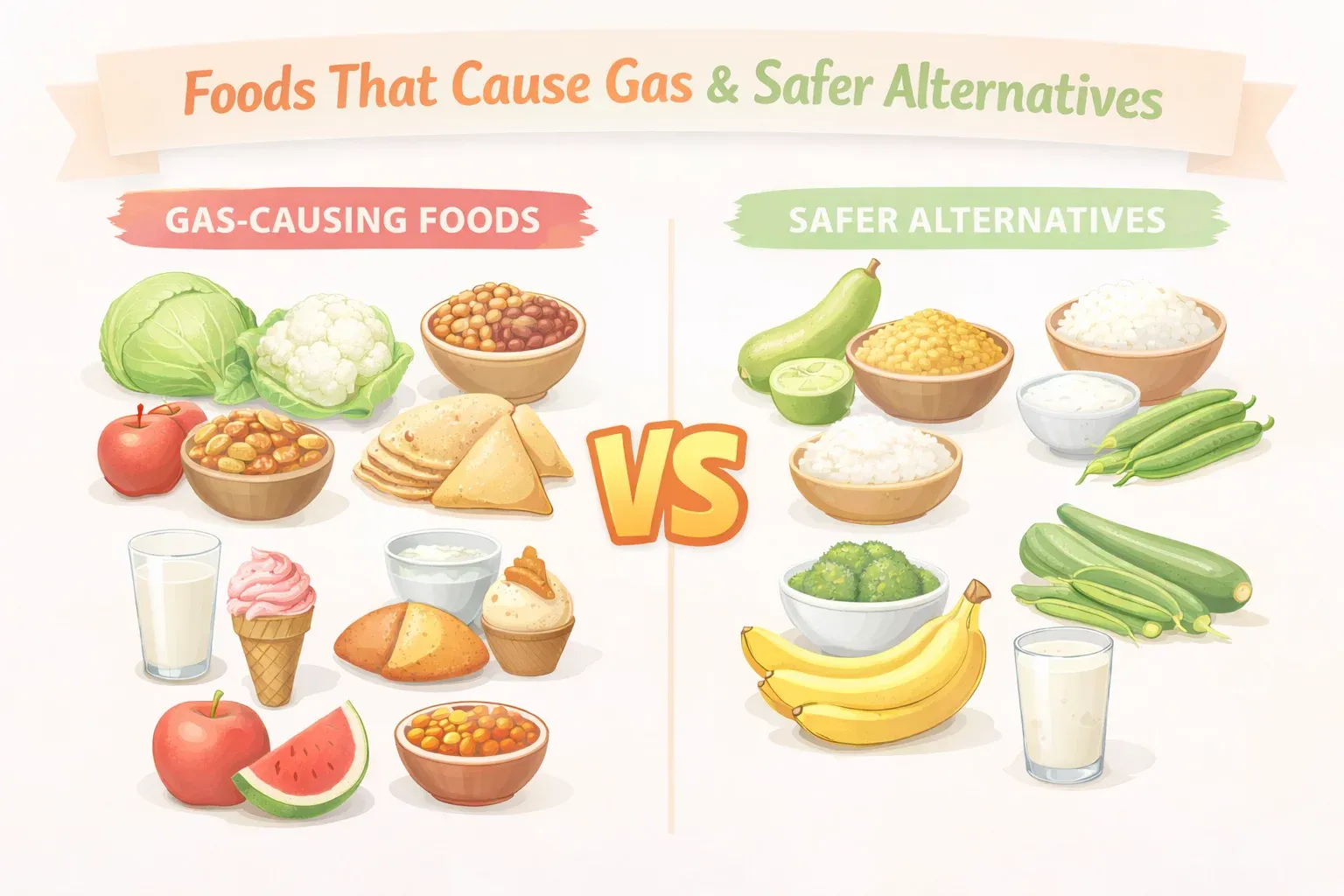
Quick Answer
Most bloating after Indian food is caused by high-fibre legumes, gas-producing vegetables, refined carbohydrates, and heavy dairy - all common in traditional Indian meals. Understanding exactly which foods trigger bloating and why can help you eat comfortably without eliminating culturally important dishes from your diet.
- Most common triggers: Rajma, chhole, whole dals, cabbage, cauliflower, onion, garlic, paneer, lassi, fried snacks and maida foods
- Main reason: High-FODMAP carbohydrates, lactose, excess oil, sodium and slow digestion can increase gas and belly tightness
- Better swaps: Moong dal, lauki sabzi, thin roti, steamed idli, dhokla, small curd portions and hing-cumin bases
- Quick relief: Walk after meals, drink warm ginger or ajwain tea, and avoid extra food for 2-3 hours
- Doctor needed: Persistent bloating, severe pain, blood in stool, weight loss, vomiting or new symptoms after age 40
Most bloating after Indian food is caused by high-fibre legumes, gas-producing vegetables, refined carbohydrates, and heavy dairy - all common in traditional Indian meals. Understanding exactly which foods trigger bloating and why can help you eat comfortably without eliminating culturally important dishes from your diet.
What Is Bloating and Why Does Indian Food Commonly Trigger It?
Bloating is a condition where excess gas accumulates in the digestive tract, causing the abdomen to feel full, tight, or visibly distended. It affects an estimated 10-30% of the general population regularly, and certain dietary patterns - including those typical of Indian cuisine - are well-established triggers.
Indian food commonly causes bloating because it relies heavily on legumes (dal, rajma, chhole), cruciferous vegetables, dairy, refined carbohydrates like maida, and spice combinations that can irritate the gut lining in sensitive individuals. When these foods are eaten in large quantities or in fast-paced meals, the digestive system struggles to break them down completely, producing excess gas in the colon.
According to Mool Health's digestive wellness team, the combination of fermentable carbohydrates and heavy oils in a single Indian meal is one of the most common patterns they see preceding bloating complaints.
Key terms used in this article:
- FODMAP: Fermentable Oligosaccharides, Disaccharides, Monosaccharides, and Polyols - short-chain carbohydrates poorly absorbed in the small intestine
- Fermentation: The breakdown of undigested food by gut bacteria, producing gas as a by-product
- Intestinal motility: The speed at which food moves through the digestive tract
How Does Indian Food Cause Bloating? The Core Mechanism
Indian food causes bloating through four distinct biological mechanisms, each linked to specific food categories.
Step 1 - Incomplete carbohydrate digestion Legumes like dal, rajma, and chhole contain oligosaccharides (specifically raffinose and stachyose). Humans lack the enzyme alpha-galactosidase needed to break these down in the small intestine. They pass intact into the large intestine, where gut bacteria ferment them, producing hydrogen, carbon dioxide, and methane gas.
Step 2 - Osmotic water retention High-sodium foods - pickles (achaar), papadums, and processed Indian snacks - draw water into the intestines. This increases intestinal fluid volume, contributing to a feeling of fullness and distension within 2-4 hours of eating.
Step 3 - Slowed gastric emptying Heavy, oil-rich dishes like butter chicken, biryani cooked with ghee, and fried items (pakoras, puris) slow the rate at which the stomach empties. Food sits longer in the stomach, causing fermentation to begin earlier and more aggressively.
Step 4 - Lactase insufficiency Studies suggest that approximately 60-70% of South Asian adults have some degree of lactase deficiency. Dairy-heavy dishes like paneer curries, raita, and lassi introduce lactose that cannot be fully digested, leading to gas and bloating in lactase-insufficient individuals.
Mool Health's nutrition advisors note that in most cases, bloating from Indian food is not a sign of a serious condition - it is a predictable response to specific food combinations that can be modified.
Which Indian Foods Are the Most Common Causes of Bloating?
The following Indian foods are the most frequently documented causes of bloating, grouped by category:
Legumes and Lentils
- Rajma (kidney beans) - very high in oligosaccharides; one of the strongest bloating triggers
- Chhole (chickpeas) - high FODMAP content; ferments rapidly in the colon
- Whole moong and urad dal - less problematic than whole beans but still gas-producing when consumed in large portions
- Split dal (masoor, toor) - generally better tolerated than whole legumes but can still cause mild bloating
Cruciferous and Gas-Producing Vegetables
- Cabbage (patta gobhi) - contains raffinose; a well-established gas producer
- Cauliflower (gobhi) - high in fructans; commonly used in Indian sabzis
- Broccoli - increasingly used in Indian cooking; significant bloating trigger
- Onions and garlic - very high in fructans; used as base ingredients in nearly every Indian dish
Refined Carbohydrates
- Maida-based breads (naan, bhatura, paratha made with refined flour) - low fibre, slow digestion, promotes bacterial fermentation
- White rice in large portions - less of a direct bloating trigger but contributes when eaten with other high-FODMAP foods
Dairy Products
- Paneer in heavy cream-based curries - double trigger: fat slows motility, lactose ferments
- Lassi and buttermilk - problematic for lactase-insufficient individuals despite being traditionally considered digestive aids
- Raita - yoghurt is generally better tolerated than milk due to bacterial pre-digestion of lactose, but large portions can still cause issues
Fried and Processed Snacks
- Samosa, kachori, pakora - high fat content slows gastric emptying significantly
- Papadums and namkeen - high sodium causes water retention and distension
- Processed Indian ready meals - often contain preservatives and high sodium
Indian Bloating Foods vs. Easy-to-Digest Indian Alternatives
Identifying a problematic food is only useful if you have a workable substitute. The table below compares common bloating-causing Indian foods against better-tolerated alternatives.
| Bloating-Causing Food | Why It Causes Bloating | Better-Tolerated Alternative |
|---|---|---|
| Rajma / Chhole | High oligosaccharides | Moong dal (split, cooked well) |
| Naan / Bhatura (maida) | Refined flour, low fibre | Roti (whole wheat, thin) |
| Cabbage sabzi | Raffinose, ferments rapidly | Lauki (bottle gourd) sabzi |
| Whole milk paneer curry | Lactose + heavy cream | Tofu-based curry or small paneer portion |
| Lassi (full-fat) | Lactose, high volume dairy | Small portion of plain yoghurt |
| Deep-fried samosa | Fat slows gastric emptying | Steamed idli or dhokla |
| Garlic-onion masala base | Very high fructans | Asafoetida (hing) + cumin base |
| Whole urad dal | High fibre + oligosaccharides | Toor or masoor dal (split) |
Mool Health's approach to digestive discomfort focuses on substitution rather than elimination - cultural foods do not need to be entirely removed, but preparation methods and portion sizes matter significantly.
How to Reduce Bloating from Indian Food: Step-by-Step Guide
The following steps are clinically observed to reduce bloating associated with Indian dietary patterns within 3-7 days of consistent application.
Step 1 - Soak and rinse all legumes before cooking Soaking rajma, chhole, or whole lentils for 8-12 hours and discarding the soaking water removes a significant portion of oligosaccharides. This reduces the fermentable carbohydrate load by an estimated 25-30% before the food reaches your gut.
Step 2 - Add digestive spices during cooking, not as garnish Asafoetida (hing), cumin (jeera), and ajwain (carom seeds) contain active compounds - primarily thymol in ajwain - that reduce intestinal spasm and gas formation. Add them at the tempering (tadka) stage so they are cooked into the oil, maximising bioavailability.
Step 3 - Replace onion and garlic in the masala base For individuals with high FODMAP sensitivity, replacing garlic and onion with a hing-cumin-ginger base can reduce bloating substantially. Ginger contains gingerols that accelerate gastric emptying.
Step 4 - Reduce portion size of legumes per meal Rather than eliminating dal entirely, reduce the serving size to approximately half a cup (cooked) per meal. Pair with a non-FODMAP vegetable to balance the plate.
Step 5 - Switch refined flour to whole wheat or jowar Replace naan and bhatura made with maida with whole wheat roti or jowar bhakri. Higher fibre supports intestinal motility and reduces fermentation time.
Step 6 - Eat slowly and avoid large meal volumes Eating quickly introduces more air into the digestive tract and overloads the stomach. Clinical observation suggests that eating over 20-30 minutes reduces post-meal bloating in most individuals.
Step 7 - Walk for 10-15 minutes after eating Light physical activity accelerates gastric emptying and reduces gas accumulation. Studies suggest even a 15-minute post-meal walk improves digestive transit time measurably.
Step 8 - Improve gut health with fermented foods Traditional Indian fermented foods - plain yoghurt, kanji, idli batter - contain live bacteria that support a balanced gut microbiome. A healthier microbiome ferments carbohydrates more efficiently, producing less gas over time.
Step 9 - Reduce salt and processed food intake High-sodium Indian snacks and pickles cause water retention, which contributes to abdominal distension. Limiting daily sodium to under 2,300 mg - and ideally under 1,500 mg for those with chronic bloating - can reduce this component within 24-48 hours.
Common Mistakes to Avoid:
- Drinking large volumes of water immediately after a heavy Indian meal (dilutes digestive enzymes)
- Consuming raw salads with high-FODMAP vegetables alongside a heavy legume dish
- Adding dairy to a meal that already contains a large portion of legumes
- Eating leftover dal that has been refrigerated for more than 24 hours (fermentation increases resistant starch)
What to Expect When You Change Your Indian Diet to Reduce Bloating
Results from dietary changes vary depending on the severity of existing gut sensitivity, the consistency of changes applied, and individual microbiome composition. Below is a realistic timeline based on commonly observed outcomes.
| Timeframe | What Typically Happens |
|---|---|
| Within 24-48 hours | Reduction in sodium-related water retention; less distension after meals if fried/processed foods are avoided |
| Days 3-7 | Noticeable reduction in gas after meals if legumes are soaked and cooking spices are applied consistently |
| Week 2-3 | Gut microbiome begins adapting to lower FODMAP load; fermentation efficiency improves |
| Month 1-2 | If fermented foods and fibre are balanced, gut microbiome diversity typically improves, reducing overall gas production |
| Month 3+ | Most individuals with food-triggered bloating (as opposed to underlying IBS or SIBO) report significant and sustained reduction in symptoms |
Mool Health notes that individuals with persistent bloating despite dietary changes should consult a gastroenterologist to rule out conditions such as IBS, SIBO (Small Intestinal Bacterial Overgrowth), or coeliac disease.
Factors That Affect Your Results:
- Pre-existing gut conditions (IBS, SIBO, IBD)
- Stress levels - the gut-brain axis directly affects intestinal motility
- Antibiotic use - disrupts microbiome composition
- Speed of dietary changes - gradual introduction of fibre is better tolerated than sudden increases
Expert Tips for Managing Bloating on an Indian Diet
Mool Health's digestive health advisors offer the following best practices for managing bloating without abandoning Indian cuisine:
- Use hing consistently - Even a small pinch (1/8 tsp) of asafoetida in the tadka significantly reduces gas from legumes.
- Prefer split lentils over whole legumes - Split masoor dal and toor dal are substantially lower in FODMAP content than whole rajma or chhole.
- Ferment your idli and dosa batter fully - Proper overnight fermentation pre-digests some of the carbohydrates, making the final product easier on the gut.
- Avoid combining dairy and legumes in the same meal - Two high-trigger categories in one sitting significantly increases bloating likelihood.
- Choose lauki, tinda, or tori as your vegetable base - These are among the lowest-FODMAP Indian vegetables and pair well with most spice profiles.
- Eat curd at room temperature, not cold - Cold dairy can slow digestion further; room-temperature plain yoghurt is better tolerated.
- Try a ginger-lemon-salt digestive before meals - Ginger stimulates digestive enzyme production; a small piece of ginger with rock salt before a heavy meal is a traditional and evidence-supported practice.
- Do not suppress burping - Natural release of upper GI gas prevents it from travelling further down the intestinal tract where it causes more discomfort.
What Does the Research Say About FODMAPs and Bloating?
The scientific evidence linking fermentable carbohydrates in foods like legumes and cruciferous vegetables to bloating is well-established.
- A 2017 study published in Gastroenterology found that a low-FODMAP diet reduced bloating symptoms in approximately 76% of IBS patients compared to 54% on a standard diet.
- Research from Monash University - the institution that developed the FODMAP classification system - consistently identifies oligosaccharides (the dominant FODMAP in Indian legumes) as the primary driver of gas production in the colon.
- A 2019 study in the Journal of Neurogastroenterology and Motility confirmed that adding asafoetida (hing) to the diet of participants with functional bloating reduced symptom scores significantly after 4 weeks of use.
- Studies on South Asian gut microbiome diversity suggest that populations with high legume intake may have a higher abundance of gas-producing Bifidobacterium species, which increases sensitivity to oligosaccharide fermentation when portion sizes are large.
Mool Health's team regularly references Monash University's FODMAP database and current gastroenterology literature when advising on dietary modifications for bloating.
Limitations of current research: Most FODMAP studies are conducted in Western populations with IBS diagnoses. More targeted research on Indian dietary patterns specifically - and South Asian gut microbiome profiles - is needed to refine recommendations for this population.
Mool Health’s Perspective on Indian Foods That Cause Bloating
Mool Health does not view Indian food as the problem. The real issue is usually the combination of portion size, preparation method, food sensitivity, gut bacteria balance, meal timing, stress, and digestion speed.
The best approach is not to remove Indian food completely. Start by tracking which foods cause bloating, then adjust preparation methods, use easier swaps, reduce trigger portions, and support gut motility through movement and regular meals.
Disclaimer
This article is for general educational purposes only and does not replace medical advice, diagnosis, or treatment. If bloating is severe, persistent, painful, associated with vomiting, fever, blood in stool, black stools, unexplained weight loss, ongoing diarrhoea, pregnancy-related concern, or sudden bowel changes, consult a qualified healthcare professional.
Key Takeaways
A complete guide to Indian foods that cause bloating, common triggers, better swaps, cooking tips, relief steps and when to seek help.
Your gut is unique your healing should be too.

Disclaimer
The content provided by Mool Health is for educational and informational purposes only and should not be considered a substitute for professional medical advice, diagnosis, or treatment.