
Abdominal Bloating ICD-10 Code: R14.0, R14.1 & R14.3 Guide
A clear ICD-10-CM guide for abdominal bloating, covering R14.0, R14.1, R14.2, R14.3, coding workflow, documentation tips and FAQs.
Ayurvedic Physician & Medical Operations Lead at Mool
Published on 18,August 2026
Updated on 18,August 2026
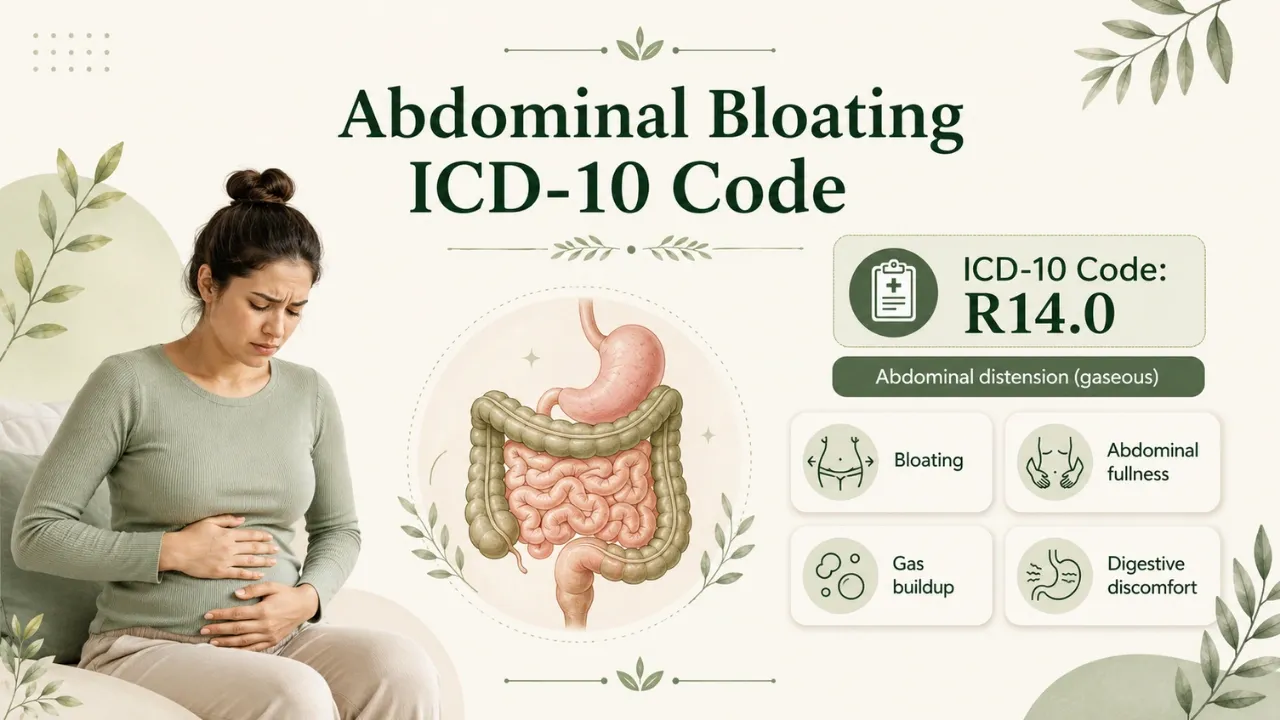
Quick Answer
The ICD-10-CM code for abdominal bloating is R14.0, abdominal distension (gaseous). Use R14.0 when bloating, abdominal fullness, or gaseous distension is the primary documented symptom and no confirmed underlying diagnosis has been established.
- R14.0 is used for abdominal bloating or gaseous distension.
- R14.1 is used when gas pain or cramping is the dominant symptom.
- R14.2 is used for eructation or excessive belching.
- R14.3 is used for flatulence or excessive gas passage.
- If IBS, GERD, constipation, or another condition is confirmed, code that condition first and use R14.0 only when separately documented.
The ICD-10 code for abdominal bloating is R14.0 - Abdominal distension (gaseous). This is the single correct billable code when bloating or gaseous distension is the primary complaint and no confirmed underlying diagnosis has been established. R14.0 falls under Category R14 - Flatulence and related conditions within ICD-10-CM, maintained by the CDC and CMS for U.S. diagnosis coding, billing, and clinical documentation.
Quick reference: R14.0 (bloating/distension) · R14.1 (gas pain/cramps) · R14.2 (eructation/belching) · R14.3 (flatulence)
What Is the ICD-10 Code for Abdominal Bloating?
The primary ICD-10-CM code for abdominal bloating is R14.0 - Abdominal distension (gaseous). This code falls under Category R14 (Flatulence and related conditions), within Block R10-R19 (Symptoms and signs involving the digestive system and abdomen).
R14.0 is used when abdominal bloating or gaseous distension is the primary presenting symptom and no definitive underlying diagnosis has been established. Abdominal bloating affects an estimated 10-30% of the general population and is among the most commonly coded digestive symptoms in outpatient settings.
Key codes at a glance:
- R14.0 - Abdominal distension (gaseous) → primary bloating code
- R14.1 - Gas pain → bloating with cramps or abdominal pain
- R14.2 - Eructation → excessive belching as primary complaint
- R14.3 - Flatulence → excessive gas passage as primary complaint
Important for coders: When a confirmed underlying condition causes bloating - such as IBS, GERD, or Celiac disease - the underlying condition code takes precedence. R14.0 is then used as an additional secondary code, not as the primary diagnosis.
ICD-10 Abdominal Bloating - Complete Code Reference Table
The full R14 category covers all gas-related abdominal symptoms. The table below covers all relevant abdominal bloating ICD-10 codes and related codes used in gastrointestinal outpatient encounters.
| ICD-10-CM Code | Description | When to Use | Notes |
|---|---|---|---|
| R14 | Flatulence and related conditions | Category code - do not use alone | Parent category; use specific subcodes |
| R14.0 | Abdominal distension (gaseous) | Primary code for abdominal bloating | Most commonly used abdominal bloating ICD-10 code |
| R14.1 | Gas pain | Bloating with abdominal cramps or pain | Use for abdominal bloating with cramps |
| R14.2 | Eructation | Belching/burping as primary symptom | Use when excessive burping is the main complaint |
| R14.3 | Flatulence | Excessive gas/wind as primary symptom | Distinct from distension - use when gas passage is primary |
| R10.9 | Unspecified abdominal pain | When pain dominates over bloating | Not bloating-specific |
| R10.13 | Epigastric pain | Upper abdominal pain with bloating | Epigastric bloating after meals - combine with R14.0 |
| K21.9 | GERD without esophagitis | When bloating is secondary to GERD | Primary code when GERD is confirmed |
| K58.9 | IBS without diarrhea | When bloating is secondary to IBS | Primary code when IBS is confirmed |
| K30 | Functional dyspepsia | Postprandial fullness, not primarily gaseous | Requires Rome IV criteria |
| K31.84 | Gastroparesis | Delayed gastric emptying confirmed | R14.0 as secondary |
What Is R14.0? Abdominal Distension vs Bloating - The Coding Distinction
R14.0 (Abdominal distension, gaseous) is the ICD-10-CM code that captures both the subjective sensation of bloating and the objective finding of abdominal distension. Despite their clinical differences, both map to the same billable code.
Abdominal bloating is a subjective symptom - the patient reports a feeling of fullness, tightness, or swelling. There may or may not be a visible change in abdominal girth.
Abdominal distension is an objective clinical finding - a measurable increase in abdominal circumference, typically confirmed on physical examination.
Both map to R14.0 in ICD-10-CM. The code description - "Abdominal distension (gaseous)" - encompasses both the patient-reported symptom and the clinician-observed finding when the cause is gaseous in nature.
When postprandial fullness is the primary complaint - particularly upper abdominal fullness after eating - consider whether K30 (Functional dyspepsia) may be more appropriate as the primary code, with R14.0 as secondary. The encounter documentation should specify:
- Location of fullness (upper vs lower abdomen)
- Timing (postprandial vs persistent)
- Whether gas passage relieves the symptom - supports R14.x; if not, consider K30 or a motility disorder code
One-liner for coders: R14.0 is the correct ICD-10 code for abdominal bloating, gaseous distension, and gas-related abdominal fullness - all three map to the same billable code.
Abdominal Bloating with Cramps ICD-10 - Code R14.1 Explained
The correct ICD-10 code for abdominal bloating with cramps is R14.1 - Gas pain. R14.1 is used when the patient presents with both abdominal distension or bloating AND abdominal cramps or pain that is clearly gas-related in origin.
The key distinction between R14.0 and R14.1:
- R14.0 - Bloating or distension without significant pain (feeling of fullness, visible swelling)
- R14.1 - Bloating accompanied by gas-related cramping or pain
When both distension and gas pain are present and equally prominent, R14.1 is the more specific and preferred code. R14.0 can be added as a secondary code if distension is also a notable separate finding.
Common clinical scenarios for R14.1:
- Patient reports sharp, crampy lower abdominal pain that shifts location and is relieved by passing gas
- Post-meal bloating accompanied by intermittent abdominal cramps
- PMS-associated gas pain and distension in women
- Lactose intolerance presenting with cramping and bloating after dairy consumption
Postprandial Abdominal Bloating ICD-10 - How to Code After-Meal Bloating
There is no single dedicated ICD-10-CM code for postprandial abdominal bloating. The correct approach for coding bloating that occurs specifically after eating depends on the clinical picture.
| Clinical Scenario | Primary Code | Additional Code | Notes |
|---|---|---|---|
| Bloating after eating, no established diagnosis | R14.0 | - | Document "postprandial" in encounter notes |
| Postprandial bloating with upper abdominal pain | R14.0 | R10.13 | Epigastric pain + distension |
| Bloating after eating - IBS confirmed | K58.9 | R14.0 | IBS as primary; R14.0 as secondary |
| Bloating after eating - GERD confirmed | K21.9 | R14.0 | GERD as primary; R14.0 as secondary |
| Bloating after eating - Gastroparesis confirmed | K31.84 | R14.0 | Gastroparesis as primary; R14.0 secondary |
| Postprandial fullness (gaseous, relieved by gas) | R14.0 | - | Document relief factor in encounter notes |
| Postprandial fullness (persistent, not relieved) | K30 | - | Functional dyspepsia - Rome IV criteria |
| Postprandial epigastric pain + bloating | R10.13 | R14.0 | Code pain as primary; add R14.0 as secondary |
Documentation checklist for postprandial coding - to support medical necessity and audit defensibility:
- Document timing: "occurs within 30-60 minutes of eating" or "immediate postprandial"
- Document location: upper (epigastric), periumbilical, or lower abdominal
- Document character: fullness, pressure, pain, cramping, or burning - each points to a different code
- Document relief factors: does passing gas relieve it? (supports R14.x) Does it persist regardless? (consider K30 or R10.x)
- Document pattern: every meal, specific foods, or triggered by volume of intake
- Record associated symptoms: nausea (add R11.0), belching (add R14.2), early satiety (flag for K30 consideration)
Coding note: There is no standalone ICD-10-CM code for "postprandial fullness." The correct code is determined by the dominant symptom character (gaseous vs pain) and whether an underlying diagnosis has been confirmed.
Postprandial Fullness vs Postprandial Pain - The ICD-10-CM Difference
Postprandial fullness and postprandial abdominal pain are not the same clinical entity and do not always share the same ICD-10-CM code. This distinction is one of the most common sources of miscoding in gastrointestinal outpatient encounters.
R10.13 (Epigastric pain) is the correct ICD-10-CM code when pain - rather than gaseous distension - is the primary postprandial symptom. R10.13 sits within Category R10 (Abdominal and pelvic pain), completely separate from Category R14 (Flatulence and related conditions).
The key clinical question is: what does the patient report as the dominant symptom?
- Dominant = pressure, fullness, swelling after eating → R14.0
- Dominant = aching, cramping, burning in upper abdomen after eating → R10.13
- Both present equally → code both; document which is primary based on clinical severity
One-liner: If bloating and pain are both present and equally prominent, use R14.1 (gas pain) - not a combination of R14.0 and R10.9.
ICD-10 Code for Gas - R14.2 (Belching) and R14.3 (Flatulence) Explained
When a patient's primary complaint is gas - rather than the sensation of abdominal bloating - the correct ICD-10 code shifts from R14.0 to either R14.2 or R14.3, depending on how the gas manifests.
- The ICD-10 code for excessive gas passage is R14.3 (Flatulence)
- The ICD-10 code for excessive belching is R14.2 (Eructation)
R14.2 - Eructation (Belching). Use R14.2 when:
- Excessive or involuntary belching is the patient's chief complaint
- Belching is causing social or functional distress
- No confirmed underlying cause (GERD, aerophagia) takes primary code priority
If excessive belching is secondary to confirmed GERD (K21.9) or aerophagia, code the underlying condition as primary and add R14.2 as a secondary code only if it represents a distinct, separately addressed clinical finding.
R14.3 - Flatulence (Excessive Gas). Use R14.3 when:
- The patient's chief complaint is excessive gas or wind passage
- Visible abdominal distension (bloating) is not the primary complaint
- Flatulence is causing significant functional impairment or distress
Quick decision guide - choosing between all four R14 subcodes:
- Swelling / fullness / visible distension → R14.0
- Gas-related cramps or pain with distension → R14.1
- Excessive belching as main complaint → R14.2
- Excessive gas passage (flatulence) as main complaint → R14.3
- Multiple gas symptoms equally present → code the most prominent as primary; add secondary R14.x codes as needed
One-liner for coders: All four R14 subcodes are billable; the parent code R14 alone is not. Always select the most specific subcode that matches the chief complaint.
Abdominal Bloating ICD-10-CM - Understanding the CM Specification
Abdominal bloating ICD-10-CM refers to the Clinical Modification version of ICD-10 used in the United States, as opposed to ICD-10-PCS (used for procedures) or the WHO's base ICD-10 (used internationally). ICD-10-CM is maintained by the CDC and CMS and is updated annually on 1 October.
Key ICD-10-CM coding rules for abdominal bloating:
- Use the most specific code available - if an underlying diagnosis is confirmed, code the underlying condition first and add R14.0 as a secondary code
- Symptom codes (R14.x) are used when no diagnosis is established - once a definitive diagnosis is made, R14.0 is typically not the primary code
- R14 codes are individually billable - R14.0, R14.1, R14.2, and R14.3 are all billable; the parent R14 alone is not
- Document clinical context - ensure the encounter note supports the coded symptom (chief complaint, examination findings, clinical impression)
- Verify annually - always check the current year's ICD-10-CM Tabular List, as codes and descriptions are updated each 1 October
ICD-10-CM vs ICD-10-PCS: ICD-10-CM is the diagnosis classification system - R14.0 is an ICD-10-CM code used to document the patient's symptom. ICD-10-PCS is the separate system used to code medical and surgical procedures performed during inpatient hospital stays. For abdominal bloating in an outpatient or office setting, only ICD-10-CM codes apply.
Conditions That Cause Bloating - ICD-10 Codes for Underlying Diagnoses
When an underlying cause of abdominal bloating is confirmed, that condition is coded as primary and R14.0 is added as secondary. According to the following are the most commonly coded underlying conditions in patients presenting with recurrent abdominal bloating.
| Underlying Condition | ICD-10-CM Code | R14.0 Role |
|---|---|---|
| Irritable Bowel Syndrome - mixed (IBS-M) | K58.2 | Secondary |
| IBS without diarrhea | K58.9 | Secondary |
| GERD without esophagitis | K21.9 | Secondary |
| Celiac disease | K90.0 | Secondary |
| Gastroparesis | K31.84 | Secondary |
| Lactose intolerance | E73.9 | Secondary |
| Functional dyspepsia | K30 | Secondary |
| Small intestinal bacterial overgrowth (SIBO) | K63.8 | Secondary |
| Constipation (unspecified) | K59.00 | Secondary |
| Ovarian cyst | N83.20 | Secondary |
When any of these conditions is confirmed in the same encounter, coding R14.0 as the primary diagnosis is an audit risk and a violation of ICD-10-CM Official Guidelines Section I.C.18.
How to Select the Right Bloating ICD-10 Code: A Step-by-Step Coding Workflow
Selecting the correct ICD-10 code for abdominal bloating takes fewer than 60 seconds when following a consistent four-step decision process. Use this workflow for gastrointestinal outpatient encounters.
Step 1: Identify the Chief Complaint
Ask: what did the patient report as their primary reason for the visit?
- Swelling, fullness, visible distension, "feels bloated" → proceed to Step 2 with R14.0 as starting point
- Cramping or pain alongside bloating → start with R14.1
- Primarily excessive belching → start with R14.2
- Primarily passing too much gas → start with R14.3
- Primarily pain (not gas-related) → exit R14 category; consider R10.x
Step 2: Check Whether an Underlying Diagnosis Is Confirmed
If the provider has confirmed IBS, GERD, celiac disease, gastroparesis, lactose intolerance, constipation, or another cause, code that condition first. Add R14.0 only when bloating or gaseous distension is separately documented and clinically relevant.
Step 3: Match the Symptom to the Most Specific R14 Subcode
- Use R14.0 for bloating, abdominal fullness, or gaseous distension.
- Use R14.1 for gas pain or crampy gas-related abdominal pain.
- Use R14.2 for excessive belching or eructation.
- Use R14.3 for excessive flatulence or gas passage.
Step 4: Document the Coding Rationale
The encounter note should clearly mention the dominant symptom, location, timing, associated pain, relief with gas passage, and whether an underlying condition has been diagnosed. Good documentation makes the code easier to defend in billing review.
Documentation Examples for Abdominal Bloating ICD-10 Coding
Clear documentation helps avoid vague symptom coding and supports accurate ICD-10-CM selection. These examples show how the same symptom may require different codes depending on the chief complaint.
| Documentation Example | Best ICD-10-CM Code | Why |
|---|---|---|
| Patient reports abdominal bloating and visible gaseous distension after meals. No confirmed diagnosis yet. | R14.0 | Bloating or gaseous distension is the primary symptom. |
| Patient reports bloating with crampy gas pain relieved after passing gas. | R14.1 | Gas-related pain is the dominant complaint. |
| Patient reports frequent belching without major abdominal swelling. | R14.2 | Eructation is the main symptom. |
| Patient reports excessive gas passage as the primary concern. | R14.3 | Flatulence is the dominant symptom. |
| Patient has confirmed IBS with recurrent bloating. | K58.x primary + R14.0 secondary when documented | The confirmed condition takes priority over the symptom code. |
Common Coding Mistakes to Avoid
Abdominal bloating is often miscoded because it overlaps with abdominal pain, gas pain, reflux, dyspepsia, and constipation. Avoid these common mistakes.
- Do not use parent code R14 alone when a specific R14 subcode is available.
- Do not code R14.0 as primary when IBS, GERD, celiac disease, gastroparesis, or another confirmed condition explains the bloating.
- Do not use R10.9 for bloating unless abdominal pain is the main documented symptom.
- Do not use R14.1 unless gas pain or cramps are clearly documented.
- Do not code belching as R14.0 when R14.2 better matches the chief complaint.
- Do not code flatulence as R14.0 when R14.3 is more specific.
- Do not assume postprandial fullness is always R14.0. If it is persistent upper abdominal fullness not relieved by gas, K30 may be more appropriate when criteria are met.
Quick Comparison: R14.0 vs R14.1 vs R14.2 vs R14.3
| Code | Best For | Main Symptom | Simple Rule |
|---|---|---|---|
| R14.0 | Abdominal bloating or distension | Fullness, swelling, gaseous distension | Use when bloating is the main issue. |
| R14.1 | Gas pain | Crampy or shifting gas-related pain | Use when pain is gas-related and prominent. |
| R14.2 | Belching | Excessive burping | Use when belching is the chief complaint. |
| R14.3 | Flatulence | Excessive passing of gas | Use when gas passage is the chief complaint. |
Patient-Friendly Meaning of Abdominal Bloating ICD-10
For patients, abdominal bloating ICD-10 simply means the diagnosis code used in medical records when bloating, gas, or abdominal distension is documented during a visit. It does not explain the root cause by itself. The code only records the symptom unless a doctor confirms a specific condition.
For example, occasional bloating after a heavy meal may be coded differently from recurrent bloating caused by IBS, constipation, GERD, lactose intolerance, or celiac disease. That is why symptom details and diagnosis history matter.
Medical Disclaimer
This article is for general health education and coding awareness only. It does not replace professional medical advice, diagnosis, treatment, or certified coding guidance. ICD-10-CM codes and billing rules may change, so healthcare providers and coders should verify codes against the current official ICD-10-CM code set and payer policies. If bloating is severe, persistent, painful, associated with vomiting, blood in stool, unexplained weight loss, fever, pregnancy, or sudden abdominal swelling, consult a qualified healthcare professional promptly.
Key Takeaways
- The main ICD-10-CM code for abdominal bloating is R14.0, abdominal distension (gaseous).
- R14.1 is used for gas pain or bloating with gas-related cramps.
- R14.2 is used for belching, and R14.3 is used for flatulence.
- R14 is a parent category and should not be used alone when a specific subcode applies.
- If IBS, GERD, constipation, celiac disease, gastroparesis, or lactose intolerance is confirmed, code the underlying condition first.
- Postprandial bloating usually uses R14.0 when gaseous fullness is dominant and no confirmed diagnosis exists.
- Good documentation should mention timing, location, symptom type, severity, associated pain, and relief factors.
Understand Your Bloating Pattern
If bloating, gas, fullness, or digestion discomfort keeps coming back, take a free gut health test to understand your pattern better.
Your gut is unique your healing should be too.

FAQs
The ICD-10-CM code for abdominal bloating is R14.0, abdominal distension (gaseous), when bloating or gaseous distension is the main documented symptom and no confirmed underlying diagnosis has been established.
Yes, R14.0 is a billable ICD-10-CM code for abdominal distension (gaseous). The parent category R14 is not used alone when a more specific subcode applies.
Abdominal bloating with gas-related cramps is usually coded as R14.1, gas pain, when the cramping or pain is clearly related to gas and is a prominent symptom.
R14.0 is used for bloating, abdominal fullness, or gaseous distension. R14.1 is used when gas-related pain or cramps are the dominant symptom.
Excessive gas passage is coded as R14.3, flatulence. If excessive belching is the main complaint, R14.2, eructation, is more specific.
Yes, but when IBS is confirmed, the IBS code should usually be primary. R14.0 may be added as a secondary code when bloating is separately documented and clinically relevant.
Yes, but if GERD is confirmed and is the reason for the encounter, GERD is coded first. R14.0 may be added as a secondary symptom code if bloating is documented.
No, there is no separate ICD-10-CM code only for postprandial bloating. R14.0 is commonly used when gaseous bloating after meals is the main symptom and no underlying diagnosis is confirmed.
Disclaimer
The content provided by Mool Health is for educational and informational purposes only and should not be considered a substitute for professional medical advice, diagnosis, or treatment.