
Best Medicine for Diarrhea and Vomiting: Relief & Recovery Guide
Diarrhea and vomiting can lead to dehydration and weakness if not managed properly. This guide explains medicines, hydration tips, and recovery methods.
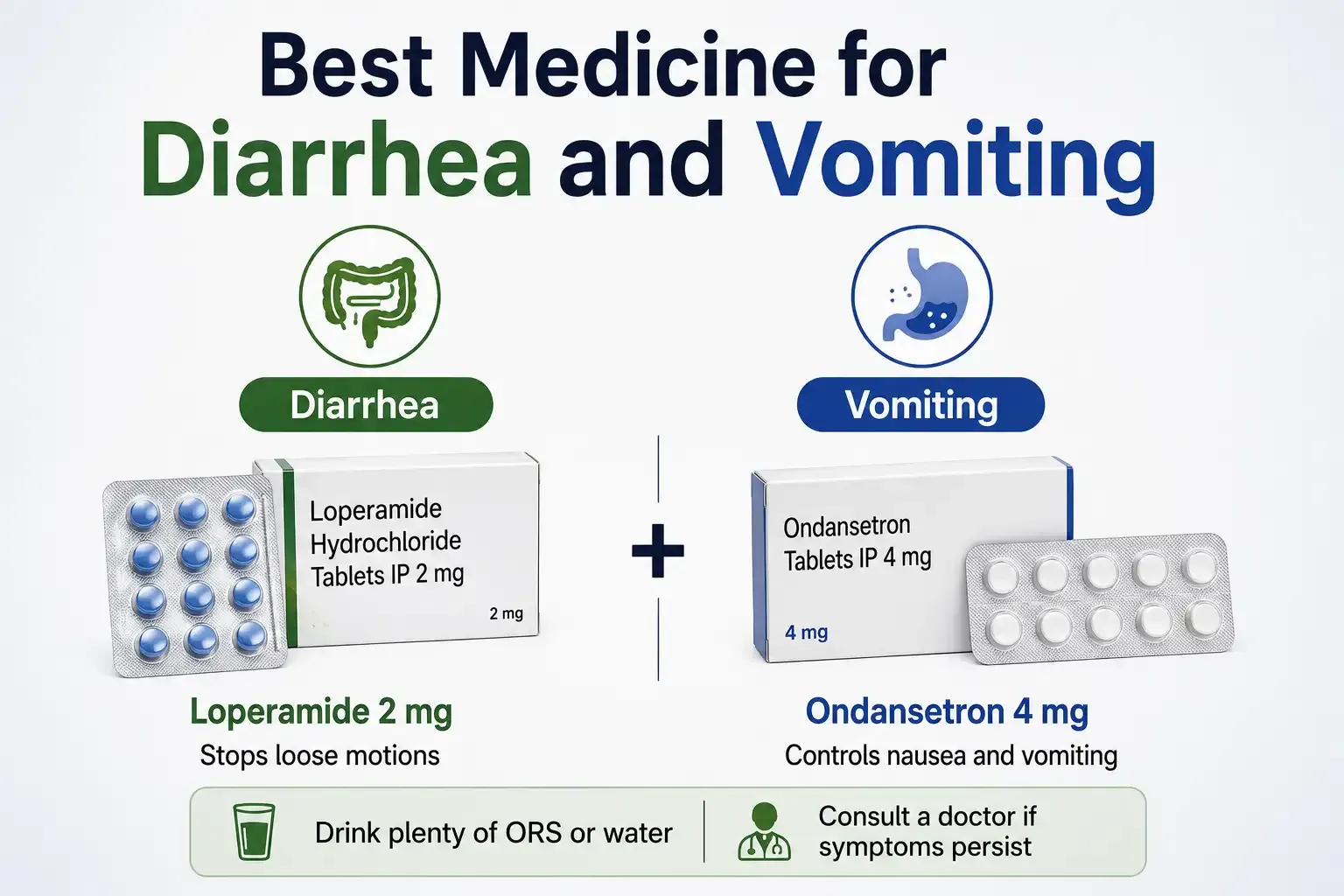
✏️ Quick Answer
No single tablet is the best medicine for diarrhea and vomiting. The right treatment depends on the cause. But one treatment has universal medical consensus as the first step: ORS (Oral Rehydration Solution). According to WHO, ORS alone can prevent up to 93% of diarrhea-related deaths when given promptly.
- ORS first , replaces fluids and salts lost through loose stools and vomiting
- Zinc supplements , for children, to shorten duration and reduce recurrence
- Probiotics , help restore gut bacteria after infection or antibiotic use
- Antibiotics , only if bacterial infection is confirmed; most cases do not need them
- Anti-diarrheal drugs , adults only, with caution; never in children or when fever or blood in stool is present
Most cases of diarrhea and vomiting are caused by viral gastroenteritis , a gut infection where the real danger is not the infection itself but the dehydration that follows. Understanding causes of diarrhea helps identify which treatment is actually appropriate. For a step-by-step home management guide, see how to stop diarrhea at home.
Why Diarrhea and Vomiting Happen Together: The Gut Mechanism
Diarrhea and vomiting occur together because the gut and brain are connected through the vagus nerve. When a virus or bacteria enters the digestive tract, the gut's immune system triggers inflammation in the stomach and small intestine simultaneously doing two things:
- It speeds up gut motility , intestinal muscles contract too quickly, pushing fluid through before water can be reabsorbed, producing loose watery stools.
- It activates vomiting reflexes , the gut sends signals through the vagus nerve to the brain's vomiting centre (area postrema), triggering reverse peristalsis to expel the irritant upward.
This is why ORS addresses both symptoms. By restoring the sodium-glucose-water balance through the SGLT1 co-transporter, ORS continues to hydrate the body even while diarrhea is ongoing.
- Viral gastroenteritis , rotavirus (most common in children), norovirus (adults and food outbreaks)
- Bacterial food poisoning , Salmonella, Campylobacter, E. coli from contaminated food or water
- Drug-induced gut irritation , antibiotics, NSAIDs like ibuprofen, and iron supplements
- Stress and anxiety , the gut-brain axis can trigger both symptoms without any infection
- Food intolerance , lactose intolerance or gluten sensitivity after specific foods
How to Use ORS Correctly: The Most Important Medicine
ORS works because of sodium-glucose co-transport: even when the gut is inflamed and water absorption is impaired, the small intestine can still absorb sodium and glucose together through the SGLT1 transporter , and water follows. This is why ORS keeps you hydrated even while diarrhea continues.
- Prepare the solution correctly. Dissolve one ORS sachet in exactly the amount of clean water stated on the packet , typically 200 ml or 1 litre. Under-diluting worsens dehydration. Over-diluting reduces effectiveness.
- Start immediately , do not wait for symptoms to peak. Begin ORS with the first episode of diarrhea or vomiting. The earlier you start, the less total fluid you lose.
- Take small, frequent sips if vomiting is active. Take 5-10 ml (about a teaspoon) every 2-3 minutes. Small sips bypass the vomiting reflex because they do not stretch the stomach. Do not drink a full glass at once.
- Replace what you lose. For every loose stool, replace approximately 100-200 ml ORS in children or 200-400 ml in adults. Continue until stools return to normal consistency.
- Do not mix ORS with milk, juice, or soft drinks. These alter the sodium-glucose ratio and reduce absorption. Use only clean water.
- Store correctly. Mixed ORS solution should be used within 24 hours at room temperature, or 48 hours if refrigerated. Discard unused solution after that.
Treatment Comparison: Which Medicine Works Best and When?
| Treatment | What It Does | Works Best For | Caution / Not For | Typical Duration |
|---|---|---|---|---|
| ORS | Replaces fluid, sodium, potassium, glucose | Everyone , first line in all ages, all causes | Do not mix with milk or juice | Continue until diarrhea stops |
| Zinc supplements | Reduces duration and recurrence | Children under 5 | Not a replacement for ORS | 10-14 days (WHO guideline) |
| Probiotics | Restores healthy gut bacteria | After antibiotic use; mild viral cases | Benefit varies by strain | 5-7 days typically |
| Antiemetics (ondansetron) | Stops vomiting signals in the brain | Adults with severe vomiting preventing fluid intake | Children, pregnancy, elderly , only with doctor's advice | Short-term (1-2 days) |
| Anti-diarrheal drugs (loperamide) | Slows gut movement to reduce stool frequency | Adults with mild diarrhea, no fever, no blood in stool | Never in children; avoid if fever or blood in stool | Maximum 2 days without review |
| Antibiotics | Kills bacterial pathogens | Confirmed bacterial infection, blood in stool, high fever | Most viral cases , antibiotics make these worse | As prescribed (3-7 days) |
| IV fluids | Rapid rehydration | Severe dehydration, unable to keep ORS down | Hospital setting required | Until rehydration is stable |
Treatment by Age Group: Who Needs What
Infants and Young Children (Under 5 Years)
- ORS is the primary treatment , never plain water alone, which can cause dangerously low sodium
- Zinc supplements for 10-14 days as per WHO and Indian Academy of Pediatrics guidelines
- Continue breastfeeding throughout , do not stop
- Anti-diarrheal drugs are NOT recommended , they can cause serious complications in young children
- If vomiting makes ORS difficult, a doctor may prescribe a single dose of ondansetron
- See a doctor within 24 hours if any signs of dehydration appear
School-Age Children and Teenagers (5-17 Years)
- ORS remains the cornerstone
- Zinc may be advised by a paediatrician
- Light, easily digestible food once vomiting settles
- Anti-diarrheal drugs only with doctor's guidance , not as a first step
Adults (18-60 Years)
- ORS or electrolyte drinks without high sugar (avoid sports drinks as a replacement)
- Loperamide may be used for short-term relief in adults with no fever and no blood in stool
- Antiemetics may be prescribed for severe vomiting
- Resume food early , fasting does not help recovery and may slow it
Elderly Adults (60+)
- Dehydration risk is higher because thirst sensation decreases with age
- ORS is critical and may need to be given proactively, before thirst appears
- Anti-diarrheal drugs interact with many common medications in older people , always check with a doctor
- Seek medical attention earlier compared to younger adults
Pregnant Women
- ORS is safe throughout pregnancy
- Most antiemetics and anti-diarrheal drugs are NOT recommended without obstetric advice
- Dehydration in pregnancy can affect the baby , seek medical guidance within 12-24 hours if symptoms are significant
Recovery Timeline: What to Expect Day by Day
- Hours 0-6 (Symptoms begin): Vomiting is often most intense in the first few hours. Start ORS immediately , even small sips of 5-10 ml every 5 minutes help.
- Hours 6-24: Vomiting usually reduces within 12-24 hours if fluids are kept down. Diarrhea may continue. Continue ORS. Avoid solid food until vomiting fully stops.
- Day 1-2: Most adults begin to feel better. Introduce light foods , plain rice, bananas, plain toast, boiled potato. Continue ORS if stools are still loose.
- Day 2-3: Stool frequency normalises in most viral cases. Energy returns gradually. Avoid dairy, raw vegetables, and oily food for one more day.
- Day 3-5: Full recovery in most adults. Children may take slightly longer.
- Bacterial infections (Salmonella, Campylobacter) can last 4-7 days and may need antibiotics
- If feeling worse on Day 3 , more weakness, less urine, dizziness when standing , go to a clinic immediately
- Persistent diarrhea beyond 7 days suggests a secondary cause , see a doctor
- WHO classifies diarrhea lasting more than 14 days as persistent diarrhea, requiring investigation beyond infection
When to See a Doctor
- Vomiting or diarrhea lasts more than 24-48 hours without improvement
- Signs of dehydration appear , no urination for 6+ hours, dizziness, extreme weakness, dry mouth
- Blood appears in stool at any point
- High fever above 38.5°C accompanies symptoms
- The patient is an infant, elderly, or pregnant
- In children under 2: sunken eyes, no tears when crying, sunken fontanelle , go immediately
What the Evidence Says
- ORS (Lancet, 1978; WHO, 2023): The sodium-glucose co-transport mechanism allows absorption to continue even during active secretory diarrhea. The WHO's ORS programme is credited with reducing global child diarrhea mortality by an estimated 50% over four decades.
- Zinc for children (Cochrane, 2016): Zinc supplementation reduced the duration of acute diarrhea by approximately 12-24 hours and reduced the risk of diarrhea continuing beyond 7 days by 24% across 33 randomised controlled trials.
- Probiotics (Cochrane, 2019): Lactobacillus rhamnosus GG and Saccharomyces boulardii reduced diarrhea duration by approximately one day in children. Effects in adults were more variable. Benefit is greatest when started within 48 hours of symptom onset.
- Ondansetron in children (NEJM, 2006): A single oral dose significantly reduced vomiting episodes and improved ORS retention, reducing the need for IV fluids.
- Antibiotics , why often wrong (Journal of Infectious Diseases, 2012): Antibiotic use in non-bacterial diarrhea does not shorten illness and increases antibiotic resistance risk. Routine antibiotic prescribing for diarrhea is classified as inappropriate by WHO.
For a broader picture of foods that harm or support gut recovery, see our guide on worst foods for gut health. For long-term gut resilience and prevention, see how to avoid gastric problems.
What This Means for You
- Get ORS first , before any other medicine. One sachet dissolved in clean water, sipped slowly
- Track your urine output , if you have not urinated in 6+ hours, increase ORS intake immediately
- Do not give children anti-diarrheal drugs , ORS and zinc are the evidence-backed choice
- See a doctor if symptoms last beyond 48 hours, fever appears, or blood is in stool
- Check your medicines cabinet , if you recently started a new medication, it may be the cause of your symptoms
Key Takeaways
Diarrhea and vomiting can lead to dehydration and weakness if not managed properly. This guide explains medicines, hydration tips, and recovery methods.
Your gut is unique your healing should be too.

Disclaimer
The content provided by Mool Health is for educational and informational purposes only and should not be considered a substitute for professional medical advice, diagnosis, or treatment.