
Diarrhea ICD 10: Codes, Types and When It Matters
Diarrhea ICD-10 codes vary by cause, including R19.7 for unspecified diarrhea and A09 for infectious cases. Learn key codes, types, and when medical care is needed.
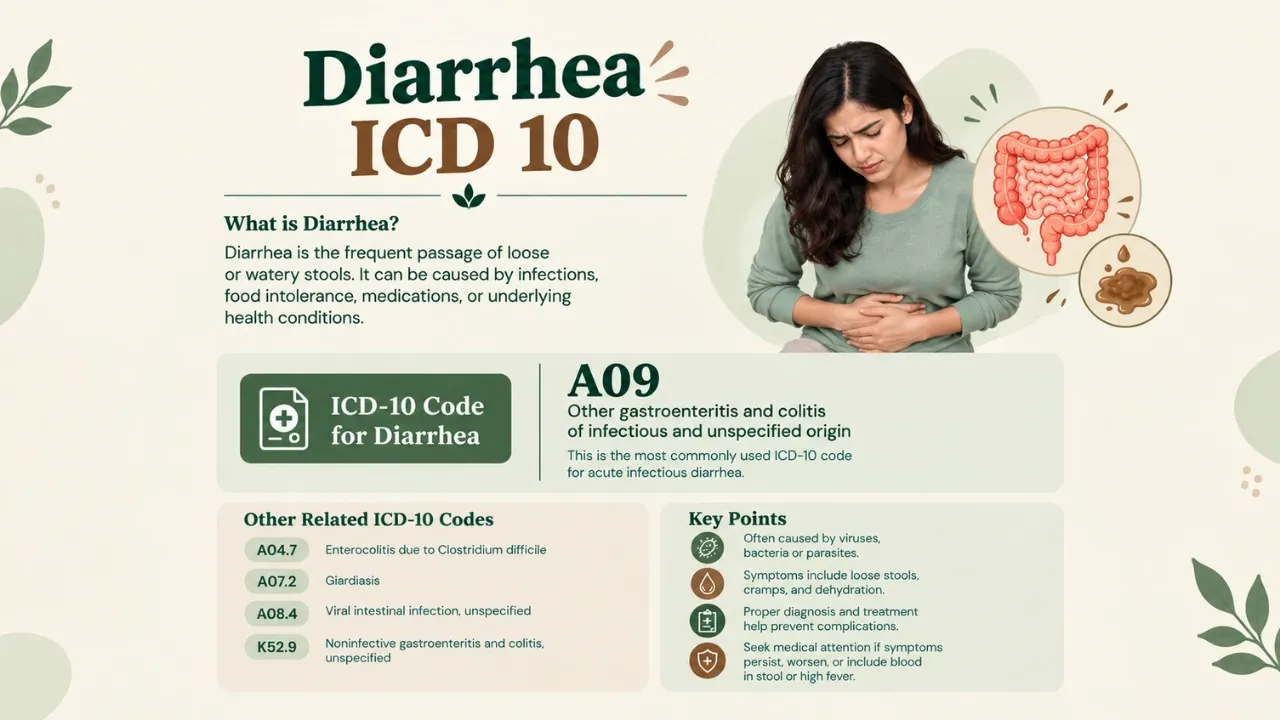
Quick Answer
The ICD-10 code for diarrhea depends on type and cause — not all diarrhea maps to the same code. R19.7 is the general code for unspecified diarrhea. A09 covers acute infectious diarrhea and gastroenteritis. K52.9 is used for chronic, non-infectious diarrhea lasting more than four weeks. K58.0 applies to IBS with diarrhea. A04.7 or K92.1 covers bloody diarrhea.
Choosing the wrong code affects billing, diagnosis records, and the downstream treatment pathway — which is why understanding the difference matters.
- R19.7 — Unspecified diarrhea
- A09 — Acute infectious diarrhea / gastroenteritis
- K52.9 — Chronic non-infectious diarrhea
- K58.0 — IBS with diarrhea
- A04.7 / K92.1 — Bloody diarrhea
- A09 — Traveler's diarrhea / vomiting and diarrhea (infectious)
What Is Diarrhea ICD-10 — ICD 10 Code for Diarrhea Explained
Diarrhea ICD-10 refers to the classification system used by healthcare providers to identify and document different types of diarrhea. ICD-10 stands for the International Classification of Diseases, 10th Revision. It helps standardize diagnosis across clinics, hospitals, and medical records.
When someone searches for icd 10 code for diarrhea or diarrhea icd 10 code, they are usually trying to understand how their condition is categorized medically. These codes do not treat the condition but help identify its type and possible cause.
Diarrhea ICD-10 Code Reference Table
| Condition | ICD-10 Code | Description |
|---|---|---|
| General diarrhea | R19.7 | Unspecified diarrhea — used when type is not specified |
| Acute diarrhea | A09 | Infectious gastroenteritis — sudden onset, common |
| Chronic diarrhea | K52.9 | Noninfective gastroenteritis — lasting 4+ weeks |
| Bloody diarrhea | A04.7 / K92.1 | Infectious or gastrointestinal bleeding |
| Traveler's diarrhea | A09 | Infectious origin during travel |
| IBS with diarrhea | K58.0 | Irritable bowel syndrome with diarrhea |
| Vomiting and diarrhea | A09 / R11.2 | Infectious gastroenteritis with vomiting |
| Diarrhea of presumed infectious origin | A09 | Diarrhea presumed to be infectious but unconfirmed |
These codes help doctors differentiate between diarrhea of presumed infectious origin icd 10 and non-infectious causes like IBS or food intolerance.
ICD-10 Diarrhea Code Reference — Including Dysentery, Loose Stool, Dehydration & Gastroenteritis
The table below extends the core code list to cover every diarrhea-adjacent query that appears in clinical documentation. These codes follow the ICD-10-CM used in the United States and ICD-10 used internationally under WHO guidelines [1].
| Condition | ICD-10 Code | Key Distinction |
|---|---|---|
| Unspecified diarrhea | R19.7 | Use when cause is unknown or not documented |
| Acute infectious diarrhea | A09 | Bacterial, viral, or parasitic — confirmed or presumed |
| Diarrhea of presumed infectious origin | A09 | Infectious cause suspected but not lab-confirmed |
| Acute gastroenteritis | A09 | GI inflammation with diarrhea, often vomiting |
| Acute watery diarrhea | A09 | Watery stool without blood — typically viral |
| Infective diarrhea | A09 | Synonym for infectious diarrhea — same code |
| Chronic non-infectious diarrhea | K52.9 | Lasting 4+ weeks, no confirmed infection |
| IBS with diarrhea | K58.0 | Functional disorder — no structural damage |
| Bloody diarrhea (infectious) | A04.7 | Enteric infection producing blood in stool |
| Bloody diarrhea / hematochezia (GI bleed) | K92.1 | Blood in stool from GI source, unspecified |
| Traveler's diarrhea | A09 | Infectious diarrhea acquired during travel |
| Vomiting and diarrhea (infectious) | A09 + R11.2 | Both coded when vomiting is a prominent symptom |
| Loose stools | R19.7 | Unformed stool without confirmed diagnosis |
| Amoebic dysentery | A06.0 | Entamoeba histolytica infection |
| Bacillary dysentery / Shigella | A03.9 | Shigella spp. bacterial infection |
| Acute dysentery (unspecified) | A09 | Dysentery without identified organism |
| Salmonella enteritis | A02.0 | Non-typhoidal salmonella with diarrhea |
| Rotavirus gastroenteritis | A08.0 | Common in children — viral |
| Norovirus gastroenteritis | A08.1 | Common in adults and outbreaks |
| Giardiasis | A07.1 | Parasitic diarrhea from contaminated water |
| Acute gastroenteritis with dehydration | A09 + E86.0 | Code dehydration separately using E86.0 |
| Clostridium difficile colitis | A04.7 | Antibiotic-associated diarrhea |
Key rule from ICD-10-CM official guidelines: When the cause of diarrhea is not confirmed, use A09 (presumed infectious) rather than R19.7. R19.7 is reserved for genuinely unspecified presentations where infection has been ruled out or not assessed.
[1] World Health Organization. International Classification of Diseases, Tenth Revision (ICD-10). Geneva: WHO, 2019.
Types of Diarrhea Based on ICD-10 Diarrhea Code
Acute Diarrhea ICD-10 — Code A09
Acute diarrhea icd 10 usually refers to sudden-onset diarrhea, often lasting a few days. It is commonly linked to infections from contaminated food or water.
- Caused by bacteria, viruses, or parasites
- Often associated with vomiting and diarrhea icd 10 classification (A09 / R11.2)
- Common in travel or poor sanitation conditions
Chronic Diarrhea ICD-10 — Code K52.9
Chronic diarrhea icd 10 refers to diarrhea lasting more than 4 weeks. It is often linked to underlying gut or metabolic issues.
- May be related to gut inflammation or microbiome imbalance
- Common in IBS and food intolerance
- Requires deeper evaluation beyond infection
Bloody Diarrhea ICD-10 — Code A04.7 / K92.1
Bloody diarrhea icd 10 is considered more serious because it may indicate infection, inflammation, or intestinal damage.
- Can be caused by bacterial infections
- May signal inflammatory bowel conditions
- Needs immediate medical attention
Irritable Bowel Syndrome with Diarrhea ICD-10 — Code K58.0
Irritable bowel syndrome with diarrhea icd 10 (irritable bowel syndrome with diarrhea icd 10 code K58.0) is a functional gut disorder where digestion is irregular without a clear infection.
- Triggered by stress and gut-brain imbalance
- Associated with bloating and abdominal discomfort
- Symptoms fluctuate over time
Traveler's Diarrhea ICD-10 — Code A09
Travelers diarrhea icd 10 usually falls under infectious categories. It occurs due to exposure to unfamiliar bacteria in food or water.
- Common during travel to new regions
- Linked to hygiene and water quality
- Often resolves but may disrupt gut balance
Vomiting and Diarrhea ICD-10 — Code A09 / R11.2
Vomiting and diarrhea icd 10 is typically coded under A09 (infectious gastroenteritis) when both occur together due to an infection. When vomiting is the primary symptom alongside diarrhea, R11.2 (nausea with vomiting) may also be assigned alongside the diarrhea code.
This combination is most common in acute viral gastroenteritis and food poisoning episodes. Dehydration is the primary risk — ORS is the first-line response.
What Causes Diarrhea?
Diarrhea is not a single disease. It is a symptom of underlying disruption in digestion, absorption, or gut health.
Infections
- Contaminated food or water
- Bacterial, viral, or parasitic infections
Gut Imbalance
- Disrupted microbiome due to antibiotics
- Poor diet or processed food intake
Food Intolerance
- Lactose intolerance
- Reaction to certain foods
Stress and Lifestyle
Stress affects gut movement and digestion speed. The gut-brain connection becomes more sensitive, leading to frequent loose stools.
The Root Cause: Digestion to Gut to Metabolism
Diarrhea often starts with improper digestion. When food is not broken down properly, it moves quickly through the intestines, reducing nutrient absorption.
This affects the gut microbiome, leading to imbalance. Over time, repeated episodes can impact metabolism, hydration, and nutrient levels like Vitamin B12.
Urban lifestyle factors worsen this:
- Irregular eating patterns
- Poor water quality
- High stress and disrupted sleep
- Frequent antibiotic use
Ignoring these patterns can lead to chronic digestive issues.
When Does Diarrhea Become Serious?
Not all diarrhea needs medical attention, but certain signs should not be ignored.
- Diarrhea lasting more than 3–4 days
- Blood in stool
- Severe dehydration
- Persistent vomiting and diarrhea
- Unexplained weight loss
These symptoms may indicate deeper issues beyond simple infection.
Foundational Fixes for Gut Recovery
Rehydrate the Body
- Drink clean, safe water
- Use oral rehydration solutions if needed
Support Gut Healing
- Eat light, easily digestible food
- Avoid processed and spicy foods
Restore Routine
- Regular meal timing
- Proper sleep schedule
These steps help the gut regain balance after diarrhea episodes.
A Root-Cause Approach: Mool Health's Perspective
Knowing your ICD-10 code classification is the starting point — but it does not explain why your gut keeps producing this symptom. For many people with recurring or chronic diarrhea coded K52.9 or K58.0, the code labels the pattern but misses the root cause.
Factors like gut microbiome imbalance, chronic stress, poor sleep, antibiotic overuse, and disrupted meal timing all contribute to persistent loose stools — and none of them show up in an ICD-10 code. That gap is exactly what root-cause gut health evaluation addresses.
Mool Health's approach starts with a Gut Test that assesses microbiome balance and digestion efficiency. This is combined with Prakruti analysis and a structured review of diet, stress, sleep, and daily habits.
The goal is to identify whether recurring diarrhea is driven by an underlying infection, gut microbiome imbalance, food intolerance, or metabolic disruption — and to build a personalised recovery plan around that finding.
This approach is not a treatment for medical emergencies. Bloody diarrhea, severe dehydration, and acute infectious episodes need clinical medical care first. But for chronic or recurring loose stools where the ICD-10 code says K52.9 or K58.0 and no clear treatment path has been established, a deeper gut health evaluation can make a meaningful difference.
What This Means for You
If you looked up a diarrhea ICD-10 code, you are likely trying to make sense of a diagnosis, a billing query, or a persistent gut symptom. Here is what matters most:
Acute diarrhea coded A09 — the most common type — resolves in most people within 3–7 days with hydration and rest. Chronic diarrhea coded K52.9 or K58.0 rarely resolves on its own; it signals an underlying imbalance in gut function that needs investigation. Bloody diarrhea coded A04.7 or K92.1 requires prompt medical evaluation regardless of other symptoms.
Your next steps, based on what you are dealing with:
- If diarrhea started within the last 72 hours — prioritise hydration with ORS, eat light, and avoid dairy and processed food
- If diarrhea has lasted more than 4 weeks — ask your doctor to rule out infection first, then investigate functional causes (IBS, microbiome imbalance, food intolerance)
- If you see blood in stool — do not wait; see a clinician today
- If you have recurring loose stools without a clear diagnosis — consider a gut microbiome assessment to identify root cause imbalances
- If you have already ruled out infection and are looking for root-cause support — a structured gut health evaluation can identify whether diet, stress, or microbiome disruption is driving your symptoms
When home management and hydration are not enough to stop recurring episodes, a root-cause approach — assessing gut microbiome, diet patterns, and lifestyle factors together — becomes the next logical step.
Key Takeaways
Diarrhea ICD-10 codes vary by cause, including R19.7 for unspecified diarrhea and A09 for infectious cases. Learn key codes, types, and when medical care is needed.
Your gut is unique your healing should be too.

Disclaimer
The content provided by Mool Health is for educational and informational purposes only and should not be considered a substitute for professional medical advice, diagnosis, or treatment.