
Mucus in Stool: Common Causes, Colours and When to Seek Help
Mucus in Stool can occur due to infections, digestive conditions, inflammation, or changes in bowel habits. Learn the common causes, treatment options, warning signs, and when mucus in stool may require medical attention.
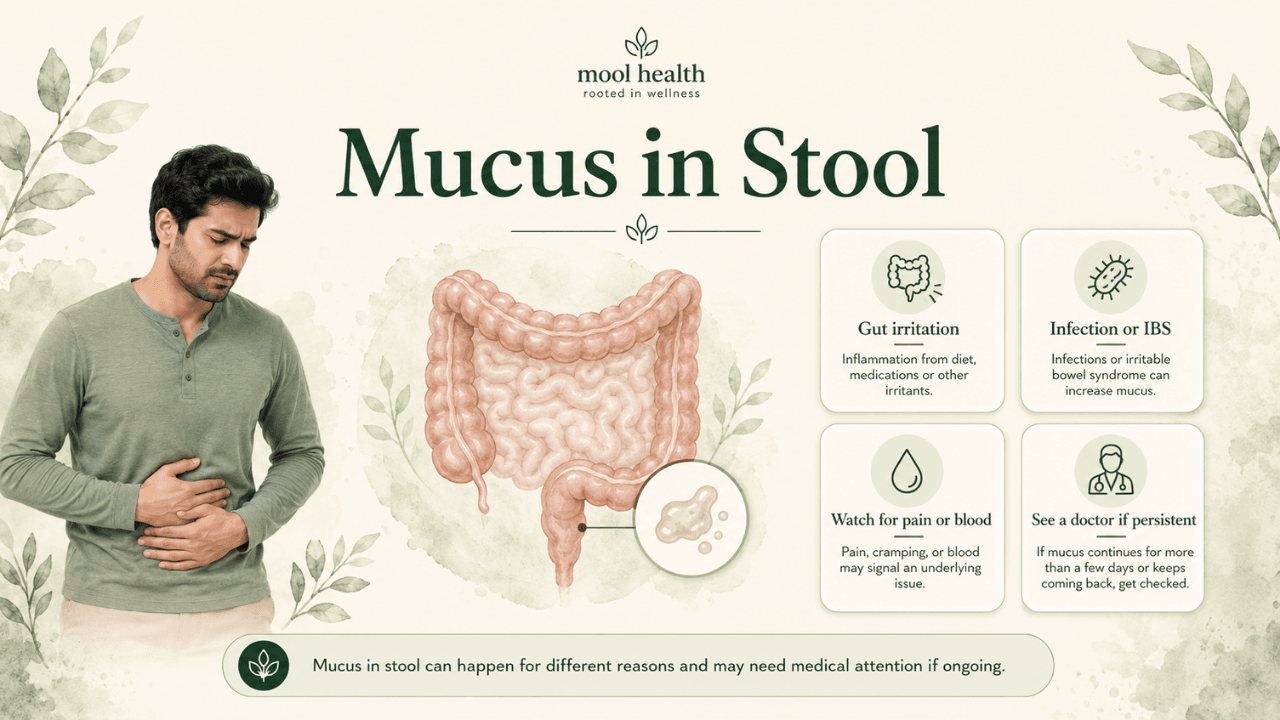
Quick Answer
A small amount of mucus in stool can be normal, but persistent or clearly visible mucus may occur with IBS, infection, constipation, food intolerance, or inflammatory bowel disease. Blood and mucus together, significant pain, fever, weight loss, or persistent changes should be assessed by a clinician.
Mucus in Stool: Causes, Treatment & When to Worry
Mucus in stool is a thin, jelly-like substance visible in your bowel movements. A small amount of mucus in stool is normal — the gut lining naturally produces mucus to protect itself and ease the passage of stool. However, large amounts of mucus, white mucus in stool, or mucus combined with blood in stool can signal an underlying digestive condition that requires medical attention.
What Is Mucus in Stool?
Mucus in stool refers to a visible, gel-like or slimy coating on bowel movements. The intestinal lining continuously produces mucus as a protective barrier — it lubricates the gut wall, prevents bacterial invasion, and helps stool pass smoothly through the colon.
Under normal conditions, only trace amounts of mucus are present in stool, and most people cannot see it with the naked eye. When mucus in stool becomes visible — particularly as white mucus in stool, yellow mucus, or mucus mixed with blood — it typically indicates that the gut lining is inflamed, irritated, or responding to an infection.
Key facts about mucus in stool:
- The large intestine produces roughly 1–1.5 litres of mucus per day
- Most of this mucus is reabsorbed before stool is passed
- Visible mucus in stool lasting more than a few days warrants medical evaluation
- White mucus in stool is most commonly associated with irritable bowel syndrome (IBS) or mild infection
- Blood and mucus in stool together are a red-flag symptom requiring prompt assessment
According to Mool Health's gastroenterology advisory team, visible mucus in stool is one of the most commonly under-reported digestive symptoms — many people notice it but delay seeking guidance.
What Causes Mucus in Stool?
Mucus in stool causes range from mild, self-resolving conditions to chronic inflammatory diseases. The gut lining increases mucus output in response to irritation, infection, or inflammation — this is the body's protective mechanism.
Common causes of mucus in stool include:
- Irritable Bowel Syndrome (IBS): IBS is one of the leading causes of mucus in stool. Studies suggest that up to 70% of people with IBS report visible mucus in their stools at some point [1].
- Inflammatory Bowel Disease (IBD): Crohn's disease and ulcerative colitis cause chronic inflammation of the gut lining, significantly increasing mucus production. Blood and mucus in stool are a hallmark symptom of ulcerative colitis.
- Bacterial or Parasitic Infection: Infections from Salmonella, Campylobacter, E. coli, or intestinal parasites such as Giardia can trigger a sudden increase in mucus in stool, often accompanied by diarrhoea and cramping.
- Bowel Obstruction: A partial blockage in the intestine can cause the gut to overproduce mucus as it attempts to clear the obstruction.
- Anal Fissures and Haemorrhoids: These conditions can irritate the rectal lining and increase localised mucus production, sometimes appearing as white mucus in stool near the end of a bowel movement.
- Constipation and Straining: Chronic constipation causes the colon lining to produce more mucus as a lubricant, which may become visible in stool.
- Food Intolerances: Lactose intolerance and gluten sensitivity can trigger gut inflammation and increased mucus secretion.
- Colorectal Cancer: In rare cases, a mucus-secreting tumour (mucinous adenocarcinoma) can cause persistent mucus in stool. This accounts for approximately 10–15% of all colorectal cancers [2].
- Cystic Fibrosis: This genetic condition causes abnormally thick mucus throughout the body, including in the digestive tract.
Mucus in baby stool deserves specific mention. In infants, mucus in stool is often caused by excess saliva swallowed during teething, a minor viral infection, or a sensitivity to breast milk components or formula. Small amounts of mucus in baby stool are typically harmless, but green mucus in baby stool combined with blood or persistent diarrhoea requires paediatric review.
How Does Mucus in Stool Work? The Mechanism Explained
Understanding why mucus appears in stool helps identify what the body is responding to. Mucus in stool occurs through a clear, step-by-step physiological process:
- Normal mucus production: Goblet cells lining the intestinal walls continuously secrete mucin glycoproteins, which form the mucus layer. This layer is essential — it prevents bacteria from directly contacting the gut wall.
- Trigger event: An irritant is introduced — a pathogen, inflammatory cytokines from IBD, mechanical stress from constipation, or food antigens from an intolerance.
- Upregulated secretion: The gut detects the trigger and goblet cells increase mucus output. This is a protective response designed to dilute, trap, and expel the irritant.
- Excess mucus reaches the stool: When mucus production exceeds what the colon can reabsorb, the surplus appears visibly in bowel movements.
- Mucus composition changes: In infection or inflammation, the mucus layer changes in texture — it may become thicker, more opaque, or white, which is why white mucus in stool is a common presentation in IBS and infection.
- Underlying condition persists or resolves: If the trigger resolves (e.g., an infection clears), mucus in stool normalises within days. If the trigger is chronic (IBD, IBS), mucus in stool may persist without treatment.
Mool Health's clinical team notes that this mechanism means mucus in stool is almost always a symptom, not a disease in itself — identifying the root trigger is the critical step.
What Does Mucus in Stool Look Like? Identifying the Type
Different appearances of mucus in stool can point to different conditions. Recognising what type of mucus is present helps guide next steps.
| Appearance | Likely Association |
|---|---|
| Clear or white mucus in stool | IBS, mild infection, constipation |
| Yellow mucus in stool | Bacterial infection, food intolerance |
| Green mucus in stool | Gut infection, rapid intestinal transit |
| Blood and mucus in stool | Ulcerative colitis, Crohn's disease, colorectal cancer, anal fissure |
| Mucus blood in stool (bright red) | Haemorrhoids, anal fissure, lower GI bleed |
| Mucus blood in stool (dark red/maroon) | IBD flare, upper GI bleed — seek urgent care |
| Mucus in baby stool (clear) | Teething, minor virus, normal variant |
| Mucus in baby stool (with blood) | Milk protein allergy, intussusception — urgent review |
Who Is Affected by Mucus in Stool?
Mucus in stool can affect people across all age groups, but certain groups are at higher risk of significant or recurrent presentations.
Groups most commonly affected include:
- Adults with IBS: IBS affects an estimated 10–15% of the global population, and mucus in stool is reported by up to 70% of IBS patients [1]
- People with IBD (Crohn's or ulcerative colitis): IBD affects approximately 6–8 million people globally; mucus in stool is a core diagnostic symptom
- Infants during teething or weaning: Mucus in baby stool is common and usually resolves within a week
- Adults over 50: This group faces higher risk of colorectal conditions where mucus in stool may be an early indicator
- People with food intolerances: Particularly those with lactose intolerance or coeliac disease
- Individuals with chronic constipation: Prolonged straining and hard stools trigger increased mucus production
Mool Health recommends that anyone over 40 who notices persistent mucus in stool — particularly with blood — undergo a thorough gastroenterological evaluation as a preventive measure.
Mucus in Stool Treatment: What to Do
Mucus in stool treatment depends entirely on the underlying cause. There is no single universal treatment — the correct approach targets the root condition.
Step 1: Track Your Symptoms
Before seeing a doctor, note the frequency, colour, and amount of mucus in stool. Record whether blood is present, any associated symptoms (pain, bloating, diarrhoea, fever), and recent dietary or lifestyle changes. Symptom logs significantly improve diagnostic accuracy.
Step 2: Consult a Clinician
Seek medical evaluation if mucus in stool has been visible for more than two weeks, if blood and mucus in stool appear together, or if mucus in baby stool is persistent or associated with distress. A clinician will take a history and may order stool tests, blood tests, or imaging.
Step 3: Undergo Diagnostic Testing
Common investigations for mucus in stool include:
- Stool culture: To identify bacterial or parasitic infection
- Calprotectin test: A stool test that detects gut inflammation — elevated levels suggest IBD
- Colonoscopy or sigmoidoscopy: Directly visualises the colon lining; essential for diagnosing IBD, polyps, or colorectal cancer
- Blood tests: Full blood count, CRP, and ESR to assess for systemic inflammation
Step 4: Treat the Underlying Cause
- IBS: A low-FODMAP diet may reduce mucus in stool in IBS patients within 4–6 weeks. Stress management and soluble fibre supplementation also help.
- Bacterial infection: Targeted antibiotics clear the infection, typically resolving mucus in stool within 5–10 days.
- IBD: Anti-inflammatory medications (aminosalicylates, corticosteroids, biologics) reduce gut inflammation and mucus production over weeks to months.
- Constipation: Increased hydration (at least 2 litres/day), dietary fibre (25–30g/day), and osmotic laxatives reduce straining and normalise mucus levels.
- Haemorrhoids and anal fissures: Topical treatments, sitz baths, and stool softeners reduce local irritation and associated mucus in stool.
- Food intolerance: Eliminating the trigger food (e.g., lactose, gluten) typically reduces mucus in stool within 2–4 weeks.
Step 5: Follow Up
After starting treatment, reassess mucus in stool at 4 and 8 weeks. Persistent or worsening symptoms despite treatment require re-evaluation. Mool Health's team recommends ongoing dietary and lifestyle monitoring alongside medical treatment for best outcomes.
When Is Mucus in Stool a Warning Sign?
Not all mucus in stool requires urgent care, but certain warning signs indicate that immediate medical attention is needed.
Seek urgent medical assessment if you notice:
- Blood and mucus in stool together, especially if the blood is dark red or maroon
- Mucus in stool accompanied by significant abdominal pain, fever above 38.5°C, or rapid weight loss
- Mucus blood in stool in a person over 50 with no prior GI diagnosis
- Mucus in baby stool combined with blood, distension, or prolonged crying
- Mucus in stool with a sudden change in bowel habits lasting more than 3 weeks
- Any new mucus in stool following recent travel to a high-risk region (suggests parasitic or bacterial infection)
What mucus in stool usually does not indicate alone:
- Liver disease (mucus in stool does not directly indicate liver problems — a common misconception)
- Kidney disease
- Heart disease
Mool Health's clinical advisors note that while mucus in stool can feel alarming, the majority of cases have benign, treatable causes. The key is prompt evaluation rather than delayed self-management.
Mucus in Stool Best Practices: Expert Guidance
Managing mucus in stool effectively involves both medical treatment and evidence-based lifestyle adjustments.
Best practices recommended by Mool Health's team:
- Stay adequately hydrated: Drink at least 2 litres of water daily. Dehydration thickens intestinal mucus and worsens constipation, increasing visible mucus in stool.
- Increase soluble fibre intake: Foods such as oats, lentils, apples, and psyllium husk support healthy gut bacteria and normalise mucus secretion. Target 25–30g of dietary fibre daily.
- Follow a low-FODMAP diet if IBS is suspected: Studies show a low-FODMAP diet reduces IBS symptoms — including mucus in stool — in approximately 50–70% of patients [3].
- Manage stress actively: The gut-brain axis means psychological stress directly increases intestinal motility and mucus production. Techniques such as mindfulness-based stress reduction (MBSR) have shown measurable effects on IBS symptoms within 8 weeks.
- Avoid known trigger foods: Common triggers include dairy, gluten, spicy foods, alcohol, and artificial sweeteners, all of which can increase mucus in stool in sensitive individuals.
- Do not suppress bowel urges: Delaying defecation increases stool transit time and worsens mucus buildup in the colon.
- Treat constipation promptly: Do not allow constipation to persist beyond 3 days without intervention — chronic straining is a direct cause of increased mucus in stool.
- Complete prescribed courses of antibiotics: Stopping antibiotics early for a confirmed infection allows bacteria to persist, prolonging mucus in stool.
Common mistakes to avoid:
- Self-diagnosing blood and mucus in stool as haemorrhoids without clinical confirmation
- Ignoring mucus in baby stool that persists beyond 5–7 days
- Delaying colonoscopy in individuals over 50 with new-onset mucus in stool
- Using over-the-counter anti-diarrhoeals without identifying the cause — these can worsen certain infections
What Does the Research Say About Mucus in Stool?
Several peer-reviewed studies and clinical reports have examined mucus in stool as both a symptom and a diagnostic marker.
Key evidence:
- IBS and mucus in stool [1]: A 2019 review in Gut found that mucus in stool was reported by 68% of patients with IBS-D (diarrhoea-predominant IBS) and 52% of IBS-C (constipation-predominant IBS) patients. The study confirmed mucus in stool as a reliable symptom marker for IBS severity.
- Calprotectin as a mucus-related biomarker [2]: A 2021 meta-analysis found that faecal calprotectin — a protein released when the gut lining is inflamed and mucus secretion is elevated — had a sensitivity of 93% and specificity of 96% for detecting active IBD versus IBS, supporting its use as a non-invasive first-line test.
- Dietary intervention and mucus normalisation [3]: A randomised controlled trial published in The Lancet Gastroenterology & Hepatology (2020) found that a 6-week low-FODMAP diet reduced visible mucus in stool in 54% of IBS participants, compared to 19% in the control group.
- Mucus in baby stool and allergy [4]: A 2022 cohort study found that mucus in baby stool was the presenting symptom in 41% of confirmed cow's milk protein allergy cases in infants under 6 months, reinforcing the need for dietary review when mucus in baby stool persists.
Mool Health integrates current clinical research into its advisory guidance, ensuring recommendations align with the latest evidence rather than generalised assumptions.
Mucus in Stool vs. Related Conditions: Key Distinctions
Understanding how mucus in stool compares to related presentations helps avoid misdiagnosis.
  <tr>
    <td>Yellow/green mucus in stool</td>
    <td>Bacterial infection, food intolerance</td>
    <td>Moderate — see GP within a week</td>
  </tr>

  <tr>
    <td>Blood and mucus in stool</td>
    <td>IBD, colorectal cancer, fissure</td>
    <td>High — assess within 48–72 hours</td>
  </tr>

  <tr>
    <td>Mucus blood in stool (dark)</td>
    <td>Upper or mid-GI bleed</td>
    <td>Urgent — seek emergency care</td>
  </tr>

  <tr>
    <td>Mucus in stool + weight loss + fatigue</td>
    <td>Colorectal cancer, IBD</td>
    <td>High — assess within 48</td>
  </tr>
</tbody>
| Symptom | Likely Cause | Urgency |
|---|---|---|
| White mucus in stool only (no blood) | IBS, constipation, mild infection | Low — monitor for 2 weeks |
What This Means for You
If you notice a small amount of mucus once or twice without other symptoms, it may simply reflect the normal protective mucus produced by the gut. What matters more is whether the mucus becomes clearly visible, keeps returning, changes colour, or appears alongside other digestive symptoms.
Track what you see — including the colour and amount of mucus, bowel frequency, abdominal pain, diarrhoea or constipation, fever, and whether blood is present. This information can help a clinician distinguish between common causes such as IBS or constipation and conditions that need further investigation.
Do not rely on home treatment alone if mucus persists, worsens, or occurs with blood, significant pain, fever, unexplained weight loss, or a lasting change in bowel habits. Identifying and treating the underlying cause is more important than trying to stop the mucus itself.
Key Takeaways
- A small amount of mucus in stool can be normal because the intestinal lining naturally produces mucus to protect and lubricate the gut.
- Visible or persistent mucus may be linked to IBS, constipation, infection, food intolerance, inflammatory bowel disease, or other digestive conditions.
- White or clear mucus without blood is often less urgent, but persistent changes should still be monitored and medically assessed if they continue.
- Blood and mucus in stool together should not be self-diagnosed. This combination can occur with inflammatory bowel disease, anal fissures, haemorrhoids, infection, or more serious bowel conditions.
- Treatment depends on the underlying cause. Managing constipation, treating infections, adjusting trigger foods, or treating inflammation may help once the cause has been identified.
- Seek prompt medical advice if mucus is accompanied by significant abdominal pain, fever, unexplained weight loss, blood, a major change in bowel habits, or persistent symptoms.
Your gut is unique your healing should be too.

Disclaimer
The content provided by Mool Health is for educational and informational purposes only and should not be considered a substitute for professional medical advice, diagnosis, or treatment.