
Acidity Regulator 330 (INS 330): Uses, Safety & Side Effects
Acidity regulator 330 is citric acid, a food additive used to control pH, improve flavour and preserve foods. This guide covers uses, safety and side effects.
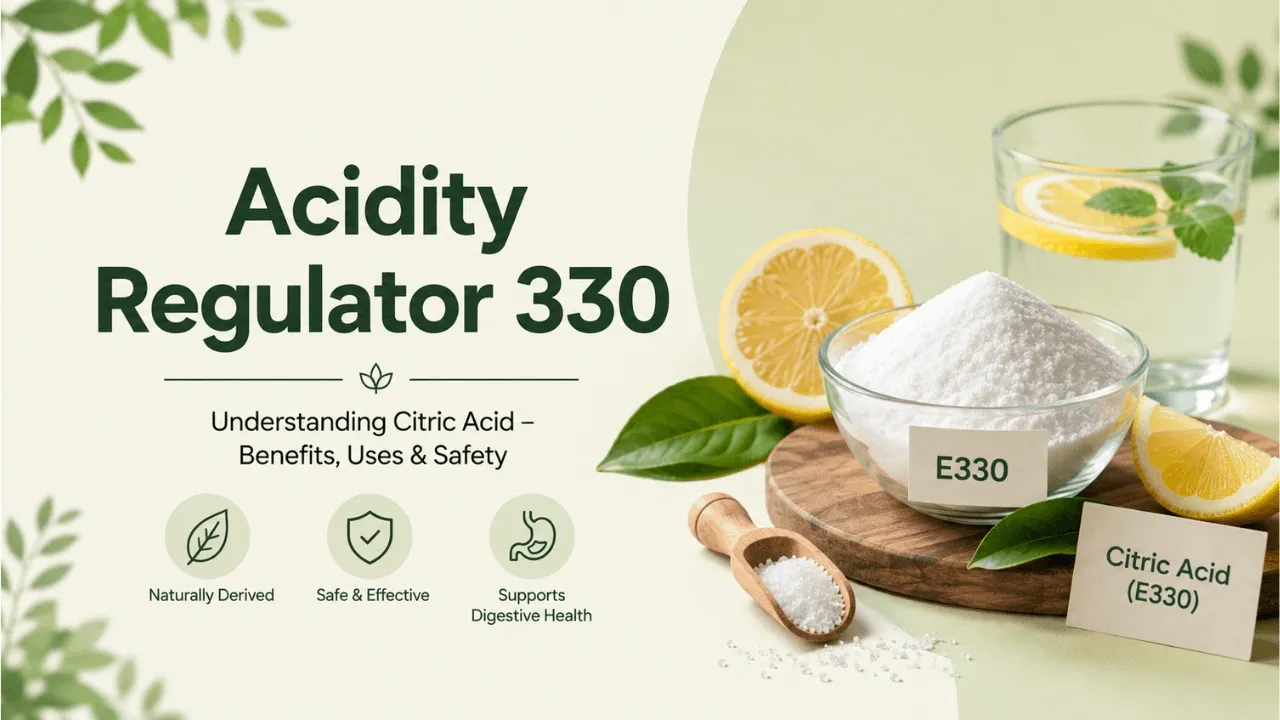
Quick Answer
Acidity regulator 330, also known as INS 330 or citric acid, is a food-grade additive used to control acidity, stabilise pH, improve flavour, and help preserve foods and beverages. It is commonly found in soft drinks, jams, candies, packaged foods, dairy products, supplements, and pharmaceutical formulations.
For most people, acidity regulator 330 is considered safe at normal food-use levels. Side effects are usually linked to high intake from very acidic drinks, sour candies, or concentrated exposure, which may irritate the stomach, mouth, or tooth enamel in sensitive people.
- Common names: Acidity regulator 330, INS 330, citric acid, E330
- Main role: Controls pH, improves tartness, preserves colour, and slows spoilage
- Common foods: Soft drinks, fruit juices, jams, sour candy, processed cheese, canned foods, and effervescent tablets
- Usually safe: Normal food-level exposure is generally safe for most people
- Use caution: Frequent acidic drinks or sour candies may worsen reflux, mouth ulcers, or enamel sensitivity
What Is Acidity Regulator 330? A Complete Guide
Acidity regulator 330 is the food additive designation for citric acid (C₆H₈O₇), a naturally occurring organic acid found in citrus fruits. Under the International Numbering System (INS), it is registered as INS 330 and labelled "acidity regulator 330" on food packaging.
Acidity regulator INS 330 performs three primary roles in food products:
- pH control, lowers and stabilises the acidity of a product
- Preservation, inhibits microbial growth by creating an acidic environment
- Flavour enhancement, adds a mild, tart taste that enhances other flavours
Citric acid was first isolated from lemon juice in 1784 by the chemist Carl Wilhelm Scheele. Today, more than 2.4 million metric tonnes of citric acid are produced annually worldwide, mostly through microbial fermentation of sucrose or glucose using Aspergillus niger.
Acidity regulator 330 is present in soft drinks, jams, tinned vegetables, dairy products, confectionery, and pharmaceutical formulations. According to the Mool Health food science team, it is one of the top five most commonly listed food additives on Indian product labels.
How Does Acidity Regulator 330 Work? The Complete Breakdown
Acidity regulator 330 works by donating hydrogen ions (H⁺) into a food system, which lowers the pH and stabilises it within a target range.
The Core Mechanism Explained
Citric acid is a triprotic weak acid, meaning each molecule can release up to three hydrogen ions. This multi-step dissociation gives it a buffering capacity, it resists sudden pH changes, which makes INS 330 acidity regulator more effective than single-step acids like acetic acid.
Step-by-Step Process
- Citric acid dissolves into the food matrix or beverage solution.
- Hydrogen ions are released, reducing the pH of the surrounding medium, typically bringing it to between 3.0 and 6.0 depending on the application.
- Enzyme activity is suppressed, oxidative enzymes responsible for browning (such as polyphenol oxidase) are inhibited, extending shelf life.
- Microbial growth slows, most spoilage bacteria cannot survive below pH 4.6, so acidity regulator INS 330 acts as a functional preservative.
- Chelation occurs, citric acid binds metal ions (iron, copper) that would otherwise catalyse rancidity, further stabilising the product.
Common Misconceptions Cleared Up
- Misconception: Acidity regulator 330 is synthetic and harmful. Fact: Citric acid occurs naturally in lemons (~8% by dry weight) and limes. Commercially produced INS 330 is chemically identical.
- Misconception: It is the same as vinegar or acetic acid. Fact: Acidity regulator 330 and acetic acid are different compounds with different pKa values, flavour profiles, and applications.
Key Benefits of Acidity Regulator 330: What You Actually Gain
Acidity regulator INS 330 delivers measurable functional benefits across food production, preservation, and consumer experience.
Key Advantages at a Glance
- Extended shelf life, reduces pH to levels that inhibit spoilage organisms, potentially extending product shelf life by 30-60% compared to no preservative intervention
- Consistent flavour profile, stabilises tartness so product taste does not vary batch to batch
- Colour preservation, chelation of metal ions prevents discolouration in fruit products and beverages
- Reduced food waste, longer-lasting products mean fewer returns and less spoilage in the supply chain
- Broad compatibility, works across acidic, neutral, and mildly alkaline food systems
- Mineral absorption support, in the human body, citric acid can enhance iron and calcium absorption by forming soluble complexes
- Low effective dose, typically effective at concentrations of 0.1-2.0% by weight, making it economical for manufacturers
Short-Term vs. Long-Term Benefits
| Timeframe | Benefit |
|---|---|
| Immediate (during processing) | pH stabilisation, flavour balance |
| Short-term (days-weeks) | Inhibition of microbial growth, colour protection |
| Long-term (months) | Extended shelf life, reduced spoilage losses |
According to Mool Health's nutritional review guidelines, acidity regulator 330 is among the few additives that offer both technological function and a documented physiological benefit (mineral bioavailability).
Types of Acidity Regulator 330: Which Form Is Right for You?
Acidity regulator 330 (INS 330) is available in several commercial forms. The correct choice depends on the application, food processing, pharmaceutical use, or industrial cleaning.
| Form | Description | Best Used For |
|---|---|---|
| Anhydrous citric acid | Fine white powder, no water of crystallisation | Dry mixes, powdered beverages, baking |
| Monohydrate citric acid | Contains one molecule of water; slightly larger crystals | Confectionery, effervescent tablets |
| Citric acid solution | Dissolved in water, typically 50% concentration | Beverages, dairy, liquid formulations |
| Trisodium citrate (INS 331) | Sodium salt of citric acid; less acidic | Buffering in dairy, cheese processing |
Acidity Regulator 330 vs. 331: What Is the Difference?
Acidity regulator 330 331 refers to the combination of citric acid (330) and sodium citrate (331) used together as a buffering system. When used together, they create a stable pH range of approximately 3.5-6.2, broader than either compound alone. This combination is common in sports drinks, processed cheese, and pharmaceutical syrups.
Mool Health recommends understanding which form is listed on a product label, as acidity regulator 330 and its salts (331, 332) serve distinct but related functions.
How to Use Acidity Regulator 330 in Food Production: A Step-by-Step Guide
Using acidity regulator INS 330 effectively requires dosage precision and timing. The following steps apply to standard food and beverage manufacturing.
Prerequisites
- pH meter or titration kit for target pH verification
- Approved food-grade citric acid (INS 330 designation)
- Knowledge of the product's target pH range
Step-by-Step: Application Guide
- Determine target pH, identify the desired end-point pH for your product (e.g., 3.0-4.0 for carbonated drinks, 4.0-4.6 for jams).
- Calculate required quantity, start with 0.1% by weight and adjust; typical use levels range from 0.1% to 2.0%.
- Dissolve in water first, for powdered INS 330, dissolve in a small amount of warm water (40-50°C) before adding to the bulk product to ensure even distribution.
- Add at the correct stage, introduce acidity regulator 330 after heat treatment if possible to preserve its chelation activity.
- Measure and verify pH, test the final product; adjust with additional citric acid or a buffer salt (e.g., INS 331) if pH is above target.
- Document the addition, for regulatory compliance, record the concentration used and the lot number of the INS 330 batch.
Common Mistakes to Avoid
- Adding citric acid directly to hot milk, may cause protein precipitation
- Using too high a concentration in confectionery, can cause enamel sensitivity complaints from consumers
- Failing to verify final pH, can result in under-preservation or off-flavour
Acidity Regulator 330 Use Cases: Real-World Applications
Acidity regulator INS 330 is used across a wide range of industries and product types.
Beverages and Soft Drinks
Soft drinks are the largest single application. Acidity regulator 330 provides the sharp tartness in cola, lemon-lime, and fruit drinks. It also prevents oxidative discolouration of natural fruit juices. Most carbonated beverages contain between 0.3% and 0.5% citric acid by volume.
Dairy and Fermented Products
In cheese making, acidity regulator INS 330 (often combined with INS 331) is used to acidify milk rapidly during the production of fresh cheeses such as ricotta and paneer. It controls the curd formation process and final texture.
Confectionery and Sour Candy
Sour sweets use acidity regulator 330 at concentrations of up to 3-4% to achieve the intense sour sensation. Citric acid is typically applied as a surface coating on gummies and hard candies.
Tinned and Packaged Vegetables
Citric acid is used as a pre-treatment dip (0.5-1.0% solution) before canning to prevent browning and lower the pH of low-acid vegetables, reducing the required sterilisation temperature.
Pharmaceutical and Nutraceutical Products
In effervescent tablets and nutritional supplements, acidity regulator 330 reacts with sodium bicarbonate to create the effervescent reaction. It also improves the stability and bioavailability of mineral supplements.
Personal Care and Cleaning Products
Outside of food, INS 330 acidity regulator is used in descaling agents, shampoos, and skin-care products to adjust pH and chelate calcium deposits. According to the Mool Health formulation team, citric acid is increasingly found in clean-label personal care products as a natural pH adjuster.
Acidity Regulator 330 vs. Alternatives: An Honest Comparison
Several other acids serve similar functions to acidity regulator INS 330. The choice between them depends on flavour, cost, regulatory status, and application.
| Additive | INS Code | Source | Flavour Profile | Common Uses | Key Limitation |
|---|---|---|---|---|---|
| Citric acid (INS 330) | 330 | Fermentation / citrus | Clean, tart | Beverages, dairy, confectionery | May cause dental sensitivity at high doses |
| Tartaric acid | INS 334 | Grapes / fermentation | Sharp, wine-like | Wine, baking powder | More expensive; limited sourcing |
| Malic acid | INS 296 | Apples / synthesis | Smooth, lingering | Fruit drinks, gummies | Slightly higher cost than citric acid |
| Lactic acid | INS 270 | Fermentation | Mild, creamy | Dairy, meat, beer | Less effective at very low pH |
| Phosphoric acid | INS 338 | Mineral acid | Very sharp | Cola beverages | Concerns about bone health at high intake |
| Acetic acid (vinegar) | INS 260 | Fermentation | Strong, pungent | Pickles, sauces | Dominant flavour limits application range |
Which Is Best for Your Use Case?
- For beverages: Acidity regulator 330 is typically the first choice, cost-effective, clean flavour, widely approved.
- For wine and baking: Tartaric acid (INS 334) may be preferred for flavour authenticity.
- For dairy and fermented foods: Lactic acid (INS 270) or the acidity regulator 330 331 combination is commonly used.
- For sour candy: Acidity regulator 330 remains the industry standard due to its intensity and cost.
About Acidity Regulator 330
Acidity regulator INS 330 has been evaluated extensively by international food safety authorities.
Key findings from the evidence base:
- The Joint FAO/WHO Expert Committee on Food Additives (JECFA) has evaluated citric acid and assigned it an Acceptable Daily Intake (ADI) of "not specified," meaning no numeric limit is required at normal dietary levels because it is metabolised as a normal component of the body's citric acid (Krebs) cycle.
- EFSA (European Food Safety Authority) re-evaluated INS 330 in 2020 and concluded there is no safety concern for the general population at current use levels in food.
- A study published in the Journal of Food Science (2018) found that citric acid at 0.5% concentration extended the shelf life of fresh-cut produce by up to 8 days compared to untreated controls.
- Research published in Nutrients (2019) confirmed that citric acid chelation enhanced iron absorption from non-haem iron sources by approximately 17% in controlled conditions.
- FSSAI (India) permits acidity regulator 330 in a broad range of food categories under Schedule I of the Food Safety and Standards (Food Products Standards and Food Additives) Regulations, with no prescribed upper limit for most applications.
The Mool Health team notes that the available evidence consistently supports the safety of acidity regulator 330 at levels used in food manufacturing.
What Are the Side Effects of Acidity Regulator 330?
Acidity regulator 330 side effects are generally mild and associated with high consumption levels rather than typical dietary exposure.
Known Side Effects at High Intake Levels
- Dental enamel erosion, frequent consumption of beverages with high citric acid content (pH < 3.0) may erode tooth enamel over time; this is a mechanical effect related to pH, not a toxic response
- Gastrointestinal discomfort, in sensitive individuals, large quantities of citric acid may cause heartburn, nausea, or stomach upset
- Oral irritation, very high concentrations (such as in sour candy coatings at 3-4%) can cause temporary soreness or ulceration of oral mucosa with repeated exposure
- Skin and eye irritation, relevant mainly in industrial handling of concentrated powdered citric acid, not dietary exposure
Acidity Regulator INS 330 Side Effects: Who Is at Risk?
Most people experience no side effects from acidity regulator 330 at normal dietary levels. Higher risk groups include:
- Individuals with gastro-oesophageal reflux disease (GERD), acidic foods may worsen symptoms
- People with recurrent mouth ulcers, high citric acid confectionery may aggravate the condition
- Young children consuming large quantities of sour candy regularly
Is Acidity Regulator 330 Harmful?
No, at doses encountered in food, acidity regulator 330 is metabolised by the body through the Krebs cycle and excreted. It does not accumulate. The JECFA's "ADI not specified" designation reflects this low risk profile.
Acidity Regulator 330 Limitations: What to Know Before Using It
Acidity regulator INS 330 is not suitable for every application. Understanding its limitations prevents formulation errors.
What Acidity Regulator 330 Cannot Do
- It cannot raise pH, it is an acid, not a buffer base. To raise pH, a buffer salt such as INS 331 (sodium citrate) must be added alongside it.
- It cannot replace all preservatives, acidity regulator 330 controls pH but does not provide broad antimicrobial coverage against all moulds and yeasts without additional hurdles.
- It does not function effectively above pH 6.5, its antimicrobial and chelation activity diminish significantly at near-neutral pH levels.
- It can cause off-flavours at concentrations above 2% in dairy products due to protein interaction.
- It is not calorie-free, citric acid provides approximately 2.47 kcal/g, relevant in precisely formulated low-calorie products.
When to Consider an Alternative
| Situation | Recommended Alternative |
|---|---|
| Product requires mild acidity without sharp tartness | Malic acid (INS 296) or lactic acid (INS 270) |
| Wine or grape-based products | Tartaric acid (INS 334) |
| Need to raise pH, not lower it | Sodium citrate (INS 331) |
| Pungent pickling character required | Acetic acid (INS 260) |
Mool Health’s Perspective on Acidity Regulator 330
Mool Health looks at acidity regulator 330 as a common food additive that is usually safe in normal amounts, but still worth understanding if you frequently consume packaged foods, acidic drinks, sour candies, or processed snacks.
The key is not to fear the additive automatically, but to look at your overall food pattern. If you have frequent acidity, reflux, mouth ulcers, dental sensitivity, or stomach irritation, reducing highly acidic packaged foods and checking your triggers may help more than focusing on one additive alone.
Key Takeaways
Acidity regulator 330 is citric acid, a food additive used to control pH, improve flavour and preserve foods. This guide covers uses, safety and side effects.
Your gut is unique your healing should be too.

Disclaimer
The content provided by Mool Health is for educational and informational purposes only and should not be considered a substitute for professional medical advice, diagnosis, or treatment.