
Bloating vs Belly Fat: How to Tell the Difference
A practical guide explaining bloating vs belly fat, key differences, home checks, causes, warning signs, and first steps to reduce belly swelling.
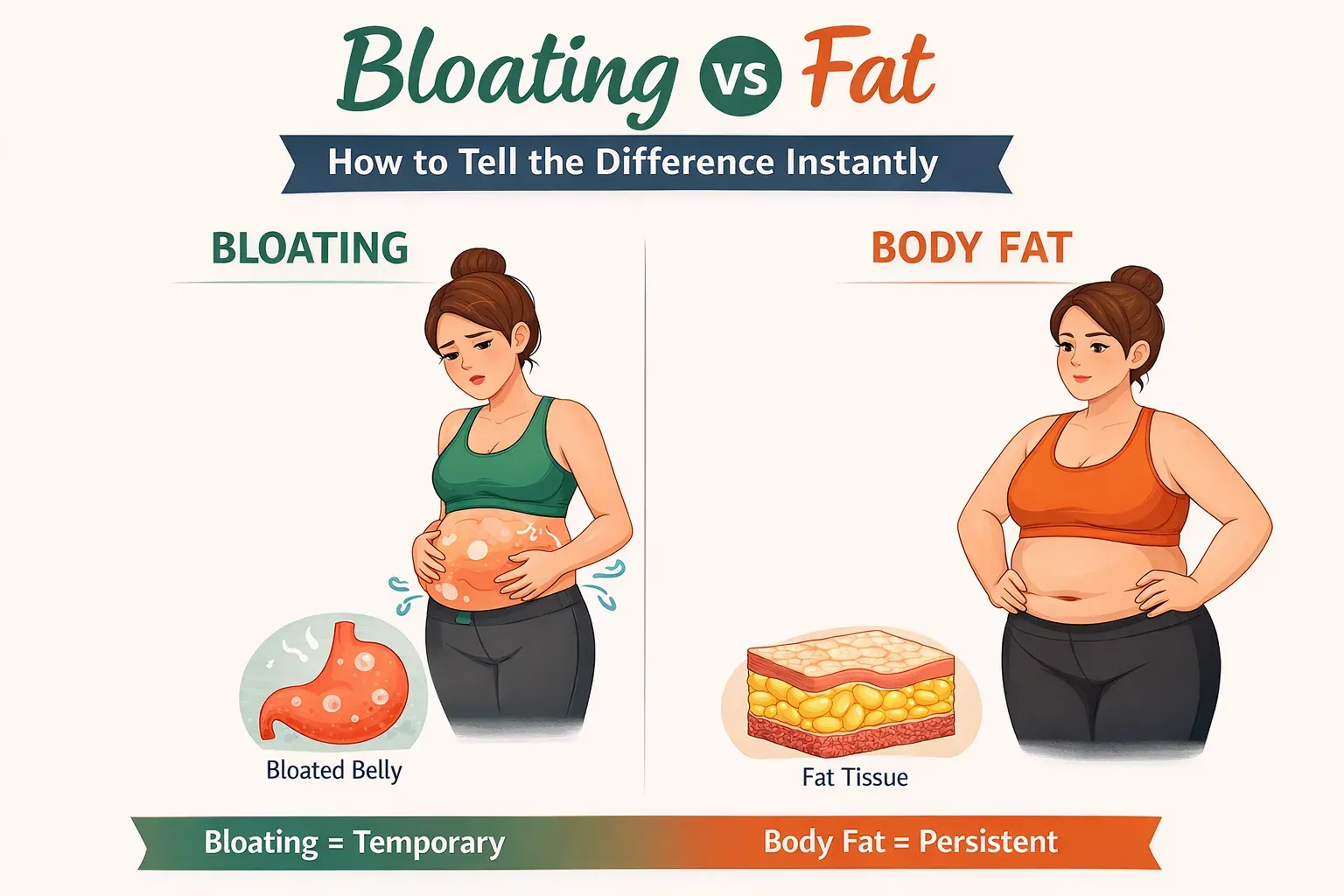
Quick Answer
That fuller stomach you see in the mirror by evening is almost certainly not fat - it is bloating. Bloating can expand your abdomen by several centimetres within hours, while actual belly fat takes weeks to months of sustained calorie surplus to accumulate. The distinction matters because the fix is completely different: bloating responds to digestive support within hours to days, while reducing belly fat requires weeks of metabolic and lifestyle change.
The fastest way to tell them apart: if your stomach is noticeably flatter first thing in the morning and visibly larger after meals or by evening, you are almost certainly looking at bloating, not fat.
What Is the Difference Between Bloating vs Fat?
The difference between bloating vs fat comes down to timing, cause, and physical sensation. Bloating is a temporary swelling caused by gas, fluid shifts, or slowed digestion. Belly fat is stored energy that builds gradually through calorie surplus, hormonal patterns, and metabolic changes.
Bloating:
- Appears within hours
- Changes noticeably through the day
- Feels tight, stretched, or pressurised
- Often reduces after passing gas or a bowel movement
Belly fat:
- Builds over weeks, months, or years
- Stays consistent in size throughout the day
- Feels softer and pinchable
- Does not change after digestion improves
When people ask about belly fat vs bloating, the most useful clue is timing. Bloating comes and goes. Fat stays.
How to Tell the Difference Between Bloating and Belly Fat at Home
You do not need a doctor to do a first-pass assessment of bloating vs belly fat. These six steps take less than five minutes and give a clear directional answer.
Check your stomach first thing in the morning, before eating or drinking. Stand in front of a mirror. If your abdomen looks flat or close to flat, what you see after meals is almost certainly bloating - not fat. Fat does not disappear overnight.
Press gently on the fullest part of your abdomen. If it feels hard, tense, or pressurised - especially after a meal - that is gas or digestive distension. If it feels soft and you can gently pinch the layer, that is subcutaneous fat.
Track the timing. Note when your stomach is at its largest. Bloating typically peaks 1-4 hours after meals and often improves after passing gas or a bowel movement. Fat has no relationship to meal timing.
Weigh yourself two days in a row under the same conditions. A difference of more than 1 kg between days is almost always fluid and gas. Actual fat gain requires a sustained caloric surplus of roughly 7,000 kcal per kilogram, accumulated over weeks.
Notice the feeling. Bloating usually comes with physical sensation - pressure, heaviness, gas, or discomfort. Fat is physically painless and sensation-neutral.
Review the past 4-8 weeks. Has your overall body shape, clothing fit, or weight changed consistently and slowly? That pattern points to fat. Has your abdomen varied dramatically from day to day or meal to meal? That pattern points to bloating.
If you check all six steps and still feel uncertain, both conditions may be present at the same time - which is common. Addressing digestion first often clarifies the picture within 2-4 weeks.
| Clue | Bloating | Belly Fat |
|---|---|---|
| Speed of onset | Appears suddenly | Builds slowly |
| Feel | Tight or pressurised | Soft or pinchable |
| Daily pattern | Changes through the day | Mostly stays the same |
| After meals | Usually worse | Not dramatically different |
| After passing gas | May reduce | No real change |
| Morning vs evening | Often flatter in the morning | Similar all day |
What Does Bloating Feel Like?
Bloating is not just a visual issue - it comes with physical discomfort that helps distinguish it from fat. Many people describe bloating as a balloon-like pressure inside the abdomen.
Common sensations associated with bloating:
- Tightness or pressure in the stomach
- Feeling full after only a few bites
- Trapped gas or heaviness in the lower belly
- Visible swelling that worsens by evening
- Relief after a bowel movement
- Fluctuating belly size from morning to night
This is why lower abdominal bloating can create a firm outward bulge that looks similar to weight gain. The key difference is that bloating shifts with digestion, hydration, stress, and bowel habits - sometimes within hours.
According to Mool Health's gut health team, most people who feel persistently "fat and bloated" are actually managing recurrent digestive bloating layered on top of a baseline that may include some abdominal fat. Addressing the digestive layer first often makes the picture significantly clearer.
What Does Belly Fat Feel Like?
Belly fat feels different from bloating in both sensation and behaviour. Fat is usually softer and more stable. You can often pinch it. It does not appear after a single meal and does not reduce overnight because you passed gas or skipped dinner.
Belly fat may build because of:
- Sustained calorie surplus
- Reduced muscle mass
- Poor or insufficient sleep
- Insulin resistance
- Long periods of sitting with low movement
- Repeated stress-driven eating patterns
Unlike bloating, belly fat is not painful or pressurised. It can be frustrating, but the sensation is distinctly different from the hard, stretched, digestive discomfort that bloating produces. In many adults, particularly in urban settings, abdominal fat becomes more common when late nights, processed foods, frequent takeout meals, and low movement become routine.
Visceral Fat vs Bloating: The Distinction Most People Miss
Not all belly fat is the same, and understanding the difference between visceral fat and bloating changes what you should do about it.
Subcutaneous fat sits directly under the skin. You can pinch it. It feels soft and moves when you press it. It builds slowly and responds to sustained diet and movement changes over 8-16 weeks.
Visceral fat sits deeper, wrapped around the organs inside the abdominal cavity. You cannot pinch it. It creates a firm, rounded abdomen that looks different from the soft roll of subcutaneous fat. Visceral fat is metabolically active - it releases inflammatory compounds and disrupts hormonal signalling. Research published in Obesity Reviews (2021) indicates that visceral fat is more strongly associated with metabolic disease than total body fat percentage.
Abdominal distension - the medical term for visible abdominal swelling - can come from either bloating or visceral fat, which is why fat vs bloating in the deep abdominal region is frequently confused.
| Feature | Visceral Fat | Bloating / Distension |
|---|---|---|
| Speed of change | Weeks to months | Hours to days |
| Firmness | Moderately firm, stable | Variable - tight after meals, flatter at rest |
| Morning vs evening | Similar | Usually flatter in the morning |
| Pain or pressure | Rarely painful | Often uncomfortable or pressurised |
| Responds to passing gas | No change | Often reduces |
| Metabolic risk | High | Low by itself |
Visceral fat accumulation is primarily driven by chronic cortisol elevation, poor sleep, insulin resistance, and physical inactivity - not by a single large meal. If your abdomen feels consistently rounded, firm, and unchanged from morning to evening over many weeks - and you also carry excess weight in other areas - visceral fat is a more likely contributor than bloating.
Hormonal Belly Bloating vs Fat: Why the Line Gets Blurry
Hormonal belly bloating vs fat is one of the most searched distinctions because hormones can cause both - sometimes simultaneously. A person may feel swollen, puffy, and larger around the waist, but the cause may not be simple fat gain.
How hormones cause bloating: Hormonal shifts can slow digestion, increase water retention, and alter gut motility. This is common around menstruation, during perimenopause, with thyroid imbalance, during stressful periods, and in people with PCOS. The belly may suddenly feel heavy or swollen even when actual body fat has not changed.
How hormones cause fat gain: Poor sleep, chronic stress, insulin resistance, and disrupted circadian rhythm can all encourage abdominal fat accumulation. A landmark study in Psychosomatic Medicine (Epel et al., 2000) demonstrated that women who secreted more cortisol in response to stress had significantly more abdominal fat, even when total body weight was similar. When cortisol stays elevated and meal timings are irregular, the body may crave more refined foods, manage blood sugar poorly, and store more energy around the midsection.
| Pattern | Hormonal Bloating | Hormonal Fat Gain |
|---|---|---|
| Onset | Quick and cyclical | Slow and persistent |
| Feeling | Tight, puffy, heavy | Soft, stable |
| Timing | Worse around stress or cycle changes | Builds over time |
| Digestion link | Often strong | Usually indirect |
Hormonal belly bloating vs fat gain becomes harder to separate when both are present at the same time. A person may already carry some abdominal fat, but stress, PMS, poor digestion, or constipation can make the stomach protrude even more on certain days.
Mool Health's approach to hormonal belly bloating vs fat begins with understanding whether the primary driver is digestive, metabolic, hormonal, or a combination - before recommending any changes.
Lower Belly Fat vs Bloating: Why This Area Is the Most Confusing
The lower abdomen creates the most confusion between fat vs bloating. The area below the navel can swell for several reasons - trapped gas, constipation, menstrual changes, pelvic tension, and a sluggish gut can all create temporary lower-belly expansion that looks like fat.
Lower belly bloating often feels firmer and more reactive. It may increase after meals, worsen when bowel movements are delayed, and reduce once digestion improves.
Lower belly fat is usually softer and does not fluctuate much from morning to night.
This distinction is especially relevant in women, where hormonal shifts, gut sensitivity, PCOS, stress, and reduced activity can combine. In those cases, the body may hold both mild lower belly fat and frequent bloating simultaneously - making the stomach shape look more dramatic than either issue alone would cause.
Lower belly fat vs bloating can also be clarified by the morning check: press gently below the navel after waking, before eating. If the area feels soft and the same as it does by evening, that points more toward fat. If it is notably flatter than it is after lunch, bloating is the more likely driver.
Bloating vs Weight Gain: Are You Actually Getting Heavier?
Bloating and weight gain are not the same thing, but they often happen at the same time - which makes the feeling of being both fat and bloated very common.
How to tell which is happening:
A change of 1-2 kg on the scale overnight is almost always fluid and gas - not fat. Actual body fat requires a calorie surplus of roughly 7,000 kcal to add 1 kg, meaning true fat gain accumulates over weeks, not overnight. Bloating can temporarily add 0.5-2 kg of apparent weight through water retention and gas volume. That weight typically disappears within 12-24 hours once digestion normalises.
| Indicator | Bloating | Weight Gain |
|---|---|---|
| Scale change overnight | 0.5-2 kg possible | Negligible |
| Returns to baseline | Within 24-48 hours | Does not return without calorie deficit |
| Clothes fitting | Tighter after meals, normal by morning | Consistently tighter over weeks |
| Digestive symptoms | Present (gas, pressure, fullness) | Usually absent |
| Energy levels | Often unchanged | May feel sluggish over time |
Why do people feel fat and bloated at the same time?
Because the two conditions share triggers. Processed foods cause bloating through additives, excess salt, and refined carbohydrates - while also contributing to calorie surplus. Poor sleep increases both cortisol-driven fat storage and gut motility problems. Stress drives both emotional eating and gut tension. Addressing the digestive layer often makes the metabolic layer more visible - and easier to work on.
What the Research Says About Bloating vs Belly Fat
The science behind these two conditions helps explain why so many people struggle to separate bloating vs belly fat.
On bloating prevalence: A 2023 review published in Neurogastroenterology & Motility found that abdominal bloating affects approximately 15-30% of the general population, with higher rates in women and people with irritable bowel syndrome (IBS). The gut microbiome plays a central role: imbalances in bacterial populations lead to excess gas fermentation, which directly drives the distension most people experience as bloating.
On visceral fat and metabolic risk: Research from the International Journal of Obesity (2022) confirms that visceral fat - not subcutaneous fat - is the primary driver of insulin resistance, inflammation, and cardiovascular risk in people with a high waist circumference. Visceral fat releases pro-inflammatory cytokines that further disrupt gut function, creating a feedback loop where fat gain worsens bloating.
On sleep and body composition: Data from the NHANES cohort study show that sleeping fewer than 6 hours per night is independently associated with higher waist circumference and greater visceral fat mass, even after controlling for diet and exercise habits.
Key takeaway: Bloating, visceral fat, hormonal disruption, and poor sleep are not separate problems - they form an interconnected web. Addressing one often improves the others.
Why Modern Lifestyle Makes Both Bloating and Belly Fat Worse
Many people do not have only one issue. They have a digestive problem layered over a metabolic one - and modern urban life encourages exactly that pattern.
Long work hours, late-night screens, rushed eating, low daylight exposure, and chronic stress can disrupt both the gut and metabolism. When sleep gets delayed, circadian rhythm suffers. That affects hunger hormones, gut motility, insulin sensitivity, and inflammation - increasing both bloating during the day and belly fat over the long term.
Factors that worsen both conditions simultaneously:
- Frequent glucose spikes from refined snacks and sugary drinks encourage fat storage, especially when movement is low
- Processed foods and inconsistent meal timing feed digestive discomfort and gas production
- Repeated antibiotic over-reliance may disturb the gut microbiome, making gas production and food sensitivity more likely
- Low water intake slows bowel movement and increases constipation, pushing the abdomen outward
- Vitamin D and B12 gaps often sit inside a larger pattern of poor routine, low energy, and reduced digestive resilience
The deeper sequence matters: digestion affects the microbiome, the microbiome influences inflammation and metabolic function, and liver and hormone balance respond to how you eat, sleep, and recover.
What to Do First: Addressing Bloating vs Belly Fat
Whether you are dealing with bloating, fat, or both, the first steps often overlap. Instead of guessing which single variable to change, Mool Health recommends addressing foundations in three areas.
Support digestion:
- Eat at regular, consistent times each day
- Chew food slowly and avoid very large meals
- Notice which foods trigger gas - reduce them one at a time, not all at once
- Walk for 10-15 minutes after meals to support gut motility
Improve bowel movement:
- Drink enough water throughout the day - low hydration slows transit
- Add fibre gradually through whole foods
- Do not ignore constipation for more than a day or two
Reduce metabolic strain:
- Stabilise meal timing to support circadian rhythm
- Reduce repeated sugar spikes from refined snacks
- Protect sleep timing as much as possible
- Build daily movement - even light walking - into the routine
For most people, consistent improvement in bloating is visible within 2-4 weeks of supporting digestion and gut rhythm. Measurable changes in abdominal fat become apparent over 8-16 weeks of sustained lifestyle change.
Common Signs It Is More Likely Bloating
These clues strongly suggest the difference between bloating vs fat is pointing toward a bloating problem:
- Your stomach becomes visibly larger after meals
- The size changes noticeably from morning to evening
- You feel gas, heaviness, or pressure in the abdomen
- You often feel better after passing stool or gas
- The stomach feels hard rather than soft and pinchable
- The swelling worsens with constipation, stress, or specific foods
Common Signs It Is More Likely Belly Fat
These clues point more toward body fat accumulation rather than bloating:
- The belly size has increased gradually over months
- The area feels soft, stable, and pinchable
- The size does not change much after meals or between morning and evening
- You notice weight or size changes in other areas of the body too
- The bulge remains even when digestion feels completely normal
- Your routine consistently includes low activity, poor sleep, and frequent overeating
When to See a Doctor About Abdominal Swelling
Most bloating is not dangerous, but persistent abdominal swelling should be checked by a doctor if it is severe, painful, rapidly worsening, or linked with vomiting, fever, blood in stool, unexplained weight loss, appetite loss, or a sudden change in bowel habits.
You should also seek medical advice if your abdomen stays distended for many days without improving after bowel movement, passing gas, hydration, or dietary changes.
Understand What Your Belly Is Telling You
If bloating, gas, constipation, or belly fullness keeps repeating, start by understanding your gut pattern before guessing the fix.
Key Takeaways
A practical guide explaining bloating vs belly fat, key differences, home checks, causes, warning signs, and first steps to reduce belly swelling.
Your gut is unique your healing should be too.

FAQs
If your stomach is flatter in the morning and becomes larger after meals or by evening, it is more likely bloating. Belly fat usually stays more consistent through the day.
Yes, bloating can make the abdomen look fuller within hours because gas, fluid, or slowed digestion can push the belly outward temporarily.
No. Belly fat does not reduce after passing gas or bowel movement. If your stomach size reduces after digestion improves, bloating is likely involved.
Yes. Many people have some belly fat along with recurring digestive bloating, which can make the abdomen look larger than either issue alone.
Mild bloating may settle within a few hours or after bowel movement. Recurrent bloating linked to constipation, stress, or food triggers may take days to improve.
Seek medical advice if swelling is severe, persistent, painful, rapidly worsening, or linked with vomiting, fever, blood in stool, unexplained weight loss, or major bowel habit changes.
Disclaimer
The content provided by Mool Health is for educational and informational purposes only and should not be considered a substitute for professional medical advice, diagnosis, or treatment.