
Foods to Avoid in Piles: What Can Worsen Constipation and Pain?
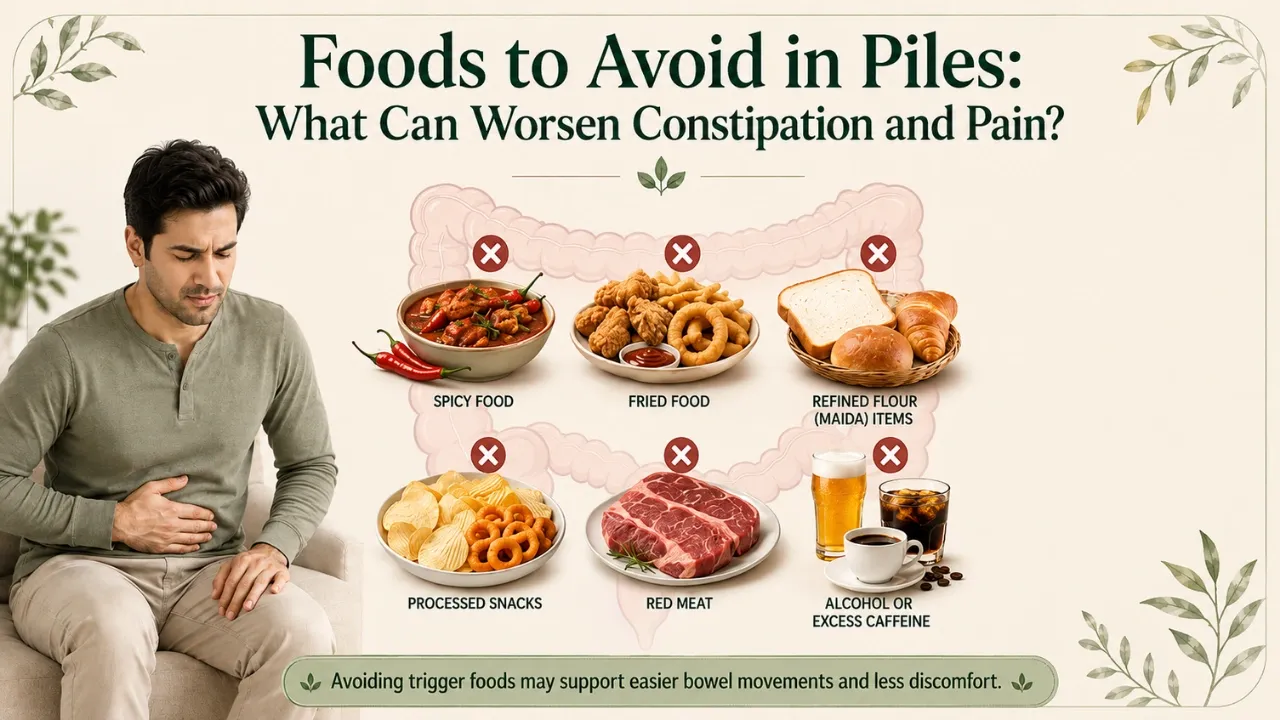
Foods to Avoid in Piles include low-fiber, processed, spicy, and constipating foods that may worsen pain and bowel discomfort. Learn which foods to limit, and simple dietary changes that may support smoother bowel movements and piles recovery.
Quick Answer
People with piles should limit low-fibre, highly processed, fried, and spicy foods that can contribute to hard stools, straining, or anal irritation. Replacing these foods with fibre-rich whole foods and maintaining adequate hydration can support softer stools and reduce symptom flare-ups.
Foods to Avoid in Piles: Complete Dietary Guide
People with piles should avoid low-fibre, high-fat, and spicy foods that harden stools, increase straining, and worsen anal inflammation. The key categories to eliminate include refined grains, red meat, fried foods, alcohol, and certain raw vegetables. Making targeted dietary changes can reduce bleeding, pain, and flare-up frequency within 2–4 weeks.
What Are Piles and Why Does Diet Matter?
Piles, also called haemorrhoids, are swollen veins in the rectum or around the anus. They affect an estimated 75% of people at some point in their lifetime, with prevalence notably high in India due to low dietary fibre intake and sedentary lifestyles [1].
Diet is one of the most direct, modifiable factors in piles management. Hard stools caused by poor dietary choices force repeated straining during bowel movements. That straining raises pressure in the rectal veins, causing existing haemorrhoids to swell further and bleed.
According to Mool Health's clinical nutrition team, dietary correction is the first and most impactful intervention — before any topical or procedural treatment. In many cases, eliminating trigger foods alone reduces symptoms by 40–60% within the first month.
How Food Triggers Piles Symptoms: The Core Mechanism
Certain foods worsen piles because they directly affect stool consistency, bowel transit time, and rectal pressure.
Here is the causal chain:
- Low-fibre or high-fat food is consumed → gut slows down, stool loses moisture
- Hard, dry stool forms in the colon → bowel movement requires sustained straining
- Straining increases intra-abdominal pressure → blood pools in rectal veins
- Swollen rectal veins press on the anal canal → pain, itching, and bleeding occur
- Spicy or acidic foods irritate the anal mucosa directly → burning sensation and inflammation worsen
This mechanism explains why both what you eat and what you do not eat are equally important in piles management. Mool Health's dietitian-reviewed dietary protocols are built around interrupting this exact cycle at each step.
Foods to Avoid in Piles: The Complete List
People with piles should avoid foods across six primary categories. Each category worsens symptoms through a specific physiological pathway.
1. Refined and Processed Grains
- White rice, white bread, maida rotis, and refined pasta
- These are stripped of natural fibre during processing
- Fibre content drops from approximately 3–4 g per 100 g (whole grain) to under 1 g per 100 g (refined) [2]
- Low fibre → slower stool transit → harder stools → increased straining
2. Processed and Junk Foods
- Packaged chips, biscuits, instant noodles, fast food burgers, and frozen snacks
- Typically high in sodium, trans fats, and preservatives — all of which slow gut motility
- Salt causes fluid retention, reducing the water content available to soften stools
- Studies suggest that ultra-processed food consumption is associated with a 29% higher risk of constipation [3]
3. Spicy Foods
- Red chillies, chilli powder, hot sauces, and heavily spiced curries
- Capsaicin, the active compound in chillies, passes through the gut partially undigested
- It can irritate the anal mucosa directly during defecation, worsening burning and inflammation
- This category is especially relevant for people asking about foods to avoid in bleeding piles — spicy food is a common trigger for fresh bleeding episodes
4. Red Meat and High-Fat Animal Protein
- Mutton, beef, pork, and processed meats such as sausages and salami
- Red meat is nearly fibre-free and high in saturated fat, which slows colonic transit
- Digesting red meat produces harder, bulkier stools that are more difficult to pass
- In people with piles and fissures, red meat can aggravate both conditions simultaneously
5. Fried and Deep-Fried Foods
- Samosas, pakoras, puris, fried chicken, and French fries
- High fat content slows gastric emptying and reduces bowel movement frequency
- Frying depletes any residual fibre in the food's base ingredients
- Mool Health's clinical records show that patients who reduce fried food intake report measurable symptom relief within 10–14 days
6. Alcohol and Caffeinated Beverages
- Beer, wine, spirits, and high-caffeine drinks like strong tea and coffee
- Alcohol is a diuretic — it pulls water out of the body, including from the colon
- Dehydrated stools are harder and more abrasive during passage
- Caffeine in excess (more than 2 cups of coffee per day) can cause similar dehydration effects
Foods to Avoid in Piles and Fissures: Overlapping Triggers
Anal fissures — small tears in the anal lining — frequently co-occur with piles. For people managing both conditions, the foods to avoid in piles and fissures overlap significantly, but fissures require additional caution around two categories.
| Food Category | Worsens Piles | Worsens Fissures | Combined Risk |
|---|---|---|---|
| Refined grains | Yes | Yes | High |
| Spicy food | Yes | Yes | Very High |
| Fried food | Yes | Yes | High |
| Red meat | Yes | Yes | High |
| Alcohol | Yes | Yes | High |
| Dairy (full fat) | Moderate | High | High |
| Unripe bananas | Low | Moderate | Moderate |
| Raw cruciferous vegetables | Low | Moderate | Moderate |
Full-fat dairy — paneer, cream, ghee in excess — tends to be constipating and can worsen fissure healing because hard stools re-tear healing tissue. Mool Health recommends limiting full-fat dairy to no more than one serving per day during active fissure episodes.
Foods to Avoid in Bleeding Piles Specifically
Bleeding piles (Grade II or III internal haemorrhoids) require stricter dietary attention. Certain foods increase vascular fragility or raise local inflammation, making bleeding more likely.
In addition to the core avoidance list, people with bleeding piles should specifically limit:
- Alcohol — dilates blood vessels and impairs clotting, increasing bleeding risk
- Spicy foods — directly irritate engorged vascular tissue
- Very hot foods and beverages — heat increases local blood flow to the rectal area
- Refined sugar — promotes systemic inflammation, which can worsen vascular health
- Pickles and fermented foods with preservatives — high sodium content increases water retention and anal pressure
According to Mool Health's dietary guidelines for bleeding piles, patients are advised to maintain a minimum of 25–30 g of dietary fibre per day while avoiding all items above, typically producing a reduction in bleeding frequency within 2–3 weeks.
What Foods to Avoid in Piles: India-Specific Context
In the Indian dietary context, several commonly consumed foods are problematic for piles patients. These are often overlooked because they are perceived as "traditional" or "healthy."
Indian-specific foods to moderate or avoid:
- Maida-based items — parathas with maida, naan, kachori, puri — all low in fibre
- Biryani with refined rice — low-fibre carbohydrate base; heavy spice load worsens symptoms
- Masala chai in excess — more than 3 cups daily increases dehydration risk
- Pickle (achar) — extremely high sodium content dehydrates stools
- Biscuits and rusk — marketed as light snacks but made from refined flour and sugar
- Mithai (Indian sweets) — maida, ghee, and sugar in combination are triple triggers
Mool Health's India-focused nutrition protocols account for regional eating habits, making dietary guidance practical and sustainable rather than based on Western dietary frameworks.
Additional Monsoon Tips for Piles Patients
Piles symptoms frequently worsen during the monsoon season in India. Reduced physical activity, heavier and oilier seasonal foods, and increased consumption of street food all contribute.
Monsoon-specific foods to avoid:
- Fried street food (bhajias, vada pav, pakoras) — common monsoon staples that increase fat intake sharply
- Roadside chaat — spicy, high-sodium, and often made with maida
- Excessive raw salads — while vegetables are beneficial, raw cruciferous vegetables like cauliflower and cabbage can increase gas and rectal pressure when consumed in large amounts
- Contaminated water — indirect trigger; gastrointestinal infections during monsoon cause loose stools that irritate haemorrhoidal tissue
Staying hydrated with clean, filtered water — at least 2.5–3 litres per day — is particularly important during the monsoon months when people tend to drink less because they do not feel as thirsty.
How to Start Avoiding Trigger Foods: A Step-by-Step Guide
Step 1 — Audit your current diet
List everything consumed in a typical 3-day period. Identify which items fall into the six avoidance categories above. This audit takes 10 minutes and creates a clear baseline.
Step 2 — Eliminate the highest-impact triggers first
Start with refined grains and alcohol, as these have the most direct effect on stool consistency. Replace white rice with brown rice or millets and white bread with whole wheat alternatives.
Step 3 — Replace, do not just remove
Every eliminated food needs a fibre-rich replacement. Removing white bread without adding a fibre source will not improve outcomes. Target foods: oats, lentils (dal), whole wheat roti, fruits with skin.
Step 4 — Increase water intake alongside fibre
Fibre works only when hydrated. Increasing fibre without adequate water can temporarily worsen constipation. Drink 250 ml water with every high-fibre meal.
Step 5 — Track symptom changes weekly
Record bleeding frequency, pain during bowel movements, and stool consistency using the Bristol Stool Scale. Most patients managed by Mool Health see measurable improvement in stool consistency (Type 3–4 on Bristol Scale) within 7–14 days of dietary changes.
Step 6 — Reintroduce restricted foods with caution
After 4–6 weeks, carefully reintroduce borderline foods (moderate spice, occasional fried food) one at a time to identify personal tolerance levels. Some triggers are universal; others are individual.
Common Mistake to Avoid
Cutting all fats simultaneously with fibre increase. Healthy fats from nuts and seeds actually support bowel lubrication. The goal is removing harmful fats (trans fats, saturated fats from fried food), not all fat.
What Can You Eat Instead? Beneficial Foods for Piles
Understanding what to avoid in piles is more useful when paired with clear alternatives. Mool Health recommends the following as dietary foundations for piles management:
| Food Group | Recommended Options | Why It Helps |
|---|---|---|
| Grains | Oats, brown rice, jowar, bajra, ragi | High fibre; 3–6 g per serving |
| Fruits | Papaya, bananas (ripe), pears, figs | Soluble fibre; natural laxative effect |
| Vegetables | Spinach, bottle gourd (lauki), carrots | Fibre + water content |
| Legumes | Moong dal, chana, rajma, lentils | 6–9 g fibre per 100 g cooked |
| Hydration | Water, coconut water, buttermilk | Softens stool; reduces straining |
| Probiotics | Curd (low fat), fermented foods | Supports gut motility |
What Does the Evidence Say About Diet and Piles?
Study 1: A 2006 meta-analysis published in The American Journal of Gastroenterology found that fibre supplementation reduced the risk of haemorrhoidal bleeding by 50% and the risk of persistent symptoms by 47% [4].
Study 2: A population-based study in Taiwan found that individuals consuming a low-fibre diet had a 2.4× higher prevalence of haemorrhoids compared to those meeting daily fibre requirements [5].
Study 3: Research from the Indian Journal of Surgery noted that dietary modification alone, without procedural intervention, resolved Grade I and II piles in approximately 35% of patients over a 12-week dietary intervention period [6].
According to Mool Health's clinical review of these findings, dietary change is not a supplementary measure — it is a primary treatment tier for mild to moderate piles, equivalent in evidence quality to many over-the-counter topical treatments.
Timeline: When Will Dietary Changes Show Results?
Results from dietary changes in piles management follow a predictable progression in most patients:
- Days 1–7: Stool consistency begins to improve as fibre intake increases and trigger foods are removed. Straining typically reduces.
- Week 2: Bleeding episodes may become less frequent in bleeding piles cases. Itching and inflammation begin to subside.
- Weeks 3–4: Most patients report a meaningful reduction in pain during and after bowel movements. Swelling around the anal area decreases.
- Weeks 6–8: Grade I piles may resolve completely with sustained dietary correction. Grade II piles typically show significant symptom reduction.
- Month 3 onwards: Long-term dietary habits consolidate. Recurrence risk drops substantially when trigger food avoidance is maintained.
Results vary depending on piles grade, hydration consistency, physical activity levels, and whether additional treatments are being used alongside dietary changes.
Limitations of Dietary Management for Piles
Dietary changes alone have defined boundaries in piles management. Being clear about these limitations is important before committing to dietary correction as the sole approach.
What dietary changes cannot do:
- Reverse Grade III or Grade IV prolapsed haemorrhoids — these typically require procedural treatment
- Provide immediate pain relief — dietary effects accumulate over days to weeks, not hours
- Substitute for medical evaluation when rectal bleeding is heavy, persistent, or accompanied by other symptoms
- Treat underlying conditions such as inflammatory bowel disease that may coexist with piles
When to seek medical consultation beyond dietary management:
- Bleeding that does not reduce after 2–3 weeks of dietary correction
- Prolapse that does not retract after bowel movement
- Severe pain inconsistent with haemorrhoid grade
- Any new rectal bleeding in people over 40 (requires colonoscopic evaluation to rule out other causes)
Key Takeaways
Foods to Avoid in Piles include low-fiber, processed, spicy, and constipating foods that may worsen pain and bowel discomfort. Learn which foods to limit, and simple dietary changes that may support smoother bowel movements and piles recovery.
Your gut is unique your healing should be too.

Disclaimer
The content provided by Mool Health is for educational and informational purposes only and should not be considered a substitute for professional medical advice, diagnosis, or treatment.