
How to Stop Diarrhea in Babies Fast, Safely at Home
Diarrhea in babies needs careful hydration and monitoring. This guide explains safe steps parents can take, plus warning signs that need medical help.
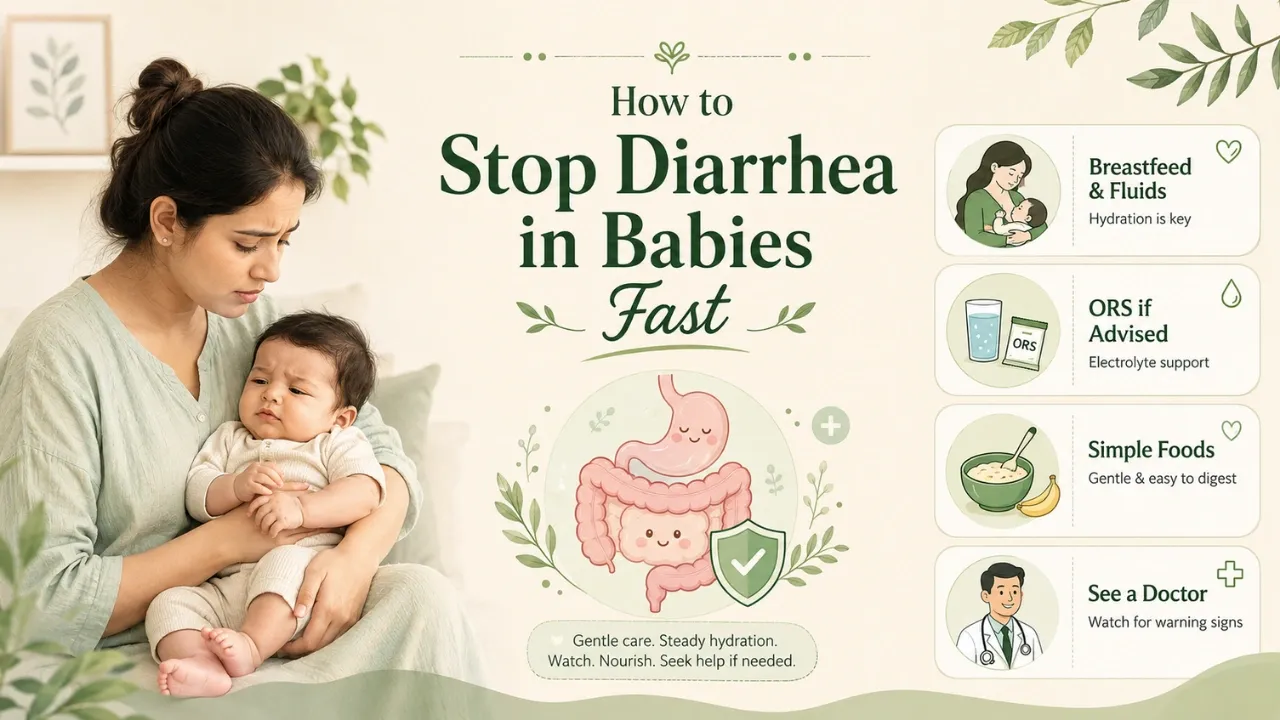
Quick Answer
Seeing your baby pass frequent loose stools can be frightening. Many parents worry about dehydration, weakness, and whether something serious is happening. The good news is that most diarrhea in babies can be safely controlled at home if you act quickly and correctly. This guide explains what works fast, what to avoid, and when to see a doctor, using simple, medically grounded advice suited for Indian families.
How to Stop Diarrhea in Babies Fast: The Short Answer
You cannot stop loose stools in babies with medicines — and trying to is dangerous. What you can do is stop the harm diarrhea causes: dehydration, weakness, and gut damage.
The fastest, safest action is starting Oral Rehydration Solution (ORS) within the first hour of noticing frequent loose stools. Paired with continued breastfeeding and zinc supplementation, most babies show clear improvement within 48-72 hours without any medication.
Here is what actually works — and what to skip:
- ✅ ORS within the first hour — replaces fluids and electrolytes lost through loose stools
- ✅ Continue breastfeeding — breast milk contains antibodies that fight the infection
- ✅ Zinc for 14 days — cuts diarrhea duration by approximately one day and prevents future episodes
- ✅ Gut-friendly foods — soft rice, banana, apple puree for babies on solids
- ❌ Anti-diarrheal medicines — not safe for infants; they block flushing of infection
- ❌ Glucose water or soda — wrong electrolyte ratio; worsens dehydration
The sections below explain each step in detail, including how to prepare ORS correctly, which foods help by age, and exactly when to call a doctor.
What Causes Diarrhea in Babies?
Diarrhea in babies is usually the body's response to irritation in the gut. Common causes of diarrhea include:
- Viral infections (most common, especially rotavirus or stomach flu)
- Bacterial contamination in food or water
- New foods during weaning
- Antibiotics (which disturb gut bacteria balance)
- Teething-related gut sensitivity (mild, short-lasting)
- Cow's milk protein intolerance or lactose sensitivity
In most cases, diarrhea settles within 2-5 days if dehydration is prevented and the gut is supported.
Why Stopping Dehydration Is More Important Than Stopping Stools
Many parents want to "stop the loose motions immediately." But medically, the priority is:
Preventing dehydration, not stopping stools. Loose stools are the body's way of flushing out infection. Blocking them with medicines can be dangerous for babies.
Does the Baby's Age Change How You Manage Diarrhea? Infant vs Toddler Guidance
Age changes both the risk level and the management approach. Here is a simple breakdown:
Newborns Under 3 Months: Go to a Doctor the Same Day
Diarrhea in a baby under 3 months is a medical emergency until proven otherwise. The gut lining is too immature to handle infection alone, and dehydration happens within hours. Do not wait and observe — call your pediatrician or go to a hospital immediately.
- Continue breastfeeding every 1-2 hours
- Do not attempt home ORS without doctor guidance at this age
Infants 3-12 Months: ORS + Breastfeeding + Watch Closely
This is the highest-risk group for dehydration because fluid reserves are small relative to body weight. Rotavirus is the most common cause in this age group in India. Because rotavirus vaccine is now included in India's universal immunisation schedule, vaccinated babies typically have milder episodes.
- Start ORS within the first hour
- Continue breast milk or formula without diluting
- Add zinc (10 mg/day for under 6 months; 20 mg/day for over 6 months) for 14 days
- Monitor urine output every 4-6 hours
Toddlers 1-3 Years: ORS + Soft Foods + Gradual Return to Normal Diet
Toddlers can communicate discomfort better and tolerate oral fluids more reliably. The risk of dehydration is lower than in infants, but still real.
- Offer ORS in small cups or a sippy cup — 100-200 ml after each loose stool
- Soft foods like khichdi, banana, boiled potato, curd (plain) can be continued
- Avoid fruit juices, packaged snacks, and sugary drinks
- Most toddler diarrhea from viral causes resolves in 3-5 days with ORS and diet alone
How to Stop Diarrhea in Babies Fast and Safely
1. Start Oral Rehydration Solution (ORS) Immediately
ORS is the fastest and safest life-saving step. For a complete guide on using ORS correctly, see how to stop diarrhea safely.
- Use WHO-recommended ORS sachets
- Mix exactly with clean, boiled and cooled water
- Give small sips every 5-10 minutes
- Continue even if stools are frequent
How much ORS?
| Age | ORS Amount |
|---|---|
| Under 6 months | Spoon or syringe feeds frequently |
| 6-12 months | 50-100 ml after each loose stool |
| 1 year and above | As much as the child accepts |
Important: Do NOT dilute ORS too much or add sugar or salt.
2. Continue Breastfeeding or Formula Feeding
Never stop feeding during diarrhea.
- Breast milk contains natural antibodies and gut-healing factors
- Formula-fed babies should continue their regular formula
- Do not dilute formula unless advised by a doctor
Stopping feeds can worsen weakness and slow recovery.
3. Use Zinc Supplementation (Doctor-Recommended)
Zinc is proven to reduce duration and severity of diarrhea.
- For babies under 6 months: 10 mg daily for 14 days
- For babies over 6 months: 20 mg daily for 14 days
Zinc helps repair the gut lining, improve immunity, and reduce repeat episodes. Zinc is not a medicine to stop stools, but it helps diarrhea end faster.
4. Offer Gut-Friendly Foods (for Babies on Solids)
If your baby has started solids, the right food choices make a real difference to recovery speed.
Best foods during diarrhea:
- Soft rice porridge (kanji)
- Mashed banana for recovery (pectin firms stools, potassium replaces electrolytes)
- Apple puree (stewed)
- Curd for gut recovery (for babies over 8 months, if tolerated)
- Boiled potato mash
Avoid temporarily:
- Packaged juices
- Sugary biscuits
- Fried foods
- Spicy or salty foods
Food supports healing. Fasting does not.
5. Watch Closely for Dehydration Signs
Seek medical help immediately if you notice any of the following:
⚠️ Emergency dehydration signs:
- Dry mouth or tongue
- Sunken eyes or soft spot (fontanelle)
- Passing little or no urine
- Lethargy or excessive sleepiness
- No tears while crying
These mean ORS alone may not be enough.
What NOT to Do (Very Important)
- ❌ Do not give anti-diarrheal medicines
- ❌ Do not give antibiotics unless prescribed
- ❌ Do not give home remedies like tea, glucose water, or soda
- ❌ Do not stop feeding
- ❌ Do not use adult medications
These can worsen dehydration or harm the gut.
ORS vs Home Remedies: What Actually Stops Diarrhea in Babies Safely?
Many parents look for fast home remedies before reaching for ORS. Here is an honest, evidence-based comparison:
| Approach | Does It Help? | Why / Why Not | Safe for Babies? |
|---|---|---|---|
| WHO-ORS sachets | ✅ Yes — first-line treatment | Replaces lost sodium, potassium, and glucose in the exact ratio the gut absorbs best | Yes, all ages |
| Breastfeeding (continued) | ✅ Yes | Provides antibodies (sIgA), hydration, and gut-healing growth factors | Yes, always |
| Soft rice kanji | ✅ Partial | Easy to digest, mild binding effect, reduces stool volume | Yes, babies on solids |
| Banana | ✅ Partial | Pectin firms stools; potassium replaces electrolytes lost in loose stools | Yes, from 6 months |
| Plain curd / yoghurt | ✅ Conditional | Live cultures support gut bacteria recovery; only if baby is over 8 months and tolerates dairy | Over 8 months only |
| Glucose water | ❌ No | Too high in sugar, wrong electrolyte ratio — worsens osmotic diarrhea | No |
| Soda / cola drinks | ❌ No | High sugar, carbonation causes gas, no electrolytes | Never for babies |
| Homemade salt-sugar water | ❌ Risky | Incorrect ratio is dangerous — too much salt causes hypernatraemia | Use only if WHO-ORS unavailable AND ratio followed exactly |
| Anti-diarrheal medicines (loperamide) | ❌ No | Blocks gut motility — traps the infection inside; can cause toxic megacolon | Never for babies |
| Ginger tea / jeera water | ❌ Insufficient evidence | No clinical evidence in infants; displaces proper hydration | Not recommended |
The bottom line: ORS is the only intervention proven to reduce diarrhea-related mortality. Home foods like banana and kanji support recovery but cannot replace electrolytes lost through repeated loose stools. Use them together, not instead of ORS.
How Long Does Diarrhea Last in Babies?
| Type | Typical Duration |
|---|---|
| Viral diarrhea | 2-5 days |
| Teething-related | 1-2 days |
| Food-related | Improves in 24-48 hours |
| Bacterial | May last longer , needs doctor review |
If diarrhea lasts more than 3 days, consult a pediatrician.
What to Expect Day by Day: Baby Diarrhea Recovery Timeline
If you start ORS within the first few hours of symptoms, here is what most parents can expect:
Day 1: Stools will likely remain frequent and watery. This is normal — the gut is still flushing the irritant. Focus entirely on fluid replacement. Your baby may refuse solids — that is fine. Continue breastfeeding every 1-2 hours. Keep a count of wet nappies (at least 3-4 wet nappies in 24 hours means hydration is holding).
Day 2: Most viral cases begin to show a reduction in stool frequency. Stools may still be loose but less watery. If your baby is breastfed, breast milk actively helps repair the gut lining — keep feeding. For babies on solids, soft foods can be reintroduced: mashed banana, soft rice, boiled potato.
Day 3: The majority of viral diarrhea cases in babies improve significantly by day 3. Stool consistency begins to firm. Appetite may return. Continue ORS after any remaining loose stools. Continue zinc for the full 14-day course even if symptoms have resolved — zinc rebuilds the gut lining and reduces the risk of another episode within 2-3 months.
Day 5 and beyond: If diarrhea is still frequent and watery at day 5, consult a pediatrician regardless of other symptoms. Persistent diarrhea beyond 7 days may indicate a bacterial infection, food intolerance, or post-infectious lactase deficiency (temporary inability to digest lactose).
Signs your baby is recovering well:
- Fewer stools per day than the previous day
- Stools becoming less watery and more formed
- Baby is alert, making eye contact, and playful between episodes
- Wet nappies returning to normal frequency
- Appetite gradually returning
- Tears when crying (sign of adequate hydration)
Signs that recovery is NOT progressing — seek medical help:
- No improvement after 72 hours of ORS and feeding
- Increasing lethargy or unresponsiveness
- Blood or mucus appearing in stools
- Dry mouth, sunken eyes, fewer than 2 wet nappies in 12 hours
When Should You See a Doctor Urgently?
Go to a hospital or pediatrician if your baby has:
- Blood or mucus in stools
- Fever above 38.5°C
- Persistent vomiting
- Diarrhea in a baby below 3 months
- Diarrhea lasting more than 72 hours
- Signs of dehydration listed above
How Gut Health Affects Diarrhea Recovery
A baby's intestine is delicate and still developing. Diarrhea disrupts digestive enzymes, friendly gut bacteria and microbiome balance, and nutrient absorption. This is why some babies develop temporary lactose intolerance, weak appetite, and recurrent loose stools after an episode.
Supporting the gut through the right foods, ORS, and age-appropriate probiotics for babies helps restore normal gut function faster than medicines alone.
What the Research Says: Evidence Behind ORS, Zinc, and Probiotics for Baby Diarrhea
The recommendations in this article are not opinions — they are backed by decades of global clinical research. Here are the key findings parents should know:
Oral Rehydration Solution (ORS): A landmark 1978 paper in The Lancet described ORS as 'potentially the most important medical advance of the 20th century' for reducing child mortality. The WHO and UNICEF updated the ORS formula in 2002 to a lower-osmolarity version (245 mOsm/L), which reduced stool output and vomiting in children compared to the original formulation. A Cochrane systematic review (Hartling et al., 2006) confirmed that oral rehydration is equally effective as intravenous (IV) fluids for most cases of mild-to-moderate dehydration in children.
Zinc Supplementation: A Cochrane review of 33 trials (Lazzerini and Wanzira, 2016) found that zinc supplementation reduces diarrhea duration by approximately 12-24 hours in children over 6 months and reduces the probability of diarrhea continuing beyond day 7 by around 27%. The Indian Academy of Pediatrics (IAP) and WHO both recommend zinc as a standard add-on to ORS for all children under 5 with acute diarrhea.
Probiotics: A 2020 Cochrane review (Collinson et al.) found that Lactobacillus rhamnosus GG and Saccharomyces boulardii are the two strains with the most consistent evidence for shortening diarrhea duration in children — by approximately 1 day. However, the review noted high heterogeneity in studies and cautioned that probiotic recommendations should be strain-specific. Always ask your pediatrician which strain is appropriate for your baby's age.
Continuing Feeding (vs Fasting): An early meta-analysis by Brown et al. (1994) established that continued feeding — especially breastfeeding — during diarrhea reduces stool output, shortens illness duration, and improves nutritional recovery compared to bowel rest. This finding reversed decades of advice to 'rest the gut.' The evidence has held across 30+ years of subsequent research.
Rotavirus Vaccine: In India, rotavirus (the most common viral cause of severe diarrhea in infants) accounted for approximately 32% of diarrhea-related hospitalisations in children under 5 before vaccine introduction. The Indian government included the rotavirus vaccine in the Universal Immunisation Programme (UIP) in 2016. Vaccinated children experience significantly milder diarrhea episodes even when infected.
How Mool Health Helps with Baby Diarrhea Support
Mool Health does not sell medicines or quick fixes. Instead, it supports parents by:
- Explaining why diarrhea happens, not just what to do
- Helping parents understand gut development and immunity
- Guiding feeding, hydration, and recovery steps
- Reducing panic with clear, evidence-based education
- Supporting long-term digestive resilience, not shortcuts
By focusing on root causes , digestion, microbiome balance, and feeding patterns, Mool Health helps parents make calm, confident decisions during stressful moments.
What Is Diarrhea in Babies? How to Tell It Apart From Normal Loose Stools
Diarrhea in babies is a sudden increase in the frequency, volume, and wateriness of stools beyond what is normal for that baby's age and feeding pattern. It is not a disease itself — it is a symptom that the gut is expelling something it cannot process.
The key distinction from normal loose stools:
| Feature | Normal Loose Stool | Diarrhea |
|---|---|---|
| Frequency | Varies (1-8 times/day in newborns) | Sudden increase of 3+ more stools than usual |
| Consistency | Soft, seedy (breastfed), pasty (formula) | Watery, liquid, may smell sharper |
| Blood/mucus | None | May be present in bacterial diarrhea |
| Duration | One-off | Repeating over hours or days |
| Baby's state | Alert, feeding well | May be lethargic, refusing feeds |
Breastfed newborns naturally have 6-10 soft, yellow, seedy stools per day — this is normal. Diarrhea in a breastfed newborn means a sudden change from that baby's own pattern, not a fixed number.
The defining signal is change, not count. If your baby's stools are suddenly more frequent, much more watery, and the baby seems unwell — that is diarrhea.
What This Means for You
If you start ORS within the first hour of your baby's loose stools, continue breastfeeding, and add zinc for 14 days, most babies show clear improvement within 48-72 hours — without any medication. The gut heals faster when it is hydrated and fed, not when it is rested or medicated.
Your next actions right now:
- Get ORS sachets at home before you need them — keep WHO-recommended ORS sachets in your medicine cabinet so you can start within the first hour if diarrhea begins
- Start ORS immediately — small sips every 5-10 minutes, regardless of stool frequency
- Do not stop breastfeeding — breast milk is the most powerful gut-healing tool available to you
- Add zinc — ask your pediatrician for age-appropriate zinc drops or syrup and complete the full 14-day course even after recovery
- Track wet nappies — fewer than 2 wet nappies in 8 hours means go to a doctor now
If your baby is under 3 months, has blood in stools, shows signs of dehydration, or does not improve after 72 hours, do not manage at home — seek emergency medical evaluation immediately.
Key Takeaways
Diarrhea in babies needs careful hydration and monitoring. This guide explains safe steps parents can take, plus warning signs that need medical help.
Your gut is unique your healing should be too.

FAQs
The clearest signs of recovery are fewer stools per day than the previous day, stools becoming more formed and less watery, and your baby returning to normal alertness and playfulness between episodes. Wet nappies returning to their usual frequency — at least 4-6 per day — confirms hydration is recovering. Most viral cases in babies show measurable improvement by day 2 or 3 when ORS is started early.
Many babies initially resist ORS because of its mild salty taste. Try giving it chilled (cooled in the fridge, not with ice), using a syringe or dropper for very small babies, or offering it on a spoon. Do not add sugar or flavouring — this changes the electrolyte ratio. If your baby persistently refuses ORS and shows signs of dehydration, go to a hospital where IV fluids can be given.
Yes, as a temporary bridge only. Mix 1 litre of clean boiled-and-cooled water with 6 level teaspoons of sugar and half a level teaspoon of salt. This approximates the WHO oral rehydration formula but is not as precise. Replace with proper ORS sachets as soon as possible. Never guess the ratio — too much salt causes dangerous hypernatraemia in babies.
Yes, in viral diarrhea this is common. The gut is actively flushing the infection, so stool frequency may peak on day 1 or 2 before declining. As long as you are replacing fluids with ORS and your baby has at least 2-3 wet nappies per day and is alert, this is expected. If stool frequency is still increasing on day 3 or blood appears, consult a doctor.
No, but it significantly reduces severity. The rotavirus vaccine, now part of India's Universal Immunisation Programme (UIP), does not prevent all cases of rotavirus diarrhea, but it reduces the risk of severe hospitalisation-requiring episodes by approximately 50-72% in Indian children. Vaccinated babies who do get diarrhea typically recover faster and with fewer complications.
Antibiotics disturb the gut's natural bacterial balance, leading to loose stools in 5-30% of babies. Management is the same: ORS for hydration and continued feeding. Discuss with your pediatrician whether a probiotic (specifically Lactobacillus rhamnosus GG or Saccharomyces boulardii ) is appropriate alongside the antibiotic course. Do not stop the antibiotic without medical advice — incomplete courses cause resistance.
Gradually from day 2-3 onward, as stool frequency reduces. Start with easy-to-digest foods — soft rice, banana, boiled potato — and reintroduce regular meals over 3-5 days. There is no need for a strict 'bland diet' for a week. Early reintroduction of a varied diet supports faster nutritional recovery. Avoid high-fat, high-sugar, and high-fibre foods until stools are fully normal.
After severe or prolonged diarrhea, the gut lining temporarily loses lactase — the enzyme that digests lactose in milk. This causes continued loose stools even after the infection has cleared, because undigested lactose ferments in the colon. It typically resolves on its own within 4-6 weeks. In breastfed babies, breast milk is still the best option despite containing lactose — its gut-healing factors outweigh the lactose issue. For formula-fed babies, your pediatrician may suggest a lactose-free formula temporarily.
Disclaimer
The content provided by Mool Health is for educational and informational purposes only and should not be considered a substitute for professional medical advice, diagnosis, or treatment.